1. Introduction : Comment les éclairages LED façonnent l'avenir de la production vidéo
Dans le monde d'aujourd'hui, dominé par le visuel, le contenu vidéo règne en maître en tant que moyen de communication, de divertissement et d'éducation. Qu'il s'agisse de tutoriels sur YouTube, de récits courts sur TikTok, de flux en direct sur Twitch, de publicités soignées ou de films indépendants, l'attrait de la vidéo est indéniable. Cependant, même le concept créatif le plus brillant peut tomber à plat sans une présentation visuelle professionnelle, ce qui fait qu'il est difficile de se démarquer dans le vaste océan de contenu.
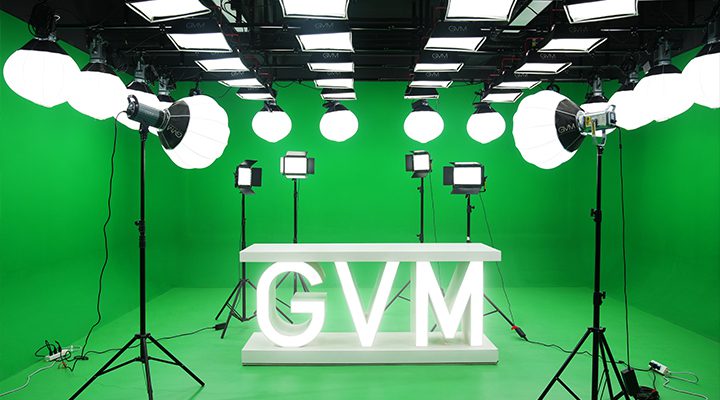
C'est précisément là qu'un éclairage de haute qualité - en particulier un éclairage dédié - peut s'avérer utile. lumière pour l'enregistrement vidéo - devient absolument essentiel. Il fut un temps où l'équipement d'éclairage professionnel était coûteux et encombrant, ce qui décourageait de nombreux créateurs de contenu en herbe. Mais avec les progrès rapides de la technologie LED, ce paysage s'est complètement transformé. Grâce à leur incroyable efficacité, leur longue durée de vie et leur polyvalence inégalée, les éclairages vidéo à LED sont en train de révolutionner discrètement la production vidéo.
En tant que créateur de vidéos ou producteur de contenu, comprenez-vous vraiment vers quoi cette technologie se dirige ? Pourquoi devriez-vous vous intéresser à ces tendances ? Parce que l'anticipation et la maîtrise de ces informations détermineront directement votre capacité à produire un contenu vidéo plus compétitif et plus accrocheur, à obtenir un meilleur classement sur les moteurs de recherche comme Google et, en fin de compte, à gagner le cœur de votre public.
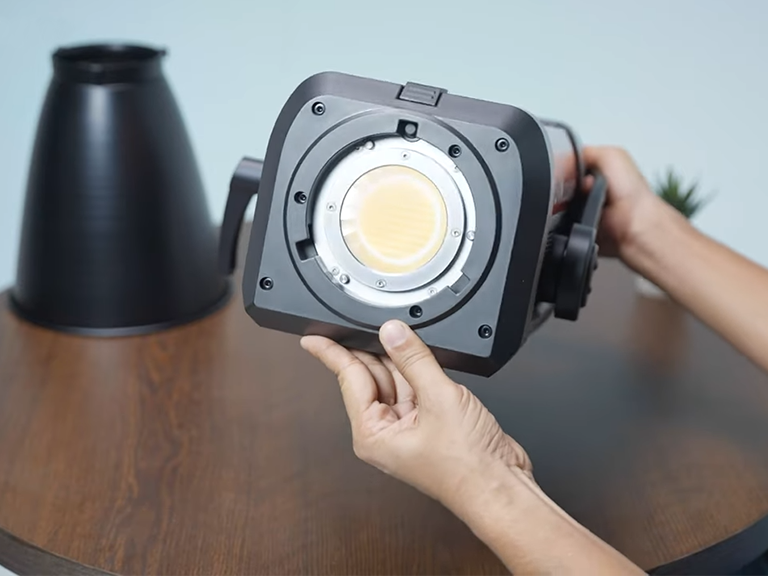
2. Pourquoi il est essentiel d'améliorer votre éclairage pour l'enregistrement vidéo
Vous vous demandez peut-être : “Mes lampes actuelles fonctionnent bien, dois-je vraiment les mettre à niveau ?” La réponse est un oui catégorique, et voici pourquoi :
2.1 L'avantage concurrentiel : le secret pour se démarquer
Imaginez qu'un internaute cherche “meilleure lumière pour l'enregistrement vidéo” sur YouTube. Ils obtiendront d'innombrables résultats. Si votre vidéo présente des séquences claires, des couleurs précises et un éclairage doux et bien étagé, alors que celle de votre concurrent est sombre et parsemée d'ombres dures, qui, à votre avis, les spectateurs choisiront-ils ? Une présentation visuelle professionnelle permet non seulement d'augmenter le nombre de vues et l'engagement, mais aussi de renforcer la reconnaissance et la crédibilité de votre marque.
2.2 Efficacité et économies
Les anciennes lampes halogènes ou fluorescentes consomment une quantité choquante d'énergie et génèrent une chaleur désagréable. Les vidéoprojecteurs à LED, en revanche, sont réputés pour leur efficacité énergétique supérieure, ce qui se traduit par des factures d'électricité moins élevées. En outre, les émetteurs LED ont une durée de vie des dizaines de fois supérieure à celle des ampoules traditionnelles, ce qui réduit considérablement le coût et la fréquence des remplacements et de la maintenance. À long terme, l'investissement dans l'éclairage LED avancé est une décision financière judicieuse.
2.3 Liberté de création et flexibilité
L'avenir des éclairages LED promet une liberté créative sans précédent. Des réglages précis de la température de couleur aux modes RGBWW à spectre complet, en passant par les effets d'éclairage prédéfinis et le contrôle à distance des applications, ces fonctionnalités vous permettent de vous adapter sans effort aux différents environnements de prise de vue et de créer l'ambiance souhaitée. Qu'il s'agisse d'une interview sérieuse, d'un vlog animé ou d'un court-métrage dramatique, un système d'éclairage avancé lumière pour l'enregistrement vidéo sera votre allié le plus précieux.
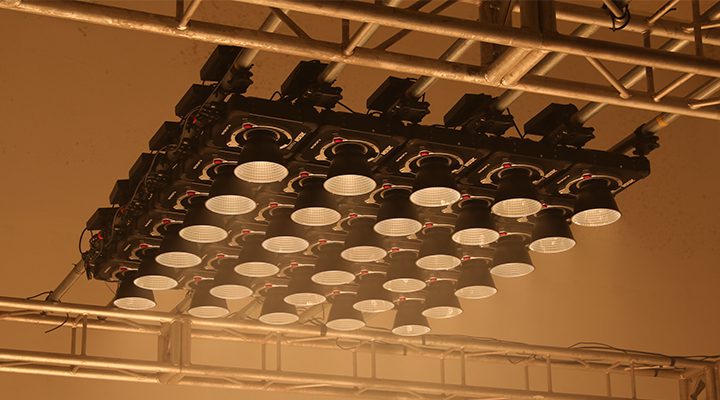
3. Tendances actuelles et innovations dans la technologie de l'éclairage LED pour l'enregistrement vidéo
Pour mieux choisir votre avenir lumière pour l'enregistrement vidéo, Pour cela, nous devons comprendre les tendances technologiques les plus excitantes dans le domaine de l'éclairage LED :
3.1 Indice de rendu des couleurs (IRC) et précision de la température de couleur corrélée (TCC) plus élevés
- Qu'est-ce que l'IRC et le TLCI ? L'IRC (indice de rendu des couleurs) et le TLCI (indice de cohérence de l'éclairage télévisuel) sont des paramètres qui mesurent la capacité d'une lumière à reproduire avec précision les vraies couleurs des objets. Pour les créateurs de vidéos, une valeur CRI/TLCI élevée (95+ est souhaitable) est cruciale, car elle garantit que les tons de peau et les couleurs des produits apparaissent aussi naturels et précis que possible sur la caméra.
- Dernières avancées : Les lampes LED modernes ont atteint un rendu des couleurs presque parfait. La technologie de température de couleur variable (Bi-color) est désormais standard, vous permettant de passer librement d'une lumière chaude (3200K) à une lumière froide (5600K). Parmi les autres avancées, citons les lampes RGBWW à spectre complet, qui non seulement émettent n'importe quelle couleur, mais peuvent également simuler avec précision la lumière du jour et le tungstène, offrant ainsi une précision chromatique exceptionnelle.
3.2 Augmentation du rendement lumineux et de l'efficacité lumineuse
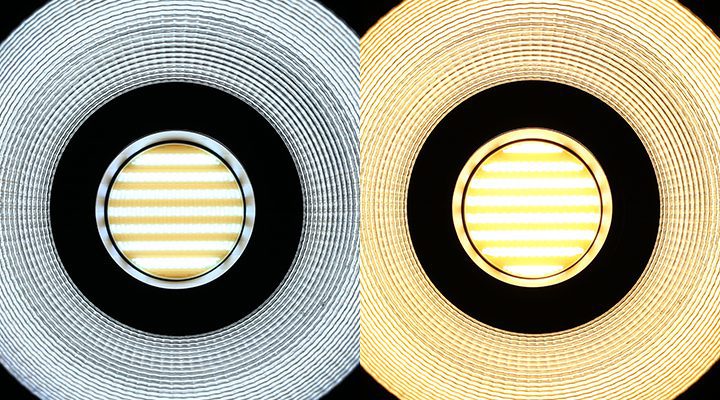
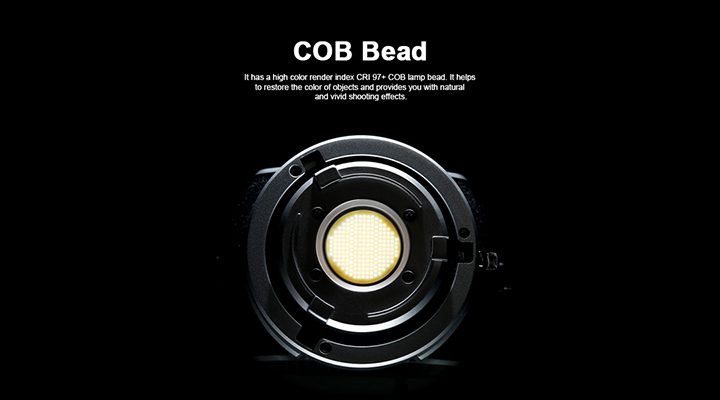
La luminosité des lampes à LED augmente continuellement tout en conservant une forme incroyablement compacte. La nouvelle technologie de source ponctuelle COB (Chip On Board) permet à une seule puce LED d'émettre une lumière intense, associée à des systèmes de refroidissement plus efficaces (parfois même des conceptions sans ventilateur), ce qui permet aux lampes LED de grande puissance de rester relativement compactes et silencieuses.
3.3 Fonctions intelligentes et connectivité (contrôle par application, DMX, synchronisation sans fil)
Il s'agit d'un événement majeur dans l'évolution de la lumière pour l'enregistrement vidéo. Grâce à des applications pour smartphone (comme Sidus Link d'Aputure ou Godox Light), vous pouvez contrôler à distance et avec précision la luminosité, la température de couleur, la teinte et les effets spéciaux de vos éclairages sur le plateau. La synchronisation multi-lumières simplifie considérablement les configurations d'éclairage complexes, et vous pouvez même enregistrer et rappeler des scènes prédéfinies. Pour les productions professionnelles, les technologies DMX512 et DMX sans fil LumenRadio offrent des capacités de contrôle et d'intégration encore plus puissantes.
3.4 Portabilité et progrès de la technologie des batteries
Avec l'essor de la création de contenu mobile, la portabilité est devenue primordiale. Les futures lampes LED seront encore plus légères et plus compactes, et la technologie des batteries a fait des progrès considérables. Une plus grande autonomie, des vitesses de chargement plus rapides et des solutions de batterie remplaçables à chaud rendent possibles les prises de vue en extérieur ou dans des environnements où l'alimentation électrique est limitée. De nombreuses nouvelles lampes LED sont également compatibles avec la charge USB-C PD, ce qui vous permet de les alimenter avec le chargeur de votre ordinateur portable.
3.5 Nouveaux facteurs de forme et effets spéciaux
La polyvalence de la technologie LED a donné naissance à diverses formes d'éclairage innovantes :
- Lampes tubulaires LED : Idéal pour le rétro-éclairage, l'éclairage d'accentuation ou la simulation d'effets spécifiques.
- Panneaux flexibles : Pliable, il s'adapte aux espaces restreints et aux formes uniques.
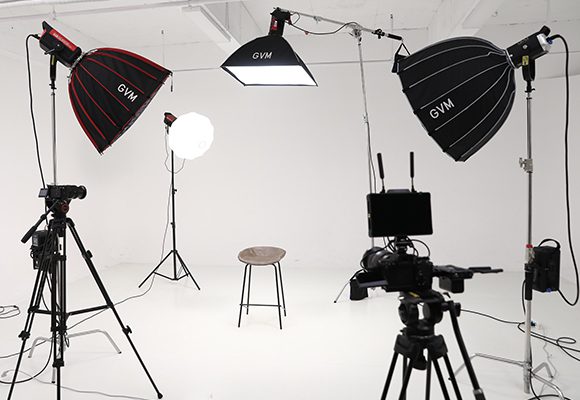
- Sources ponctuelles COB : Puissance de sortie élevée, façonnée avec divers modificateurs (boîtes à lumière, fresques).
- Effets FX intégrés : De nombreux éclairages incluent des effets de scénario simulés tels que les lumières des voitures de police, les éclairs, les bougies ou les écrans de télévision, ce qui enrichit considérablement la narration et l'atmosphère de la vidéo.
- Cartographie des pixels : Certains tubes LED haut de gamme permettent un contrôle individuel des pixels pour la couleur et la luminosité, ce qui permet de créer des animations lumineuses dynamiques étonnantes.
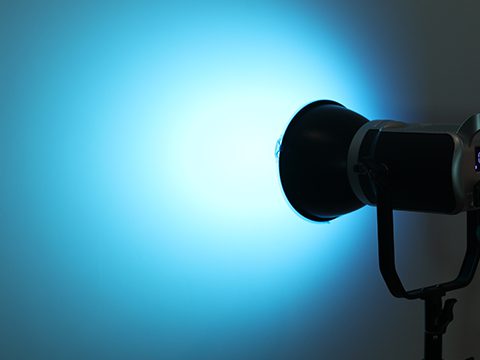
4. Paramètres et caractéristiques clés à prendre en compte par les créateurs de vidéos
Lorsque vous choisirez votre prochain lumière pour l'enregistrement vidéo, Pour ce faire, il convient de se concentrer sur les paramètres clés suivants :
4.1 Rendement lumineux (Lumens/Lux)
Il est essentiel de connaître la luminosité réelle de l'appareil. Les lumens indiquent le flux lumineux total, tandis que les lux mesurent l'éclairement à une distance donnée. Choisissez la luminosité adaptée à la distance de prise de vue et aux exigences de la scène. Pensez également aux modificateurs tels que les boîtes à lumière et les fresnels, qui permettent de façonner et de contrôler efficacement la lumière.
4.2 Indice de rendu des couleurs (CRI et TLCI)
Visez toujours des valeurs CRI/TLCI élevées (95+). Les couleurs de votre vidéo seront ainsi naturelles et fidèles à la réalité, ce qui évitera des complications lors de l'étalonnage en post-production.
4.3 Gamme de température de couleur (CCT)
Optez pour des lampes bicolores, qui vous permettent de passer librement de 3200K (chaud) à 5600K (lumière du jour) pour vous adapter à la lumière ambiante ou créer différentes ambiances. Les lampes RGBWW offrent un spectre de couleurs encore plus large.
4.4 Consommation électrique et options d'alimentation
Tenez compte de la puissance totale de l'éclairage et des méthodes d'alimentation qu'il prend en charge. Pour les prises de vue sur le terrain, les batteries à monture en V, les batteries de la série NP-F ou les batteries intégrées sont essentielles. Pour les prises de vue en studio, l'alimentation CA est plus stable.
4.5 Dissipation de la chaleur et bruit
Le bruit du ventilateur est l'un des plus grands maux de tête des créateurs de vidéos. Si votre tournage nécessite un enregistrement audio synchrone, veillez à choisir des éclairages sans ventilateur ou à faible bruit.
4.6 Contrôle et écosystème intelligents
Un système de contrôle stable et riche en fonctionnalités peut considérablement améliorer l'efficacité de votre flux de travail. Si votre budget le permet, choisir des éclairages issus de l'écosystème d'une même marque (par exemple, Aputure) permet un contrôle inter-appareils transparent. Vérifiez également les possibilités de mise à jour du micrologiciel pour bénéficier de nouvelles fonctionnalités et d'optimisations des performances à l'avenir.
4.7 Durabilité et construction
Le matériau et la résistance structurelle de la lampe sont également importants. Un boîtier en aluminium de qualité aéronautique et des indices IP (résistance à la poussière et aux éclaboussures) garantissent un fonctionnement stable sur de longues périodes dans divers environnements. En outre, vérifiez la compatibilité avec les montures d'accessoires standard, telles que la monture Bowens, pour l'utilisation de diverses boîtes à lumière et réflecteurs.
5. Comment choisir l'éclairage LED à l'épreuve du temps qui répond à vos besoins spécifiques ?
Il n'y a pas de solution unique pour tout le monde“ lumière pour l'enregistrement vidéo. Le meilleur choix dépend de vos besoins spécifiques et de votre budget.
5.1 Créateurs de vidéos débutants (YouTube, TikTok)
- Caractéristiques : Économique, facile à utiliser, portable.
- Recommandations : Lampes LED compactes de bureau, lampes LED annulaires, petites lampes à panneaux bicolores. Recherchez des modèles alimentés par USB ou par batterie intégrée.
- Exemples de marques : Ulanzi, Neewer, SmallRig série d'entrée de gamme.
5.2 Les blogueurs et les diffuseurs en direct sur YouTube
- Caractéristiques : Besoin d'un éclairage stable et de haute qualité, particulièrement soucieux d'un fonctionnement silencieux et d'une commande à distance.
- Recommandations : Lampes COB de puissance moyenne avec boîtes à lumière, lampes à panneau bicolore de puissance moyenne. Recherchez des modèles avec contrôle d'application et un faible bruit de ventilateur.
- Exemples de marques : Godox série SL, Aputure série Amaran, Nanlite série Forza.
5.3 Producteurs de vidéos commerciales ou d'entreprise
- Caractéristiques : Exigez un IRC élevé, un rendement élevé, un contrôle précis et de la fiabilité.
- Recommandations : Lampes COB haute puissance, panneaux lumineux RGBWW de haute qualité. Le contrôle DMX et la compatibilité avec les montures Bowens sont des bonus.
- Exemples de marques : Série LS d'Aputure, série Forza/FS de Nanlite, série VL de Godox.
5.4 Cinéastes et vidéastes indépendants
- Caractéristiques : Précision des couleurs cinématographiques, puissance élevée, effets spéciaux, durabilité.
- Recommandations : Lampes COB haut de gamme, lampes tubulaires à LED, panneaux flexibles, lampes RGBWW avec effets FX intégrés. Les solutions de batterie à montage en V et une construction robuste sont essentielles.
- Exemples de marques : Série Aputure Nova/LS Pro, série Nanlite PavoTube/Forza.
6. Perspectives d'avenir pour la lumière LED pour l'enregistrement vidéo
Le développement de la technologie LED est incessant, et l'avenir de la technologie LED est en train de se dessiner. lumière pour l'enregistrement vidéo promet d'être encore plus passionnante :
6.1 Encombrement réduit, puissance accrue
La miniaturisation se poursuivra, les futures lampes LED pouvant s'intégrer dans des appareils encore plus petits ou se présenter sous des formes plus souples tout en émettant une lumière encore plus puissante.
6.2 Éclairage intelligent piloté par l'IA
L'intelligence artificielle devrait être profondément intégrée dans les systèmes d'éclairage. Les futures lampes LED pourraient analyser automatiquement la lumière ambiante, identifier les sujets et optimiser l'éclairage en fonction d'effets prédéfinis. Elles pourraient même proposer des suggestions de configuration d'éclairage personnalisées en fonction de vos intentions créatives.
6.3 Efficacité énergétique et protection de l'environnement
L'accent étant mis de plus en plus sur le développement durable, les lampes LED vont encore améliorer l'efficacité de la conversion de l'énergie et réduire leur empreinte carbone. Les fabricants adopteront également de plus en plus de matériaux et de processus de production respectueux de l'environnement.
6.4 Plus d'options de personnalisation et de modularité
Les futures lampes LED pourraient devenir plus modulaires, permettant aux utilisateurs d'assembler des têtes lumineuses, des sources d'alimentation, des modules de contrôle et des accessoires d'effets lumineux comme des blocs de construction, afin d'obtenir des configurations hautement personnalisées.
7. Conclusion : Adoptez l'innovation, illuminez votre parcours vidéo
Des simples lumières de remplissage aux partenaires créatifs intelligents, la technologie des lumières LED pour l'enregistrement vidéo évolue à un rythme effréné. Pour tout créateur de vidéo et producteur de contenu, cela représente à la fois un défi et une opportunité sans précédent.
Comprendre ces tendances technologiques, prêter attention aux paramètres clés, choisir judicieusement et investir dans une solution d'avenir, c'est possible. lumière pour l'enregistrement vidéo améliorera considérablement la qualité de vos vidéos et votre efficacité créative. Un éclairage de qualité ne rend pas seulement vos images plus attrayantes, il vous permet aussi de raconter vos histoires avec plus d'impact.
Ne laissez pas un mauvais éclairage entraver votre créativité. Il est temps d'adopter l'innovation et d'illuminer votre parcours vidéo avec les lumières LED les plus avancées, pour que votre contenu brille sur Google et dans le cœur de votre public !
Faites-nous part de vos réflexions sur l'avenir de la technologie des lampes vidéo à LED ou de vos questions sur le choix d'une lampe pour l'enregistrement vidéo dans les commentaires ci-dessous !