Le éclairage trois points Le montage a survécu à un siècle de cinéma pour une seule raison : ça marche. Longtemps avant que les LED n'existent, les directeurs de la photographie utilisaient une lumière principale, un lumière d'appoint, et un rétroéclairage pour sculpter les visages, séparer les sujets des arrière-plans et créer de la profondeur sur un écran plat 2D. Cette logique anime toujours tous les drames Netflix, les vlogs YouTube et les interviews Zoom en 2026.
Ce guide vous accompagne à travers Qu'est-ce que l'éclairage à trois points, pourquoi cela importe encore, et comment construire un équipement de jeu fonctionnel chez soi sans se ruiner — en utilisant du matériel GVM authentique que vous pouvez associer dès aujourd'hui.
Mis à jour en juin 2026 — mis à jour pour la dernière série GVM PRO SD, y compris le PRO SD200B (notre meilleur choix pour le slot de lumière principale).
Qu'est-ce que l'éclairage à trois points ?
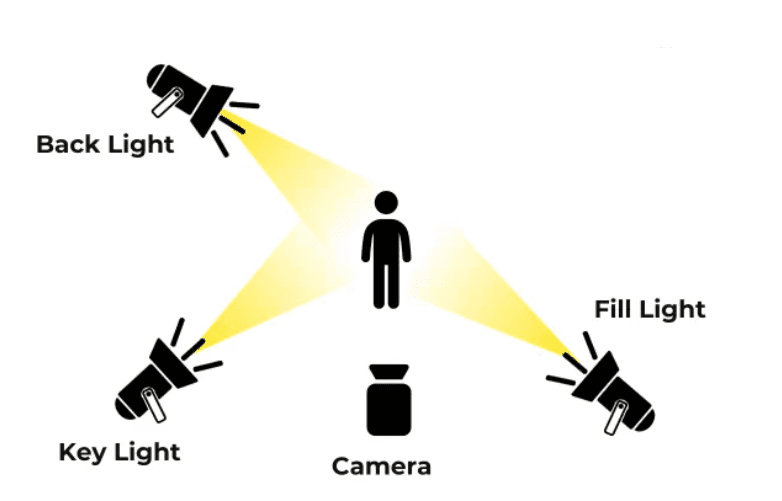
Éclairage trois points est une méthode d'éclairage qui utilise trois lumières placées à trois angles distincts autour d'un sujet :
- Lumière principale — la source principale, la plus lumineuse, généralement à 30-45° d'un côté de la caméra
- Lumière d'appoint — une source plus douce et plus tamisée, du côté opposé de la clé, adoucissant les ombres
- Rétroéclairage — une lumière de contour ou une lumière de cheveux placée derrière le sujet, le séparant de l'arrière-plan
Ce n'est pas une règle. C'est un point de départ. Une fois que vous aurez compris la géométrie, vous pourrez la briser (et vous devriez). Mais tous les directeurs de la photographie, photographes de produits et streamers que vous avez admirés ont commencé par apprendre ce triangle.
Si vous vous êtes déjà demandé La photographie en trois points est une méthode d'éclairage fondamentale qui utilise trois sources lumineuses distinctes pour éclairer un sujet. Les trois lumières sont : * **La lumière principale :** C'est la source lumineuse la plus forte et la plus dominante. Elle met en évidence le sujet et lui donne sa forme. * **La lumière de remplissage :** Moins intense que la lumière principale, elle est placée du côté opposé du sujet par rapport à la lumière principale. Elle est utilisée pour adoucir les ombres créées par la lumière principale et contrôler le contraste. * **La lumière arrière (ou lumière de contour) :** Elle est placée derrière le sujet, généralement en hauteur et orientée vers le sujet. Elle sépare le sujet de l'arrière-plan, créant un contour lumineux autour du sujet et ajoutant de la profondeur. Le but de l'éclairage en trois points est de créer une image bien éclairée, tridimensionnelle et visuellement attrayante en contrôlant avec précision la manière dont la lumière frappe et interagit avec le sujet. Il permet de sculpter le sujet, de révéler sa texture et ses détails, et d'établir une ambiance ou une humeur. le but est contrôle — contrôle de l'ombre, contrôle de la séparation, contrôle de l'ambiance. Les trois points vous donnent trois leviers indépendants au lieu d'une grande pièce lumineuse.
Les Trois Points Expliqués
Lumière Principale : Le Conteur
La lumière principale est la plus forte, souvent la plus directionnelle. Elle définit le ambiance: La lumière dure de côté paraît dramatique, la lumière douce de face paraît amicale, la lumière zénithale paraît divine. Positionnez-la à 30-45° hors axe par rapport à la caméra et légèrement au-dessus du niveau des yeux (environ 30-45° en hauteur) pour imiter l'angle de la lumière naturelle du soleil.
Pour la plupart des configurations domestiques, une seule COB bicolore 200W comme le GVM PRO SD200B atteint le juste milieu. Au 45 400 lux @ 1 m Avec une température de couleur bicolore allant de 2700K à 6800K, il a suffisamment de puissance pour dominer la lumière du jour à travers une fenêtre, et suffisamment de portée pour correspondre aux lampes d'ambiance tungstène à l'extrémité chaude.
Lumière de remplissage : Le dompteur d'ombres
Le remplissage est simplement une version atténuée de la clé, placée de l'autre côté. Le travail consiste à soulever les ombres donc ils sont visibles mais toujours façonnés. Deux approches pratiques :
- Remplissage dur — même luminaire, mais avec une puissance lumineuse réduite à 25–50% de la puissance nominale
- Remplissage doux — un panneau, une carte rebondissante ou une boîte à lumière de l'autre côté
Le rapport d'éclairage La (clé:remplir) est l'âme du look. Un ratio de 4:1 donne une sensation cinématographique ; un ratio de 2:1 ressemble à une interview amicale ; un ratio de 1:1 est plat et de style beauté. Nous avons abordé les ratios en détail dans notre guide des ratios d'éclairage.
Rétroéclairage : Le Séparateur
Le rétroéclairage (aussi appelé lumière de contour ou lumière de cheveux) va derrière le sujet, généralement au-dessus et légèrement sur le côté. Cela crée une bordure lumineuse le long des épaules et des cheveux du sujet, les séparant de l'arrière-plan.
Le rétroéclairage est un élément où les configurations bon marché ont souvent des lacunes. Vous n'avez pas besoin de puissance — vous avez besoin précision et contrôle. Un luminaire focalisable de 100W, de petite taille, comme le GVM PRO PF100B À 20–30%, la sortie fonctionne à merveille ici.
Meilleur éclairage à trois points (notre recommandation)
Si vous voulez un kit qui ça marche tout simplement Dès la sortie de la boîte, voici la configuration que nous recommandons chez GVM, construite autour du PRO SD200B :
| Rôle | Lumière recommandée | Puissance | Pourquoi ça marche |
|---|---|---|---|
| Clé | GVM PRO SD200B | 200W | Assez lumineux pour les pièces éclairées par la lumière du jour, assez silencieux pour les interviews |
| Remplir | GVM PRO SD200B (2e unité) | 200W | Faites correspondre la clé exactement, tamisez simplement à votre goût |
| Retour | GVM PRO PF100B | 100W | Compact, focalisable, contrôle parfait du bord |
| Total | — | 500W | Couverture professionnelle complète pour un prix public inférieur à $700 |
Voici le Meilleur éclairage à trois points pour les créateurs qui savent déjà qu'ils tourneront au moins deux fois par semaine pendant l'année à venir. Deux PRO SD200B dans le kit ne sont pas un luxe, c'est une assurance contre la perte de la clé en plein tournage. Vous voulez le deuxième SD200B ? Achetez toute la série PRO SD ici.
Envie de voir comment le SD200B se compare à ses grands frères de 300W et 500W ? Lisez notre analyse de la série GVM PRO SD.
L'éclairage trois points à la maison : comment adapter la configuration
La plupart des tireurs à domicile ne disposent pas d'une chambre d'amis avec des plafonds de 3 mètres. Voici comment la même logique s'applique dans une pièce de 3x3 mètres.
Étape 1 : Choisissez votre coin
Tenez-vous à 1,2–1,8 mètre d'un mur. Le Le mur est votre arrière-plan. Le mur opposé c'est là où va votre appareil photo. Les deux parois latérales où vont ta clé et ton remplissage.
Étape 2 : Positionnez la clé à 30–45° sur un côté
Dans une petite pièce, la clé se retrouve souvent plus près du sujet que désiré (3 pieds au lieu de 6). La solution : adoucir. Soit :
- Ajoutez une softbox de 24″ (la GVM Quick Deploy Softbox 24″ se fixe en 30 secondes)
- Ou éloignez la clé de 30 à 60 cm et augmentez la luminosité pour compenser
Étape 3 : Lâchez le remplissage, ne le laissez pas tomber
Dans les pièces exiguës, la lumière d’appoint se reflète sur tous les murs blancs. Tirez-en parti : un PRO SD200B réglé sur 30%, placé du côté opposé, remplace à la fois une source d’appoint dédiée et une carte de réflexion.
Étape 4 : Lumière arrière du mur
Dans une installation à domicile, le rétroéclairage se retrouve souvent monté sur un support poussé contre le mur du fond, incliné. vers le bas vers les épaules du sujet. Gardez-le léger — le but est la séparation, pas un éclat complet des cheveux.
Éclairage trois points à petit budget : deux vrais budgets
Si le modèle $700 est trop onéreux, vous pouvez monter un attelage à trois points tout à fait fonctionnel pour un prix bien inférieur. Voici deux configurations réelles, issues de la gamme GVM.
Budget A — ~$200 (Kit de démarrage pour créateurs de contenu)
| Rôle | Lumière | Puissance |
|---|---|---|
| Clé | GVM PRO SD80D (ou équivalent 100W) | 80–100W |
| Remplir | Petit panneau LED | 30W |
| Retour | Petit panneau LED | 30W |
Voici le lumière tricolore bon marché configuration que la plupart des YouTubers et TikTokers utilisent réellement. La sortie est plus faible, la précision des couleurs est décente (IRC 95+), et vous pouvez éclairer un visage de la poitrine à la tête dans une pièce de 3×3 mètres sans surchauffe. Compromis : une faible sortie signifie que vous vous battez contre la lumière du jour. Gardez ce matériel à l'intérieur.
Budget B — ~$400 (Mise à niveau « Hybrid Creator »)
| Rôle | Lumière | Puissance |
|---|---|---|
| Clé | GVM PRO SD200B | 200W |
| Remplir | GVM PRO SD200B (2ème) ou SD100 | 100–200W |
| Retour | GVM PRO PF100B | 100W |
C'est là que le l'éclairage à trois points à la maison La configuration devient un véritable outil de production. CRI de 97+ sur les trois lumières, bicolore partout, contrôle par application via l'écosystème GVM. L'ensemble du matériel rentre dans deux sacs à dos.
Astuce de pro : N'achetez jamais trois éclairages identiques pour un montage de débutant. Achetez-en un super clé (SD200B) et deux bien remplissages (SD80D ou panneaux). L'œil lit d'abord la lumière la plus vive ; les deux autres doivent juste être doux et assortis.
Erreurs courantes en éclairage à trois points (et leurs solutions)
Erreur 1 : Touche trop haute
La clé doit être à 30-45° au-dessus du niveau des yeux. Plus haut, vous obtenez des yeux de raton laveur et une perte de détails dans le sourcil. Plus bas que le niveau des yeux, vous obtenez un plan horrifique “par le nez”.
Corriger : Abaissez la clé d'un cran sur le pupitre, ou inclinez légèrement la tête vers le bas.
Erreur 2 : Remplissage trop fort
Si les ombres disparaissent, vous perdez l'effet d'éclairage à trois points — vous n'avez qu'une configuration plate à deux points. Les ombres font leur travail ; vous voulez les voir, juste à un contraste plus faible.
Corriger : Réduire le remplissage à 25–30% de la sortie de la touche. Réintroduire l'ombre.
Erreur 3 : Rétroéclairage au mauvais endroit
La lumière arrière doit caresser les cheveux et les épaules du sujet par le dessus et par derrière, pas l'arrière de sa tête. Une lumière arrière dirigée vers l'arrière de la tête donne l'impression d'un costume d'auréole.
Corriger : Déplacez la lumière arrière plus haut et sur un côté. Le contour devrait tracer le bord du sujet, sans les affronter.
Erreur 4 : Les trois lampes à la même distance
Les trois points ne fonctionnent que si la géométrie est correcte. Deux lumières à 30 centimètres du sujet et une à 1,80 mètre brisent le triangle.
Corriger : Utilisez un mètre ruban. Clé à 1,2–1,8 mètre, remplissage à 0,9–1,2 mètre, dos à 1,2–1,5 mètre. Ajustez à partir de là.
Fiche de référence : Alimentation et Luminosité
| Taille de la chambre | Sortie de lumière clé requise | Fixation recommandée |
|---|---|---|
| Petit bureau à domicile (3,04 × 3,04 m) | 30–60W en continu | Panneau SD80D ou 100W |
| Chambre studio (3,66 × 4,57 m) | 100–200W | PRO SD200B |
| Salon / garage (15×25 pi) | 200–300 W | PRO SD200B ou SD300B |
| Studio dédié (20×30+ pi) | 300W+ | PRO SD300B / SD500B |
Lorsque vous doublez la distance du sujet, vous trimestre la lumière qui les atteint. C'est la loi du carré inverse en action — nous l'avons expliquée en détail dans notre guide sur la loi du carré inverse.
Pourquoi cette configuration surpasse les kits à éclairage unique
Les panneaux LED uniques conviennent pour les selfies. Mais pour tout ce que vous voulez regarder pendant plus de 30 secondes, L'éclairage plat est épuisant. L'œil humain est entraîné à lire les visages en trois dimensions ; si votre éclairage est unidimensionnel, le cerveau de votre spectateur travaille plus dur et se déconnecte.
L'éclairage à trois points est la complexité minimale qui vous donne :
- Profondeur (clé + remplir)
- Séparation (lumière de fond)
- Contrôle (chaque point est un gradateur séparé)
- Ambiance (déplacer la clé, changer l'histoire)
Si vous ne retenez rien d'autre, retenez ceci: le triangle est le langage, pas la règle.
Questions fréquemment posées
L'éclairage trois points est une technique d'éclairage photographique et cinématographique qui utilise trois sources lumineuses.
Il sépare le sujet de l'arrière-plan, sculpte le visage avec des ombres contrôlées et vous offre trois variateurs indépendants pour définir l'ambiance. Une seule lumière rend tout plat; une lumière principale + de remplissage + de contre-jour crée un aspect 3D sur un écran 2D.
Quel est le meilleur éclairage à trois points pour un débutant ?
Un GVM PRO SD200B comme éclairage principal, un panneau ou un COB plus petit (SD80D) comme éclairage d'appoint à 25–30%, et un PRO PF100B pour la jante arrière. Total inférieur à $500, toutes bicolores, toutes contrôlables via une application.
Puis-je faire un éclairage à trois points chez moi sans pièce sombre ?
Oui. L'éclairage à trois points fonctionne mieux dans des pièces lumineuses car la clé a plus de choses contre lesquelles se battre. L'astuce consiste à masquer les fenêtres avec des rideaux occultants et à laisser la clé + la lumière d'appoint + la lumière arrière faire tout le travail. Les luminaires avec un CRI de 97+ comme le PRO SD200B ne vacilleront pas lorsque vous les réglerez en dessous de l'étape 1/1000.
Comment réaliser un éclairage à trois points à moindre coût avec un budget inférieur à $200 ?
Utilisez une bonne lumière principale (PRO SD80D ou équivalent 100W) et deux petits panneaux LED pour le remplissage et le contre-jour. Le résultat ne sera pas cinématographique, mais il aura l'air professionnel sur une webcam, ce qui est le but de cette gamme budgétaire.
Où dois-je placer chaque lumière dans une configuration à trois points ?
Clé à 30–45° hors champ, légèrement au-dessus du niveau des yeux. Remplissage opposé à la clé, plus sombre. Lumière arrière derrière le sujet, 45° au-dessus, effleurant les cheveux et les épaules. Les angles exacts dépendent de la forme du visage et de l'humeur, mais le triangle est non négociable.
Ai-je besoin de DMX pour l'éclairage à trois points ?
Non. Le DMX est conçu pour les configurations importantes comportant plus de 10 éclairages. Pour la maison et les petits studios, le contrôle via application via le maillage Bluetooth (intégré aux modèles PRO SD200B, SD300B et SD80D) est plus rapide et plus simple.
Verdict final
Le éclairage trois points La composition est le cadre le plus utile dans la création d'images. Apprenez le triangle, puis cassez-le exprès. Commencez par un seul GVM PRO SD200B comme ta clé - tout le reste n'est que du remblai, littéralement.
- Choix économique → PRO SD80D comme éclairage principal, deux panneaux pour l'éclairage d'appoint et l'arrière-plan → ~$200
- Meilleur dans l'ensemble → Deux PRO SD200B + PF100B → ~$500–700
- Studio-grade → PRO SD300B ou SD500B comme clé → quand la pièce est grande et que les clients paient