Mastering a configuration d'éclairage de studio professionnel in 2026 requires a strategic blend of high-output technology and creative light shaping. As the bridge between photography and cinematography continues to blur, the demand for versatile, high-power continuous lighting has skyrocketed. Whether you are building a workspace for high-end fashion editorials or a compact corner for e-commerce, the right setup is what separates an amateur snapshot from a professional masterpiece.
In this guide, we will explore the essential components of a modern studio, from the foundational three-point lighting technique to the latest innovations in integrated LED spotlights like the GVM SD500B AIO. By the end of this article, you will understand how to configure a professional studio lighting setup that is both future-proof and cost-effective.
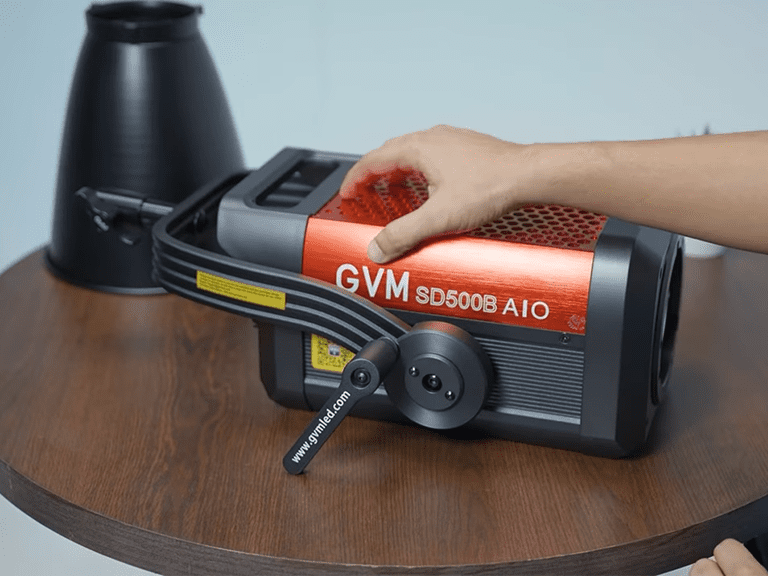
Professional Studio Lighting Setup: The Core Elements
A configuration d'éclairage de studio professionnel today is defined by three pillars: Power, Precision, and Color Accuracy. In years past, photographers relied heavily on strobes (flashes). However, in 2026, the industry has shifted toward high-output LED COB (Chip on Board) lights.
The primary advantage of continuous LED lighting is “What You See Is What You Get” (WYSIWYG). You can see the shadows and highlights in real-time, making it significantly easier to craft the mood of your shot. For a truly professional environment, your lights must offer:
- High CRI/TLCI (97+): This ensures that skin tones and product colors are reproduced accurately, reducing hours of color correction in post-production.
- Flexibilité bicolore The ability to shift from warm tungsten (2700K) to cool daylight (6800K) allows you to mimic natural light at any time of day.
- High Intensity: To compete with window light or to use large modifiers like 5-foot octaboxes, you need a powerhouse light like a 500W spotlight.
Professional Studio Lighting Setup for Beginners
If you are just starting, the world of lighting can feel overwhelming. However, a configuration d'éclairage de studio professionnel pour débutants doesn’t need twenty lights to look good. Most iconic portraits and videos are created using the classic Three-Point Lighting System:
- Lumière principale : This is your primary light source. It should be the most powerful light in your kit. For beginners, placing this at a 45-degree angle from the subject creates a flattering “Rembrandt” lighting effect.
- Lumière de remplissage : Positioned on the opposite side of the key light, the fill light “fills in” the deep shadows, controlling the contrast of the image.
- Rétro-éclairage (Rim Light) : Placed behind the subject, this light creates a “halo” effect around the hair and shoulders, separating the subject from the background and adding three-dimensional depth.
For beginners, the GVM SD500B AIO is an exceptional choice for a Key Light because its integrated design means there are no messy external ballast boxes or complicated cables to trip over, keeping your first studio clean and safe.
The Essential Professional Studio Lighting Kit
To achieve a high-end look, you need more than just the light head itself. A complete Kit d'éclairage de studio professionnel includes the light engine, sturdy stands, and modifiers.
In 2026, the “All-In-One” (AIO) trend has taken over. Professional kits now prioritize lights where the power supply is built directly into the lamp head. This makes the kit highly portable for location work while maintaining a heavy-duty presence in the studio.
Why GVM SD500B AIO is the Best Value Choice
When comparing professional kits, brands like Aputure or Profoto often come with a “brand tax” that drives prices sky-high. GVM has disrupted this market by offering the GVM SD500B AIO, which provides the same—and often higher—specs for a fraction of the cost. With 500W of power and a specialized 0.1% precision dimming system, it delivers the performance of a $2,000 light at a much more accessible price point.
GVM SD500B AIO Product Specification Table
| Fonctionnalité | GVM SD500B AIO Spécifications | Pourquoi c'est important |
| Puissance de sortie maximale | 500W (227,040 Lux @ 1m) | Overpowers the sun and fills large modifiers easily. |
| Color Temp Range | 2700K – 6800K (Bi-color) | Match any ambient light source perfectly. |
| Précision des couleurs | CRI / TLCI 97+ | Essential for professional skin tones. |
| Précision de gradation | Incréments de 0,11 TP3T (par 1 000 pas) | Ultra-smooth transitions; no flicker or color shifts. |
| Système de refroidissement | Advanced Whisper-Quiet Fan | Perfect for video interviews where audio is critical. |
| Options de contrôle | GVM App (Bluetooth Mesh) | Control multiple lights from your phone. |
| Conception intégrée | All-In-One (No external ballast) | Faster setup and less cable clutter in the studio. |
Professional Studio Light Box and Modifiers
A light source is only as good as the modifier attached to it. Bare LED lights produce harsh shadows. To fix this, photographers use a professional studio light box (softbox) to spread the light over a larger surface area.
- Quick-Deploy Softboxes: In 2026, the trend is toward “Umbrella-style” softboxes that click into place in seconds. The GVM Quick Deploy Softbox (35”) is a must-have for the SD500B AIO to create soft, flattering key light.
- Lantern Softboxes: These are used for omnidirectional lighting. If you want to light an entire room evenly for a video set, a lantern like the GVM DL85R is the best tool for the job.
- Fresnel Lenses: If you need to go in the opposite direction and create a hard, theatrical spotlight, a Fresnel lens (like the GVM F60) can intensify the beam, making your 500W light perform like a 1000W source.
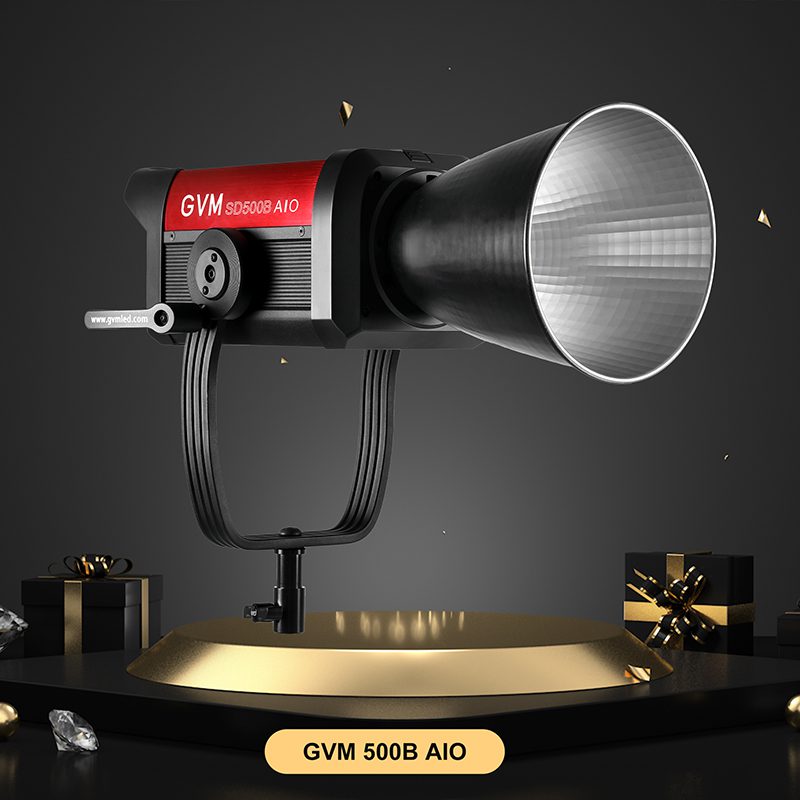
Configuration d'éclairage de studio professionnel pour la photographie de produits
Product photography is perhaps the most demanding niche. It requires absolute control over reflections and textures. A Configuration d'éclairage de studio professionnel pour la photographie de produits usually relies on high-wattage lights to allow for small apertures (like f/11 or f/16) to keep the entire product in sharp focus.
Le GVM SD500B AIO shines in this scenario because of its 0.1% precision dimming. When shooting a shiny watch or a glass bottle, a 1% jump in brightness can often be too much. Being able to fine-tune the light in 1,000 tiny steps allows the product photographer to dial in the “perfect highlight” on a metallic surface without blowing out the details.
Additionally, the 12 Effets d'éclairage dynamiques (like “Explosion” or “TV”) allow product videographers to create dramatic commercial spots with moving light cues directly in the studio, eliminating the need for expensive post-production VFX.
Comparison: GVM vs. The Competition
In the professional landscape of 2026, photographers often compare GVM with brands like Aputure (600d series) or Nanlite. While those brands produce excellent lights, the GVM SD500B AIO offers a unique Integrated All-In-One (AIO) design that simplifies the workflow.
Most 500W+ lights require a heavy “Control Box” or “Ballast” that hangs on the light stand. GVM has engineered the power supply inside the light head. This means fewer cables, fewer points of failure, and a much faster setup time for on-location shoots. When you combine this with the 227,040 Lux output, GVM emerges as the most cost-effective and practical choice for professional studios.
Conclusion: Why GVM is the Smart Investment for 2026
Choosing a configuration d'éclairage de studio professionnel is an investment in your creative future. While there are many options on the market, the GVM SD500B AIO stands out as the most balanced solution for both beginners and seasoned pros.
It offers the raw power (500W) to handle high-end film sets, the precision (0.1% dimming) for technical product photography, and the simplicity (AIO design) for solo creators. When you factor in the high CRI/TLCI and the robust GVM smartphone app control, it becomes clear: GVM provides a professional-tier experience without the prohibitive “luxury brand” markup.
Whether you are building your first Kit d'éclairage de studio professionnel or upgrading a commercial space for product photography, the SD500B AIO is the engine that will drive your visual storytelling forward in 2026.