A Video LED Focusing Light has become one of the most practical tools in a content creator’s kit. In 2026, filmmakers, photographers, and live-commerce sellers all rely on lights that can shift instantly from a tight spotlight to a soft, wide flood — no gel changes, no swapping fixtures, just a twist of a knob.
This shift matters because lighting setups today move fast. A single creator might shoot a product close-up, then a wide interview, then a live stream, all in the same afternoon. A focusing light adapts to each scenario without slowing down the workflow.
Table des matières
Focusable Video Light
The idea of a focusable video light isn’t new to still photography, but 2026 is the year it has become standard in video production at every budget level. These fixtures use a zoom lens or optical system — often a TIR (Total Internal Reflection) lens — to physically narrow or widen the beam angle.
Instead of relying on separate barn doors, diffusion domes, or multiple fixtures, a single focusable light head covers a spot beam for dramatic accents and a flood beam for even, soft coverage. This consolidation is a major reason focusable lights have overtaken fixed-beam panels for solo creators and small crews who need speed and flexibility on set.
Different Types of Video Lighting
Video lighting generally falls into a few categories, each suited to different production needs.
Panel lights (LED flat panels) spread light evenly across a wide area. They’re reliable for soft, general illumination but offer little control over beam shape.
COB (Chip-on-Board) lights concentrate output from a single high-power LED source, producing a punchier, more directional beam — ideal for pairing with modifiers like softboxes or reflectors.
Fresnel and focusing lights add a lens system on top of a COB or similar source, letting the operator adjust the beam angle from a tight spot to a wide flood.
RGB and tube lights prioritize color effects and creative accents over raw output, often used for background or mood lighting rather than key lighting.
Focusing lights sit at the intersection of COB power and Fresnel-style control, which is why they’ve become the go-to choice for creators who need one fixture to do the job of several.
Focus Lights for Photography
A focus light for photography differs from a traditional fixed-beam light in one key way: beam shaping happens at the fixture itself, not through add-on accessories.
Traditional continuous lights typically ship with a fixed beam angle. To narrow the light for a portrait or widen it for a group shot, photographers had to attach barn doors, snoots, or diffusion panels — extra gear, extra setup time, and extra weight in the bag.
A focusing light replaces most of that with a built-in lens mechanism. Turning a focus ring or knob moves the LED source relative to the lens, tightening the beam into a spot or spreading it into a flood. The advantage is speed: a photographer can go from a dramatic rim-light spot to a broad fill light in seconds, without touching a single accessory.
This also improves consistency. Because the beam shaping is mechanical and repeatable, photographers can dial in the exact same spread across multiple shoots — something far harder to replicate with clip-on modifiers.
Best Video Light
What separates a good video light from the best video light in 2026 comes down to a handful of measurable factors.
- Output and lux rating — higher lux at a given distance means more usable light, especially in spot mode for reach and in flood mode for even coverage.
- CRI et TLCI — color accuracy ratings above 95 are now the baseline expectation for anyone shooting skin tones or product footage that needs to look true to life.
- CCT range — a wide bi-color range (roughly 2700K to 6500K or beyond) lets one light match tungsten, daylight, or mixed environments without gels.
- Beam control — a genuine zoom or focus mechanism, not just a fixed diffusion cap.
- Build and portability — an integrated, all-in-one design without a separate ballast box is easier to transport and faster to set up on location.
- Smart control — app or Bluetooth control adds convenience for adjusting brightness, CCT, or effects remotely, especially useful when the light is mounted out of reach.
Lights that check most of these boxes tend to perform well across photography, video, and live-streaming use cases alike.
Portable Focusable LED Video Light
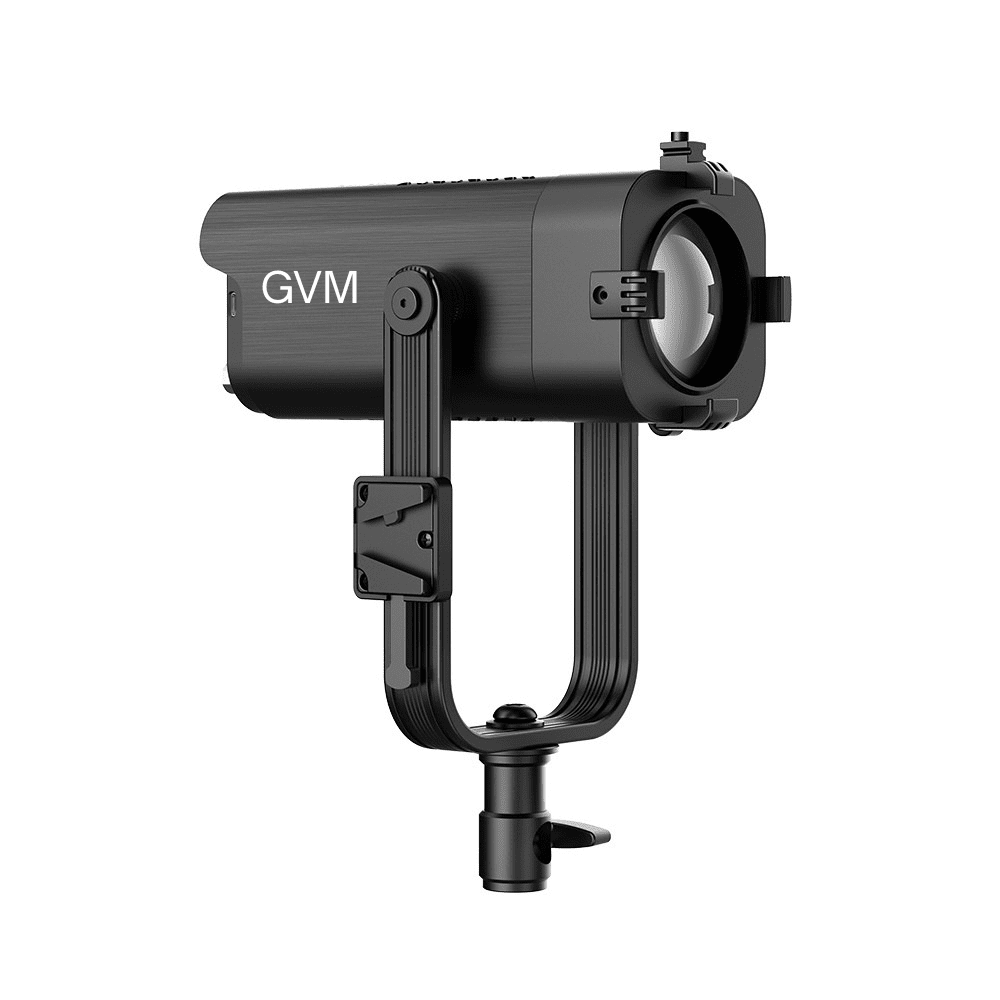
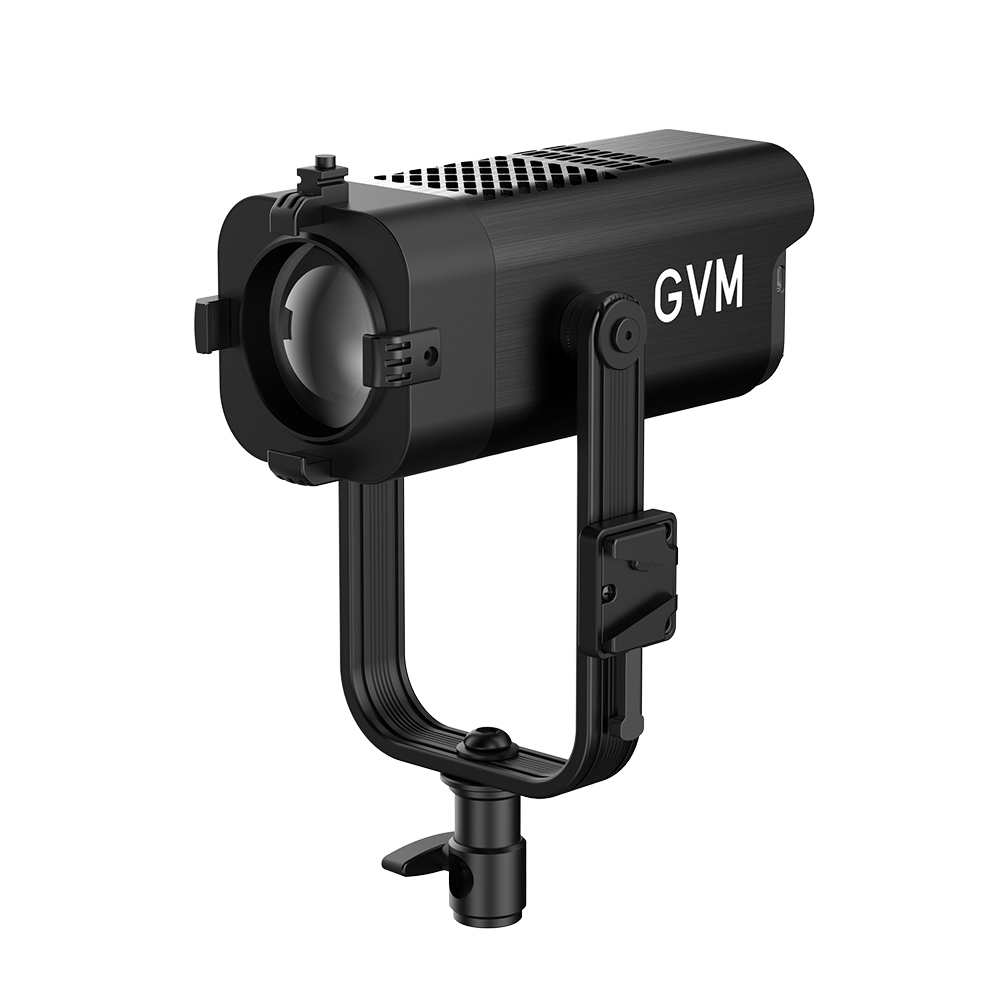
One fixture built around these exact priorities is the GVM PF100B, a 100W bi-color focusing LED light designed for creators who need studio-grade output in a compact, self-contained unit.
The PF100B uses a single COB LED chip paired with a TIR optical lens, giving it a true 15° to 45° spot-to-flood zoom range controlled by a focus knob. Its bi-color range spans 2700K to 6800K, with a CRI and TLCI both rated above 97 for accurate, camera-ready color.
Where many focusing lights need an external control box, the PF100B integrates its controller directly into the light head — one fewer cable, one fewer thing to carry, and a faster setup on location. It runs on standard AC power or an optional V-mount battery, and pairs with the GVM Mesh Bluetooth app for CCT, Source Matching, and Effects modes.
| Fonctionnalité | Specification / Benefit |
|---|---|
| Puissance | 100W Bi-Color COB LED |
| CCT Portée | 2700K–6800K, matches nearly any shooting environment |
| CRI / TLCI | ≥97 / ≥97, accurate skin tones and color-critical work |
| Angle du faisceau | 15°–45° zoom via TIR optical lens and focus knob |
| Illuminance | 30,200 lux @ 1m (Spot) / 3,460 lux @ 1m (Flood) |
| Gradation | 0–100% stepless, 4 dimming curves (Linear, Log, Exponential, S-Curve) |
| Lighting Modes | CCT Mode, Source Matching (12 sources), Effects (12 FX) |
| Refroidissement | Intelligent, High-Speed, Silent, Passive modes |
| Contrôle | On-board + GVM Mesh Bluetooth App (≤50m range) |
| Montage | / |
| Options d'alimentation | AC 100–240V or optional V-mount battery |
| Poids | 1.53 kg, integrated single-unit design |
| Price | $299 USD (regular $399 USD) |
For creators who want the flexibility of spot-to-flood focusing without carrying a separate ballast box, the PF100B’s integrated design makes it easy to achieve the effects of softboxes, reflectors, or other light modifiers based on shooting needs.
Can You Use Video Lights for Photography?
Yes — continuous video lights, especially focusing LED lights, work well for photography, and many photographers now prefer them over traditional strobes for certain work.
The main advantage is WYSIWYG (what you see is what you get) lighting: since the light stays on continuously, a photographer can see exactly how shadows, highlights, and beam spread will look in the final image before pressing the shutter. This is particularly useful for portrait work, product photography, and any shoot where precise beam shaping matters.
Focusing video lights add another layer of usefulness here — the same fixture that lights a video interview can be dialed to a tight spot for a dramatic product photo, then opened back up to a flood for a group portrait, all without changing equipment.
The trade-off is that continuous lights generally can’t match the raw burst power of a studio strobe, so for very fast action or extreme freeze-frame work, strobes still have an edge. For the vast majority of content creation, product photography, and hybrid photo/video workflows, though, a quality focusing LED light covers both needs in a single fixture.

FAQ
What is a focusing LED video light? A focusing LED video light uses a lens system, often a TIR optical lens, to adjust the beam angle from a tight spot to a wide flood, giving one fixture the range of several traditional lights.
Is the GVM PF100B good for both photography and video? Yes. Its 97+ CRI/TLCI rating, wide CCT range, and adjustable beam make it suitable for portrait photography, product shoots, interviews, and run-and-gun video work alike.
How much light output do I need for video? It depends on the space and subject, but a fixture delivering 20,000+ lux at 1 meter in spot mode, like the PF100B’s 30,200 lux, covers most indoor and small studio setups comfortably.
Can a focusing video light replace multiple fixtures? For many small crews and solo creators, yes — a single focusing light with a wide CCT range and adjustable beam angle can cover key, fill, and accent roles that once required separate lights.