A softbox for video lighting is one of the simplest upgrades a creator can make, yet it’s often overlooked in favor of buying more or brighter lights. The truth is, a powerful light source pointed directly at a subject creates harsh, unflattering shadows no matter how good the fixture is. A softbox solves this by transforming a small, hard light source into a large, soft one — the same principle used on professional film sets, in fashion photography studios, and in polished YouTube productions.
This guide covers what a softbox actually does, how it compares to umbrella lighting, how to choose the right size, and how to build a simple softbox setup for video and studio photography, whether you’re just starting out or upgrading an existing kit.
Table des matières
What Is a Softbox?
A softbox is a light modifier — a fabric-covered frame that attaches to a light source and diffuses its output before it reaches the subject. Instead of light traveling directly from a small LED panel or bulb, it passes through one or more layers of diffusion material inside the softbox, spreading it across a much larger surface area.
This matters because of a simple principle in lighting: the larger the light source relative to the subject, the softer the shadows it produces. A bare LED panel is a small, hard light source, even if it’s very bright. Once that same light is fired through a softbox, it effectively becomes a much larger source, producing gentler falloff and far less defined shadow edges.
Softboxes typically include:
- A frame, either collapsible or rigid, that mounts to the light via a speed ring or bracket
- Diffusion panels, usually an inner and outer layer, that scatter the light evenly
- Sometimes a grid, which narrows the spread of light for more directional control
Because of this structure, softboxes give creators a level of control that a bare light simply can’t offer — shaping not just how bright a scene is, but how the light physically behaves.
Softbox vs. Umbrella Lighting
Softboxes and umbrellas both diffuse light, but they behave differently and suit different situations.
Umbrellas are generally cheaper, faster to set up, and produce a wider, more uncontrolled spread of light. Shoot-through umbrellas let light pass through the fabric directly toward the subject, while reflective umbrellas bounce light back from a silver or white interior. Umbrellas are a good entry point for beginners because of their low cost and quick setup, but they offer less control over spill — light tends to scatter beyond the subject, which can be harder to manage in smaller spaces.
Boîtes à lumière offer more precise control. Because the light is contained within an enclosed frame rather than bouncing openly, softboxes reduce spill and direct light more specifically toward the subject. This makes them better suited for video work, where consistent, controlled lighting matters more over a long shoot, and for situations where you need to avoid light bleeding onto a background or nearby surfaces.
In general, umbrellas are a reasonable starting point for photographers on a tight budget, while softboxes are the better long-term investment for video creators and anyone who needs repeatable, controlled results.
How to Choose a Softbox Size
Softbox size has a bigger impact on your lighting quality than almost any other single decision. As a general guideline:
Small softboxes (roughly 16–24 inches) work well for product photography, close-up shots, or accent and rim lighting, where a tightly controlled light source is more useful than broad, soft coverage.
Medium softboxes (around 24–35 inches) are the most versatile choice for most creators. They’re large enough to soften shadows on a face or upper body for interviews, YouTube videos, and portraits, while still being manageable in a home studio or small room.
Large softboxes (35 inches and above, including octaboxes and strip boxes) are better suited for full-body photography, group shots, or professional studio setups where maximum softness and even coverage across a larger area are the priority.
As a simple rule of thumb: the softbox should be roughly as large as, or larger than, the subject it’s lighting, positioned as close as practical without entering the frame. A medium softbox placed close to a subject will almost always look softer than a large softbox placed far away.
Softbox for YouTube and Studio Video
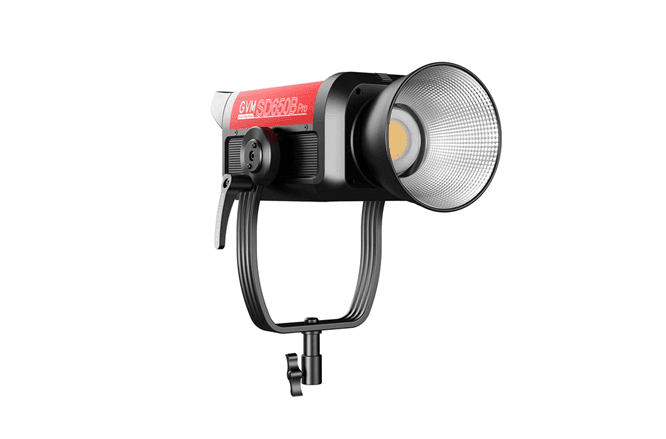
For YouTube creators and studio video production, a softbox paired with a strong bi-color LED light offers one of the best combinations of output and control available. This is where a high-powered, modifier-compatible light like the GVM SD700B AIO becomes especially useful.
The SD700B AIO is a 700W all-in-one LED light with a standard Bowens mount, meaning it accepts softboxes, parabolic modifiers, and other accessories directly without needing an adapter. Its 2700K–6800K bi-color range and 97+ CRI/TLCI rating ensure that once the light passes through a softbox, colors and skin tones remain accurate rather than shifting or looking washed out — a common issue with lower-quality lights paired with diffusion.
For creators building a softbox setup, GVM’s own Quick Deploy Softbox (35″) is designed specifically to pair with the SD700B AIO’s Bowens mount, offering fast, tool-free setup — a practical advantage for YouTubers and studios that need to break down and rebuild their lighting between shoots.
| Fonctionnalité | Specification / Benefit |
|---|---|
| Light Model | GVM SD700B AIO |
| Puissance de sortie | 700W, 26,200 lux @ 3m with standard reflector |
| Température de couleur | 2700K–6800K bi-color |
| CRI/TLCI | 97+ for accurate color through diffusion |
| Type de montage | Bowens mount — compatible with softboxes, lanterns, and reflectors |
| Gradation | 0.1%–100% stepless, flicker-free |
| Contrôle | Bluetooth app, DMX, and CRMX wireless |
| Compatible Softbox | GVM Quick Deploy Softbox (35″) |
| Meilleur pour | YouTube studios, interviews, commercial video, portrait lighting |
Because the SD700B AIO integrates its ballast into the light head, adding a softbox doesn’t add the extra bulk or cabling that comes with separate ballast systems — a meaningful advantage for creators who need to set up and tear down quickly between shoots.
Best Softbox Kit for Beginners
For beginners, the ideal starting point is a single strong light paired with one medium softbox — enough to produce a noticeably more professional look without the complexity of managing multiple modifiers and light sources at once.
A good beginner setup should prioritize:
- A light with sufficient output to still look bright after passing through diffusion, since softboxes reduce the effective brightness reaching the subject
- A Bowens or universal mount, which keeps future modifier options open rather than locking you into a single brand’s proprietary fitting
- A medium-sized softbox (24–35 inches) that works for both talking-head video and simple product or portrait photography
- Accurate color rendering, since a softbox that mutes or shifts color from a low-CRI light will still produce unflattering results
Starting with a single high-output, modifier-compatible light like the SD700B AIO and a 35″ softbox gives beginners a setup that can grow — additional softboxes, grids, or a second light can be added later without replacing the core fixture.
Conclusion
A softbox is one of the highest-impact, lowest-complexity upgrades available for video and photography lighting — it doesn’t just make a scene brighter, it fundamentally changes how flattering and professional that light looks. Umbrellas offer a cheaper entry point, but softboxes give creators the control needed for consistent, repeatable results, especially for video work. Pairing a properly sized softbox with a high-output, color-accurate light like the GVM SD700B AIO gives creators — from beginners to studio professionals — a setup that delivers cinematic, soft lighting without unnecessary complexity.
Ready to soften your lighting setup? Explore the GVM SD700B AIO and the GVM Quick Deploy Softbox to build a modifier-ready lighting kit for your next shoot.