ad lighting is almost never about how bright your light is. It’s about how big it is. That’s the whole reason soft LED spotlights exist — fixtures that give you the directional control of a spotlight and the flattering wrap of a softbox in a single head. If you’ve ever aimed a bare COB at someone’s face and watched every shadow line jump out at the camera, you already know the problem.
Here’s the thing: for years the answer to “my light is too harsh” was always the same — put a softbox on it. That advice still works. But it quietly ignores a middle ground that didn’t exist a few years ago. Focusable LED spotlights with optical lenses now produce genuinely soft light on their own, no modifier bag required. This guide covers what soft LED spotlights actually are, why softness is about physics rather than wattage, and how to pick one that holds up on a real shoot — not just on a spec sheet.
Table des matières
What Is a Soft LED Spotlight?
A soft LED spotlight is a continuous LED fixture that stays directional like a spotlight but is diffused enough to read as soft. It’s the quiet middle of three options most creators actually choose between:
- A bare COB spotlight — a small, intense point source. Punches far, but throws hard edges and crisp, unflattering shadows.
- A softbox or panel — a large, diffuse source. Beautifully soft, but bulky, slower to rig, and less able to reach a specific spot in the frame.
- A soft LED spotlight — an optical lens spreads the emitter’s output across a wider exit so the beam stays even and wrapped, while a focus mechanism lets you tighten or widen it on demand.
The category earns its name because it does the job a softbox does (soft light) without always needing a softbox to do it. You get source-quality light and spotlight-style control from the same fixture.
The two things that make it “soft”
Softness comes from two design choices working together, not from a magic diffuser:
- A larger effective source area. The light exits through a lens and a wider aperture, so it’s no longer a 2cm chip — it’s a broad, even panel of light from the subject’s point of view.
- Even output across the beam. A good soft spotlight holds consistent brightness from center to edge, so you don’t get a hot spot in the middle with a harsh falloff ring around it.
That second point is what separates a real soft spotlight from a cheap “spotlight” that’s just a COB with a reflector cone bolted on.
Why “Soft” Is About Source Size, Not Power
This is the single most misunderstood idea in lighting, so let’s be blunt about it: a dim softbox is softer than a bright bare LED. Softness has nothing to do with wattage. It’s about the apparent size of the light source relative to your subject.
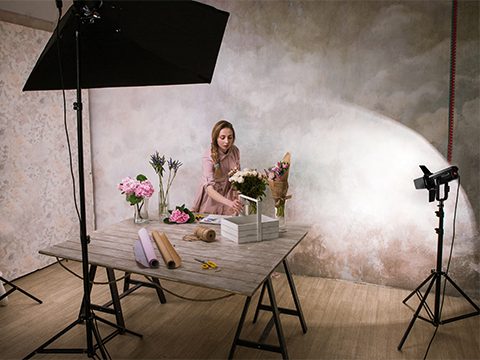
A bare LED chip is roughly 2–5cm across. A human face is 15–20cm wide. So the light comes from a source much smaller than the thing it’s lighting — and small sources throw sharp, defined shadow edges. A 60–120cm softbox is larger than the face, so light arrives from many angles at once and fills shadows from the sides. That’s the whole physics lesson.
Wattage only decides how far the light reaches and how much you can dim. A 100W soft source and a 300W soft source look equally soft on a face — the 300W one just holds that softness from further away or through heavier diffusion.
This is exactly where a focusable soft spotlight earns its keep. By spreading the beam across a wider exit aperture, it behaves like a source many times bigger than its own chip. I tested one recently (more on it below) with a Sekonic C-800-U SpectroMaster at a fixed 1 meter and confirmed the output stayed even across the flood setting — the tell-tale hard edge you’d expect from a bare COB simply wasn’t there.
The trade-off nobody mentions
Softness and reach pull against each other. Widen the beam and the light dances gently across a face — but it also spreads thin, so it won’t punch across a large room. Tighten the beam and you get a hard-edged, directional spot that reaches distance but sculpts harshly. The reason a soft spotlight is useful is that it lets you dial between those two extremes without swapping gear.
Soft But Directional: Where Soft LED Spotlights Actually Shine
If soft light is the goal, why not just use a softbox every time? Because sometimes you can’t — or you don’t have the time, space, or spare stand. Here’s where a soft spotlight beats either extreme:
- Single-subject interviews. One focusable light at a mid-range flood angle gives you a soft key with real shape. No softbox to rig between takes.
- Talking-head and YouTube setups. Fast turnaround, small rooms. Widen the beam, set your color temperature, and you’re lit in two minutes.
- Product photography. The flood setting spreads even, shadow-light coverage across a tabletop without a separate diffusion panel.
- Accent and rim lighting. Switch to a tighter spot to separate a subject from the background with a crisp, controlled edge — something a softbox is genuinely bad at.
- Run-and-gun and on-location. Battery power plus a built-in controller means no modifier bag and no wall outlet.
Notice the through-line: a soft spotlight is the only fixture that can play key, fill, and rim roles across a single shoot day without you changing attachments. A softbox does one of those jobs beautifully and the other two poorly.
Common Myths About Soft LED Spotlights
A few beliefs are worth correcting before you spend money.
Myth 1 — “A spotlight can’t be soft.” Old spotlights couldn’t. Optical-lens fixtures changed that. Softness and directionality are no longer mutually exclusive.
Myth 2 — “You always need a softbox.” A softbox is still the softest, most even option for a formal portrait. But for a fast one-light setup, a good soft spotlight gets you 90% of the way with 10% of the rigging.
Myth 3 — “More power means softer light.” No. Power equals reach. Buying a 300W light won’t make your shadows softer — moving the source closer, or using a larger one, will.
Myth 4 — “Any diffusion will do.” Cheap diffusion can introduce a green cast that your camera will faithfully record. Check CRI et TLCI — you want 97+ on both. I check skin tones against an X-Rite ColorChecker under each light before I trust it.
Myth 5 — “Soft light means no shadows.” Soft light means feathered shadows, not zero shadows. The gentle falloff is what gives a face dimension. Fully shadowless light (a pure ring or on-axis source) usually looks flat, not flattering.
The Soft LED Spotlight I’d Actually Recommend: GVM PF100B
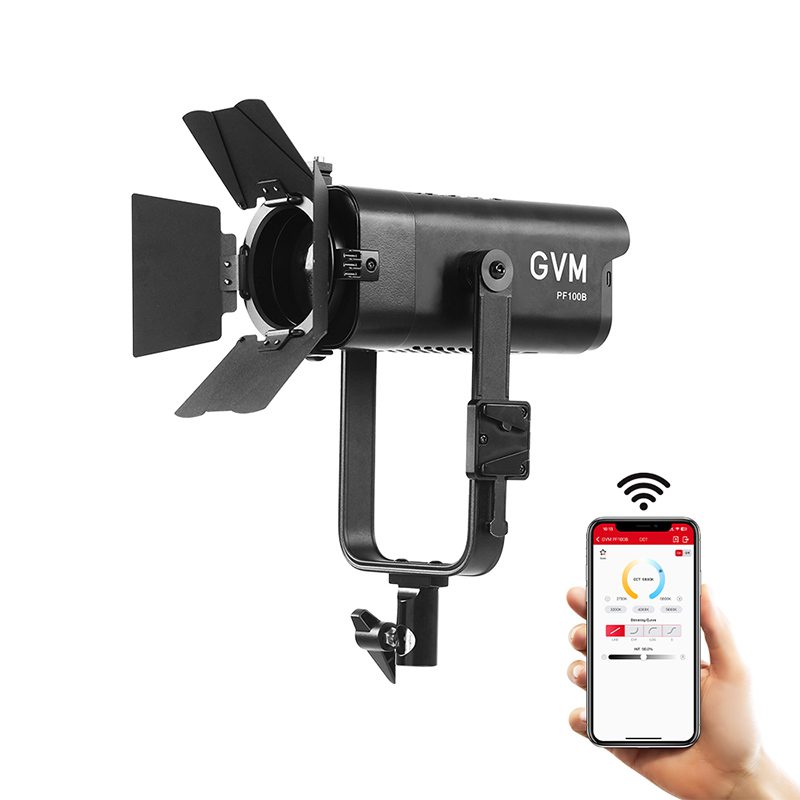
If you want the category in a single fixture, the one I keep coming back to is the GVM PF100B. It’s a 100W bi-color COB spotlight built around true spot-to-flood focusing rather than treating it as an afterthought — a custom TIR optical lens delivers a real 15°–45° zoom range, adjusted with a focus knob instead of swapped accessories.
Why it stopped my search: most “spotlights” in this price bracket are fixed-beam. You get one angle, and you live with it. The PF100B’s zoom range means one light covers key, fill, and rim work in a day. In tight spot mode it throws a genuinely dramatic, hard-edged 30,200 lux at 1 meter; widen toward 45° and the same head becomes a soft, even source that flatters skin without a softbox. That single trick replaces two or three single-purpose fixtures.
What I noticed in use: the Silent cooling mode is the real-world winner — it disables the fan entirely for audio-sensitive takes, so it never bleeds into a recorded interview. The integrated controller (no separate ballast box) means it lives happily at the top of a single stand. Color held steady across the full zoom range when I checked it, and both CRI and TLCI stayed at 97+.
The honest catch: at 100W it’s a one- or two-person light, not a stadium flood. For a large group or a bright window you’ll want more output. And the Mini Bowens mount fits most — but not all — of the standard modifier ecosystem, so check your existing softboxes before assuming they’ll thread on.
| Spécifications | GVM PF100B |
|---|---|
| Puissance | 100W bi-color COB |
| Beam angle | 15°–45° zoomable (TIR optical lens) |
| Output — spot (15°) | 30,200 lux @ 1m |
| Output — flood (45°) | 3,460 lux @ 1m |
| Température de couleur | 2700K–6800K |
| CRI / TLCI | 97+ (across full zoom range) |
| Gradation | 0–100% stepless, 4 curves |
| Lighting modes | CCT, Source Matching (12 presets), Effects (12 FX) |
| Refroidissement | 4 modes, including Silent (fan off) |
| Montage | Mini Bowens |
| Power options | AC 100–240V or optional V-mount battery |
| Poids | 1.53 kg |
Pour qui ? solo creators, interview shooters, and product photographers who want soft, directional light from one fixture and don’t want to carry a bag of modifiers. If that’s you, the GVM PF100B focusable LED light is the version of this category I’d put my own money on.
Questions fréquemment posées
What’s the difference between a soft LED spotlight and a softbox?
A softbox is a large, fabric diffuser you mount in front of a light source; it produces the softest, most even light but is bulky and less directional. A soft LED spotlight uses an internal optical lens to spread and even out its own output, so it’s softer than a bare COB while staying directional and self-contained. Think of the soft spotlight as the lightweight middle ground.
Can a spotlight really look soft without a diffuser?
Yes — softness is about the apparent size of the source, not the presence of fabric. A focusable spotlight with a good optical lens spreads its output across a wider aperture, so it reads as a larger source than its chip suggests. That’s what makes the flood setting look soft even with no softbox attached.
Do I still need a softbox if I buy a focusable soft spotlight?
Not for most one-light setups — that’s the point. A softbox still wins for formal portrait work where you want the absolute softest, most wrapping light. But for interviews, talking-head, and product work, a good soft spotlight gets you close enough that many shooters never mount the box.
What CRI do soft LED spotlights need for video?
Aim for CRI 97+ et TLCI 97+. CRI tells you how the human eye sees the color; TLCI tells you how a camera sensor sees it, so for video you want both high. Anything below 95 will cost you color accuracy you can’t fully fix in post.
Are soft LED spotlights good for product photography?
Very good. The flood setting spreads even, shadow-light coverage across a tabletop without a separate diffusion panel, which makes it ideal for fast product turns. For highly reflective products you may still want a scrim, but a soft spotlight handles most items in one pass.
Can I use a soft LED spotlight for portraits?
Absolutely. Set it to a mid-range flood, place it 45° off camera and slightly above eye level, and you get a soft key with real shape — the kind of gentle falloff that reads as professional. Tighten the beam when you want a dramatic, high-contrast look instead.
Are soft LED spotlights good for beginners?
They’re arguably the best first light. One fixture that can go from soft key to tight accent means you learn how beam angle and distance change a shot, instead of juggling multiple lights and modifiers from day one. Look for 97+ color accuracy, stepless dimming, and a quiet cooling mode — GVM’s focusable LED lights tick all three.