Cinematic lighting techniques all grow from one foundation: 3-point lighting. Once you understand how a key, fill, and backlight work together, every advanced look becomes a variation of that triangle.
This guide explains the principles, shows a practical small-room setup, and demonstrates how the GVM 1200B AIO with its 3X Optical Intensifier puts these cinematic lighting techniques into practice.
Table des matières
Cinematic Lighting Techniques Explained: Intent Over Brightness
Basic lighting makes a subject visible. Cinematic lighting techniques control how the audience feels, and the difference is intent. Four dimensions do the work:
- Lighting ratio sets the drama: close ratios feel flat and clean, wide ratios feel moody.
- Température de couleur suggests time of day and emotion, from warm candlelight to cool daylight.
- Direction and angle sculpt faces and objects through shadow.
- Background separation creates a sense of three-dimensional space.
These follow repeatable rules, and the first rule is the 3-point system: a key light, a fill light, and a backlight.
Why 3-Point Lighting Is the Gateway to Every Cinematic Technique
Many famous looks are 3-point variants:
- Rembrandt lighting: a specific key angle with reduced fill.
- Butterfly lighting: the key moved directly above the lens.
- Low-key lighting: the fill removed.
The conclusion is that mastering the triangle means understanding light itself, rather than memorizing recipes. Each cinematic lighting technique you learn afterward is a change of angle, ratio, or color applied to the same three roles.
Record Your Test Conditions
Whatever setup you build, log three things for every shot: the distance from light to subject, the color temperature (CCT), and whether you used a modifier. This habit lets you compare before-and-after frames and repeat a look reliably, which is how cinematic lighting techniques become a skill instead of luck.
Reference Scenario: A 3×3 m Room, One Creator
This is an illustrative setup, not a test result. The point is that limited space and limited gear can still produce a cinematic feel.
| Rôle | Equipment | Starting Parameters |
|---|---|---|
| Clé | GVM 1200B AIO with 3X Optical Intensifier, aimed into a white bounce board | 5600K, start around 10 to 20% output and raise to exposure, board about 1 m from the light |
| Remplir | White reflector opposite the key | 5600K, close to the lens axis, lighter than the key |
| Backlight | A small practical lamp, or a second light if available | Behind the shoulder, low output |
| Background | Black fabric, subject about 1.5 m in front of it | Absorbs stray light |
Light placement (top-down view): Put the subject near the middle of the room. Place the key at 45 degrees on one side, slightly above eye level, firing into the bounce board so the light wraps softly. Put the reflector on the opposite side near the camera. Place the rim light behind the subject on the shadow side.
Expected look: A soft, directional face with gentle shadow on one cheek, a clean edge of light on the shoulder, and a dark background that adds depth. The impression of a larger set comes from placement, not from more equipment.
From 3-Point Lighting to Advanced Cinematic Lighting Techniques
| Advanced Look | Relationship to 3-Point |
|---|---|
| Rembrandt | Lower the key, reduce fill, keep the rim |
| Butterfly | Key above the lens, fill from below |
| Split lighting | Key at 90 degrees, fill off |
| Low-key | Remove fill, lower rim, darken the background |
| High-key | Fill close to key, brighten the background |
| RGB ambience | Add a colored background layer on top of the triangle |
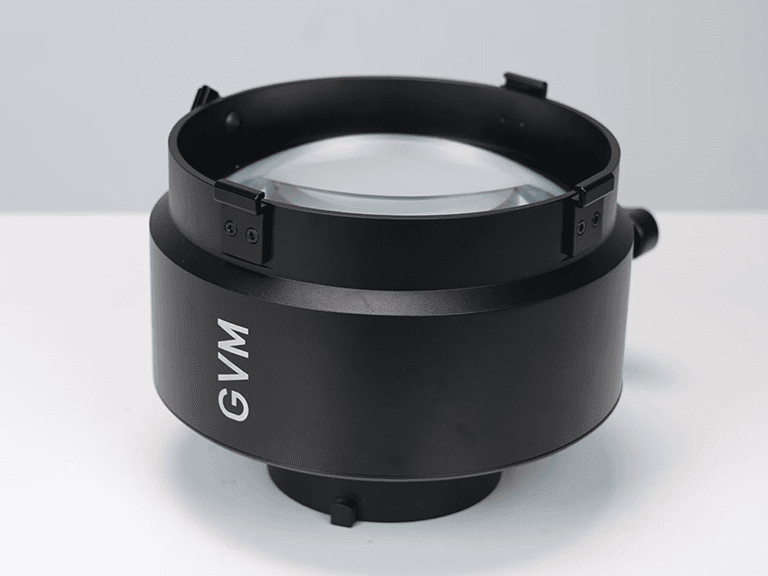
Applying Cinematic Lighting Techniques With the GVM 1200B AIO + 3X Optical Intensifier
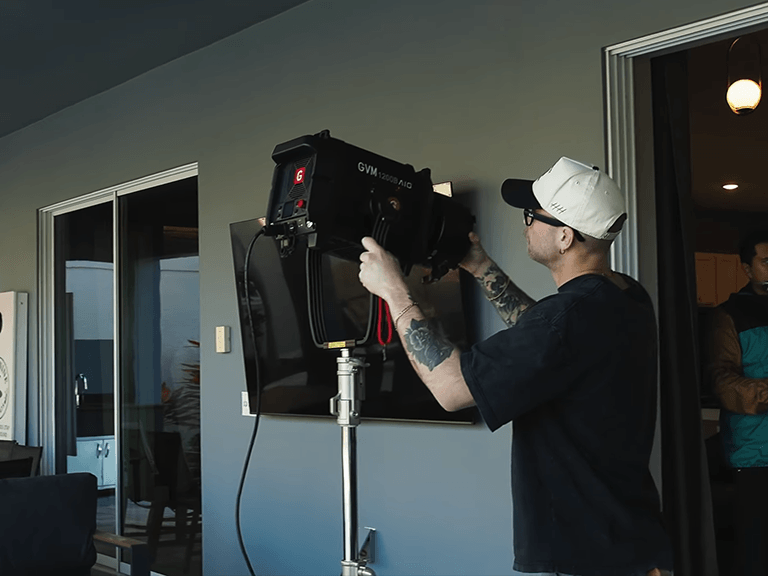
Cinematic lighting techniques need a light you can shape quickly. The GVM 1200B AIO is an all-in-one 1200W bi-color COB light with the power supply built in, so there is no external ballast: plug in and shoot. The GVM 3X Optical Intensifier (FPXG3BJ) mounts on the front to boost output by up to 300% with no extra power draw.
| Spécifications | GVM 1200B AIO | GVM 3X Optical Intensifier (FPXG3BJ) |
|---|---|---|
| Power / role | 1200W bicolore COB | Focusing lens, up to 300% brighter |
| Luminosité | 42,800 lux at 3 m (6800K, with reflector) | 35° beam angle, no harsh central hotspot |
| Color | 2700K to 6800K, CRI above 97 | Honeycomb grid included |
| Gradation | 0.3% to 100%, flicker-free | Installs in seconds |
| Contrôle | Knobs, app, CRMX/DMX/RDM/Art-Net via an optional control box | Universal Bowens mount |
| Refroidissement | Three fan modes (Auto/Low/Off) | 2.05 kg |
| Poids | 10 kg (22 lbs) | $299 USD |
| Extras | 12 effects, 12 light source modes | Great for interviews and cinematic scenes |
The lens turns the 1200B AIO into a focused cinematic spotlight, ideal for matching daylight or throwing a clean beam across a room, while the bare fixture with a bounce board gives a soft look.
Field Examples: Simulating Natural Light
Australian documentary cinematographer Andrew used this combination to create believable daylight indoors.
Painter’s studio: He angled the 1200B AIO down from beside the entrance, with the 3X intensifier lifting output to match the bright exterior. The result was sunlight that appeared to stream deep into the room.
Kitchen corner: He placed the light outside and shot through the window in the late afternoon, around 4 to 6 p.m., when ambient light was weaker. He bounced the light into a 6×6 white screen to create a large soft source and used black fabric to absorb stray reflections.
Why It Is a High-Value Choice
| Value Factor | GVM 1200B AIO + 3X Optical Intensifier |
|---|---|
| Price | $1,399 for the light (regular price $1,999), plus $299 for the lens |
| Cost per watt | About $1.17 per watt for the light, about $1.41 with the lens |
| Luminosité | 42,800 lux at 3 m with the standard reflector; a retailer listing markets the pair as a 3,600W-equivalent output |
| Setup speed | GVM says the all-in-one design goes live within 60 seconds of plugging in AC power Best Video lighting Kit Top 3 – GVM Official Site +3 |
GVM describes the 1200B AIO as the most affordable 1200W-class COB LED video light on the market. That is the manufacturer’s own claim, so verify it yourself: divide the price of any 1200W-class fixture by 1200, add the cost of any lens or power box it needs, and compare with about $1.41 per watt for the GVM pair. Prices change, so confirm current listings before buying.

FAQ
Is 3-point lighting still one of the cinematic lighting techniques today?
Yes. Most modern looks are variations of it.
Can an LED light do cinematic 3-point lighting?
Yes, with accurate color, fine dimming, and good modifiers.
What is the best key-to-fill ratio for interviews?
Around 4:1 gives layered, professional results. Close ratios feel flatter and wider ratios feel more dramatic.
Do product videos need a backlight?
Usually yes, because it separates the product from the background and adds depth.
How do I do 3-point lighting in a small room?
Dim the key, bounce the light, and keep the subject away from the walls.
Conclusion
Cinematic lighting is better positioning, not more lights. Start with one GVM 1200B AIO and the 3X Optical Intensifier, build the triangle, and shoot like a filmmaker. Explore GVM’s LED Panel Lights, the AIO series, and content creation solutions to put these cinematic lighting techniques into practice.