1. Introduction: Breaking the “Fourth Wall” with an Invisible Bridge
As a Director of Photography (DP) who has spent years on professional film sets, I’m often asked one specific question: “Elena, how do top-tier politicians, news anchors, and YouTubers stay so confident on camera without ever looking at a script?”
The secret isn’t a superhuman memory. It’s a piece of “invisible” glass known as the Téléprompteur.
In the professional world, a teleprompter is far more than a “reading tool.” It is the invisible bridge that allows a speaker to maintain that all-important eye contact while delivering complex information. In today’s digital landscape, eye contact equals trust, and trust equals conversion. A teleprompter isn’t “cheating”—it’s the ultimate synonym for efficiency and authority in modern video production.
2. What is a Teleprompter and How Does It Actually Work?
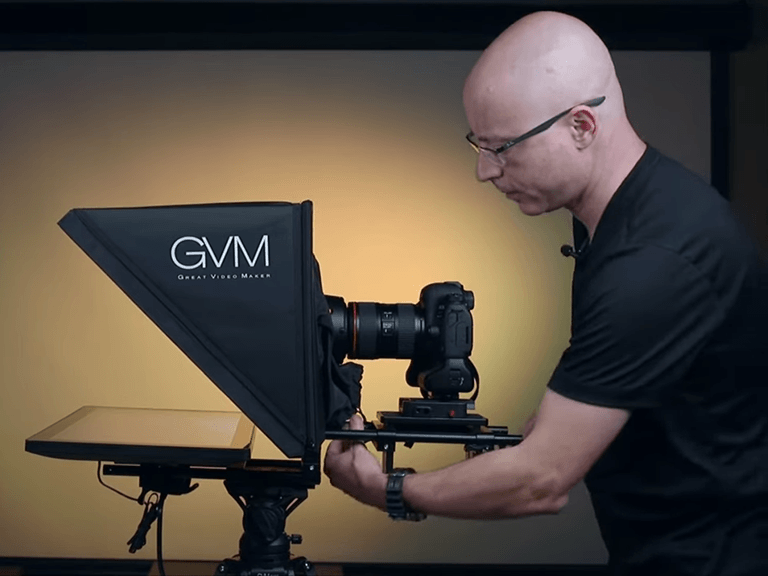
Before we dive into the history, let’s demystify this optical marvel. A teleprompter is a device that reflects text in front of a camera lens using a clever physics trick.
The Science of the 70/30 Beamsplitter
The heart of any clear teleprompter is the 70/30 Beamsplitter Glass.
- Reflection vs. Transmission: The glass is placed at a 45-degree angle. It reflects 30% of the light (the text from an iPad or monitor below) toward the speaker, while allowing 70% of the light to pass through the glass and into the camera lens.
- The “Invisible” Result: The speaker sees a clear, scrolling script, but the camera sees… nothing but the speaker. This setup ensures you are looking directly into the center of the lens, creating a deep connection with your audience.
3. The Early Days: From Paper Scrolls to Hollywood Sets
The history of teleprompters is a classic tale of “necessity driving innovation.”
The 1950s Mechanical Breakthrough
In the early days of television, actors and hosts relied on “cue cards” or sheer memory. In 1950, the first teleprompter, the “TelePro,” was born. It was a bulky mechanical beast consisting of a half-silvered mirror and a long roll of paper with hand-written script. An assistant would manually turn a crank on the side to match the speaker’s pace. It was primitive, but it revolutionized soap operas by letting actors stop hunting for hidden cue cards on set.
The Jump from Mechanical to Electronic
By the 1980s, paper rolls were replaced by CRT monitors. The text was computer-generated, allowing for much more precise speed control. However, these systems remained “luxury items” for big news stations, costing tens of thousands of dollars and requiring a dedicated technician to operate.
4. The Presidential “Bulletproof” Glass: A Golden Age of Authority
If you’ve ever watched a Presidential address, you’ve noticed two transparent glass panels standing on poles flanking the podium. These are known as Presidential Teleprompters.
Creating the “Vision of Authority”
By reflecting the script onto these transparent panels, leaders can scan the room, looking left and then right, maintaining eye contact with the entire audience. To the viewer, the leader appears brilliant (speaking without notes) and incredibly charismatic. This technology single-handedly defined the “professional look” of global leadership.
5. The Digital Revolution: When Teleprompters Met the Internet
The explosion of smartphones and tablets in the 21st century completely disrupted the industry, making the teleprompter for YouTube videos a reality for everyone.
The iPad and Smartphone Era
Expensive, heavy monitors are no longer required. Modern units like the GVM TQ-S are designed to work with iPads or Android tablets as the primary source. This has made the gear incredibly lightweight, portable, and affordable for solo creators.
Materials Science: A New Standard of Clarity
Modern glass has evolved. We no longer use simple glass; we use multi-layer dielectric coatings (Hard Film). This ensures that even in a studio with bright video recording lighting, the text remains sharp while the camera’s 4K or 8K image suffers zero color shift or light loss.
6. Pro Tips: How to Use a Teleprompter Like a Director
As a DP, I see many creators buy a teleprompter but still end up looking “stiff.” Here is my professional checklist for a natural performance:
Step 1: Proper Rigging
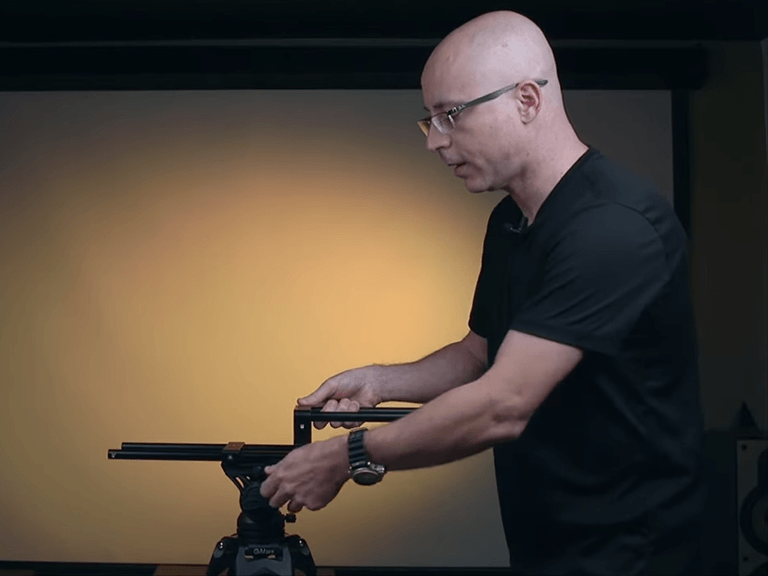
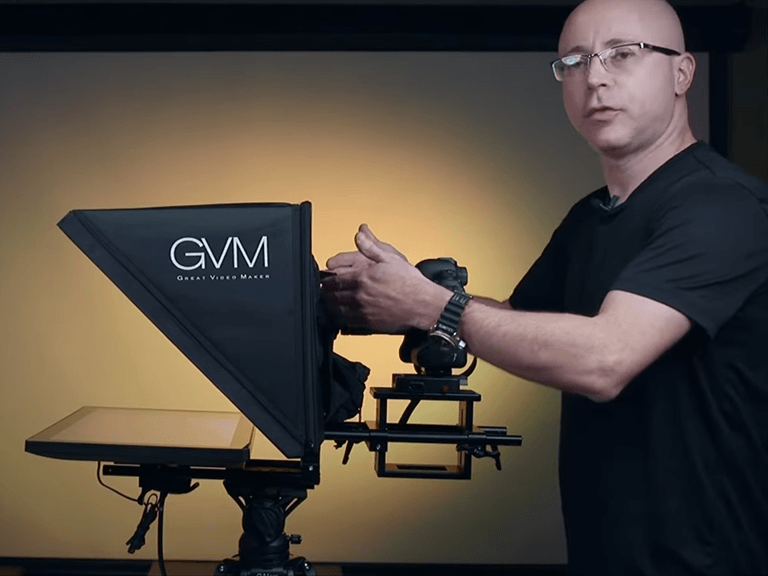
Use a professional teleprompter for camera setup. The GVM TQ-S comes with 8 camera adapter rings (52mm to 82mm). This ensures your lens is perfectly sealed within the shroud, preventing light leaks from ruining your shot.
Step 2: Master the Mirroring
Because teleprompters work on reflection, your script will appear backward unless you enable “Mirror Mode” in your app. High-end apps like the GVM Control App handle this automatically.
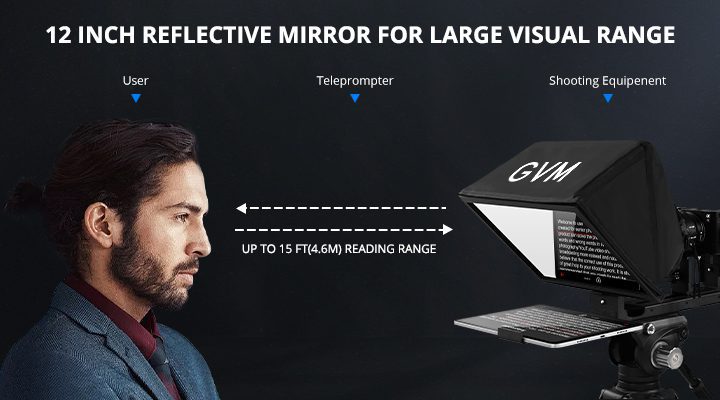
Step 3: The Secret of Focal Length and Distance
This is my most important tip: Do not stand too close!
- If you are 1 foot away, your eyes will visibly “track” from left to right as you read. This is a dead giveaway you’re using a prompter.
- The Fix: Stand at least 6–8 feet (2+ meters) away and use a 50mm or 85mm “long” lens. This narrows the field of view and makes eye tracking virtually invisible to the audience.
7. Cleaning and Maintenance: Protecting Your “Optical Heart”
The 70/30 glass is the most expensive and fragile part of your kit. If you treat it like a window, you’ll ruin it.
The Professional Cleaning Routine:
- Air First: Use an air blower to remove dust particles. Never wipe dry glass; those tiny dust specks act like sandpaper.
- No Rough Cloths: Avoid paper towels or shirts. Only use a clean, ultra-fine microfiber cloth.
- Spray the Cloth, Not the Glass: Lightly dampen the cloth with a specialized optical lens cleaner and wipe in gentle, circular motions from the center outward.
Long-Term Storage:
- Avoid Humidity: Store your prompter in its dedicated carrying case with a silica gel packet to prevent “glass mold” or oxidation of the coating.
- The Fingerprint Rule: Try to only touch the edges of the glass. The natural oils in your skin are acidic and can eventually degrade the hard film coating if left for months.
8. Why Modern Creators Choose the GVM TQ-S
In the sea of teleprompters on Amazon, the GVM TQ-S stands out because it addresses real set-life problems:
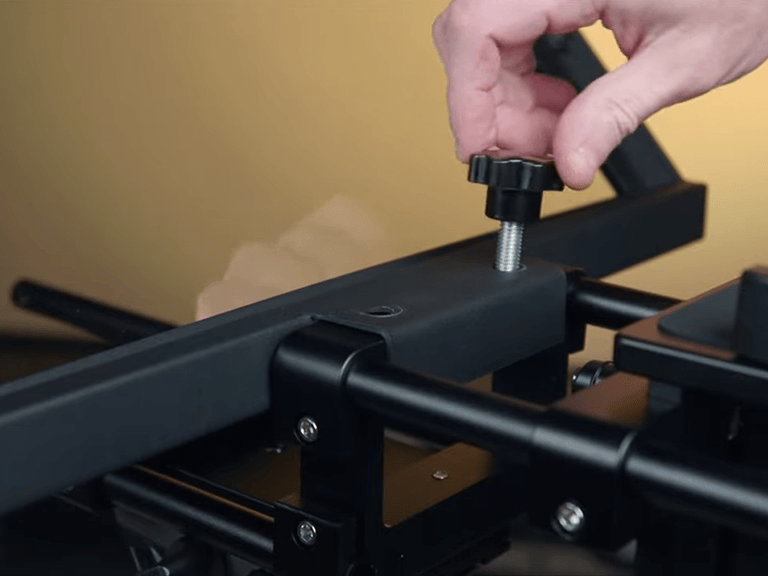
- Aluminum Alloy Construction: Unlike plastic budget brands, the TQ-S uses an aluminum alloy base and bracket, making it sturdy enough for heavy DSLRs while remaining lightweight for travel.
- 8-Lens Compatibility: It includes 52, 55, 58, 62, 67, 72, 77, and 82mm rings, ensuring it’s a universal teleprompter for camera gear.
- Smart Connectivity: Le GVM Control App (iOS/Android) combined with a Bluetooth Remote allows you to be your own director, controlling speed and font size from 15 feet away.
- Horizontal & Vertical Support: In the age of TikTok and YouTube Shorts, the TQ-S’s “Shoot Anyway” design is a lifesaver.
9. Looking Ahead: The Future of the Teleprompter
The evolution continues.
- AI Voice Tracking: We are seeing apps that “listen” to you. The script only scrolls as you speak—if you pause for a drink of water, the text stops too.
- AR Integration: Imagine a teleprompter for Mac or PC that isn’t a glass box at all, but a set of AR glasses that overlay your script directly over the lens of your webcam.
10. Conclusion: Letting the Tools Empower Your Voice
From the paper scrolls of the 1950s to the sleek, smart systems of GVM, the mission of the teleprompter has never changed: To connect people.
It isn’t just about remembering lines. It’s about freeing your mind from the stress of a script so you can focus on your emotion, your body language, and that vital connection with your viewer. In a world of infinite content, a professional teleprompter is the edge you need to move from “hobbyist” to “professional creator.”