Studio LED lights come in dozens of configurations these days, and picking the right 500W-class fixture can feel overwhelming once you start weighing price against brightness against how fast you can actually get it set up on a shoot. The GVM SD500B AIO and Nanlite FC-500B are two of the most-compared options in this power tier, and a strobe kit like the Neewer 500W set often enters the conversation too since it’s priced to compete on paper. This guide lines all three up directly — by price at the same wattage, output, and deployment speed — to show which studio LED light actually gives you the most for your budget.
Studio Light in Photography
In photography, a studio light’s real value comes down to how consistently it renders color and how easily you can dial in the exact intensity a scene calls for. The GVM SD500B AIO covers a 2700K–6800K bi-color range with a CRI/TLCI rating of 97+, and its dimming system offers 1,000 steps of flicker-free control from blackout to full output, so color stays accurate whether you’re at 5% or 100% brightness. That combination of a wide color range and stepless dimming matters more for consistent photography results than chasing the single highest lux number on a spec sheet.
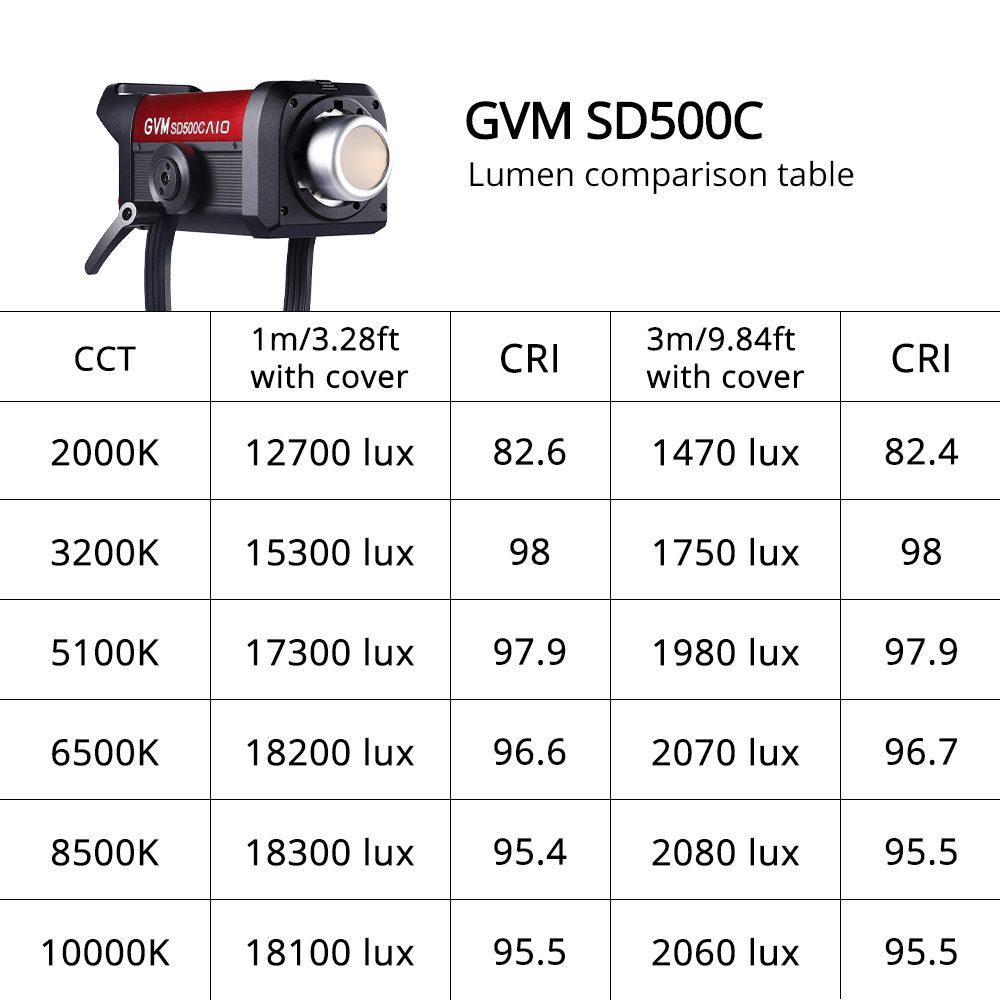
At the same 500W-class power tier, the Nanlite FC-500B offers a slightly narrower 2700K–6500K range with a 96 CRI / 98 TLCI rating, and it’s currently priced at $399 on sale. The GVM SD500B AIO comes in below that price point for a comparable feature set, which makes it the stronger value pick for photographers who want the same dimming precision and color accuracy without paying a premium for the Nanlite name. A budget option like the Neewer 500W flash kit undercuts both on sticker price, but it’s a strobe-and-softbox bundle rather than a continuous bi-color LED, so it isn’t built for the same flicker-free, adjustable-CCT photography work these two lights are designed around.
Product Photography Studio
A product photography studio typically needs a light that can be repositioned quickly between shots without a lot of setup overhead. The GVM SD500B AIO’s all-in-one design combines the LED head and power supply into a single unit, so there’s no separate ballast to place or extra cable to route around a light box — you plug in, power on, and start shooting. That single-unit build also delivers an exceptionally high output of 227,040 lux at 1 meter with the standard reflector, giving product studios far more brightness headroom per dollar spent than the Nanlite FC-500B’s 65,640 lux at 3.3 feet.
The FC-500B, by comparison, ships with its head and power supply as separate components, which is a workable setup for a fixed studio corner but adds a cable and a second piece of hardware to manage every time you reposition the light for a different product angle. For a studio running high shot volumes, the GVM’s quick, one-unit deployment translates directly into time saved across a session.
Nanlite Studio Lights
Nanlite has built a solid reputation with fixtures like the FC-500B, which brings genuine strengths to the table: a 96 CRI/98 TLCI rating, 12 built-in lighting effects, Bluetooth and 2.4GHz app control via NANLINK, and DMX/RDM connectivity for larger productions. Its separated head-and-controller design is a deliberate engineering choice that keeps the light head lightweight, which some studios prefer for boom or overhead mounting.
Where the comparison tips back toward GVM is price-to-performance. The SD500B AIO matches the FC-500B’s 12 cinematic effects and app-based Bluetooth control, adds a wider bi-color range, and delivers dramatically higher lux output — all at a lower price for the same 500W power class. For studios weighing Nanlite’s build quality against GVM’s combination of brightness, features, and cost, the value math consistently favors the GVM SD500B AIO.
Meilleurs éclairages de studio pour la photographie
When narrowing down the best studio lights for photography, the deciding factors usually come down to four things: price at a given wattage, real-world brightness, color accuracy, and how quickly the light gets you shooting. Here’s how the GVM SD500B AIO stacks up on paper:
| Fonctionnalité | Specification / Benefit |
|---|---|
| Puissance de sortie | 500W, 227,040 lux at 1m with standard reflector |
| Température de couleur | 2700K–6800K bi-color, consistent across full range |
| CRI/TLCI | 97+ for accurate, true-to-life color |
| Gradation | 1,000-step flicker-free dimming, 0.1% precision |
| Effets d'éclairage | 12 built-in cinematic effects |
| Contrôle | Bluetooth app control |
| Montage | Bowens mount, compatible with GVM softbox and Fresnel accessories |
| Conception | All-in-one unit for fast setup and repositioning |
Against the Nanlite FC-500B’s $399 price point and separated-component design, and against the Neewer 500W kit’s strobe-based approach that doesn’t offer continuous bi-color LED output, the SD500B AIO’s combination of lower cost at the same wattage, substantially higher brightness, and single-unit fast deployment makes it the most well-rounded studio light in this comparison.
Conclusion
All three lights have a place in a studio photographer’s toolkit, but when you weigh price against wattage, brightness against dollars spent, and setup speed against shot volume, the GVM SD500B AIO comes out ahead as the most cost-effective studio LED light in its class. It pairs a lower price than the Nanlite FC-500B with dramatically higher output, matching creative features, and an all-in-one build that gets you lighting a scene faster. For photographers and studios that want the best balance of value, brightness, and efficiency, the GVM SD500B AIO is the studio LED light worth adding to your kit this year.