Die three point lighting setup has survived a century of filmmaking for one reason: it works. Long before LEDs existed, cinematographers used a Hauptlicht, a Aufhelllicht, and a Hintergrundbeleuchtung to sculpt faces, separate subjects from backgrounds, and create depth on a flat 2D screen. That logic still runs every Netflix drama, YouTube vlog, and Zoom interview in 2026.
This guide walks you through what the three point lighting setup actually is, why it still matters, und how to build a working rig at home without spending a fortune — using real GVM gear you can pair up today.
Updated June 2026 — refreshed for the latest GVM PRO SD series, including the PRO SD200B (our top pick for the key light slot).
Was ist Dreipunktbeleuchtung?
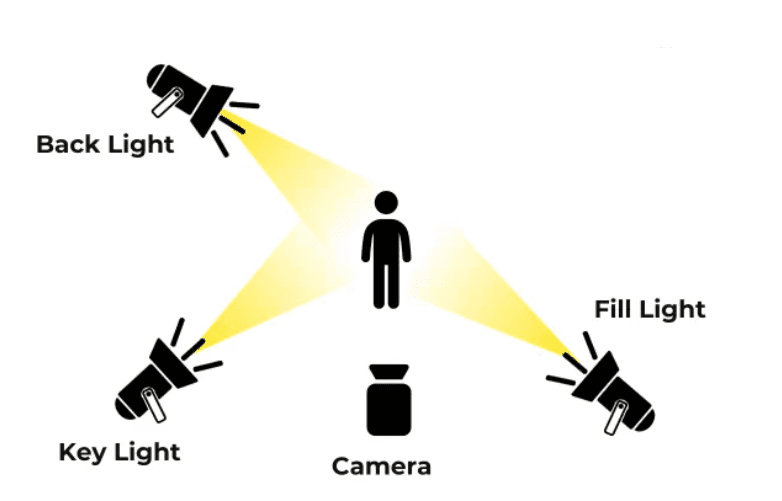
Three point lighting is a lighting method that uses three lights placed at three distinct angles around a subject:
- Key light — the main, brightest source, usually at 30–45° to one side of the camera
- Fill light — a softer, dimmer source on the opposite side of the key, softening the shadows
- Back light — a rim or hair light placed behind the subject, separating them from the background
It’s not a rule. It’s a starting point. Once you understand the geometry, you can break it (and you should). But every cinematographer, product photographer, and streamer you’ve ever admired started by learning this triangle.
If you’ve ever wondered what is the purpose of three point lighting in plain language: the purpose is control — control of shadow, control of separation, control of mood. The three points give you three independent levers instead of one big bright room.
The Three Points Explained
Key Light: The Storyteller
The key light is the strongest, often the most directional. It defines the mood: hard side-light feels dramatic, soft front-light feels friendly, overhead feels godlike. Position it 30–45° off-axis from the camera and slightly above eye level (about 30–45° up) to mimic the angle of natural sunlight.
For most home setups, a single 200W bi-color COB wie die GVM PRO SD200B hits the sweet spot. At 45,400 lux @ 1m with 2700K–6800K bi-color, it has enough output to overpower daylight through a window, and enough range to match tungsten room lamps at the warm end.
Fill Light: The Shadow Tamer
Fill is simply a dimmer version of the key, placed on the other side. The job is to lift the shadows so they’re visible but still shaped. Two practical approaches:
- Hard fill — same fixture, just dimmed to 25–50% of key output
- Soft fill — a panel, bounced card, or softbox on the other side
Die lighting ratio (key:fill) is the soul of the look. A 4:1 ratio feels cinematic; 2:1 feels like a friendly interview; 1:1 is flat and beauty-style. We covered ratios in detail in our lighting ratio guide.
Back Light: The Separator
Back light (also called rim or hair light) goes behind the subject, usually above and slightly to one side. It creates a bright edge along the subject’s shoulders and hair, separating them from the background.
Back light is where cheap rigs often cut corners. You don’t need power — you need precision and control. A small focusable 100W fixture like the GVM PRO PF100B at 20–30% output works beautifully here.
Best Three-Point Lighting Setup (Our Recommendation)
If you want a kit that just works out of the box, this is the setup we recommend at GVM, built around the PRO SD200B:
| Role | Recommended Light | Energie | Why It Works |
|---|---|---|---|
| Key | GVM PRO SD200B | 200W | Bright enough for daylit rooms, quiet enough for interviews |
| Fill | GVM PRO SD200B (2nd unit) | 200W | Match the key exactly, just dim to taste |
| Back | GVM PRO PF100B | 100W | Compact, focusable, perfect rim control |
| Total | — | 500W | Full pro coverage under $700 street price |
This is the best three point lighting setup for creators who already know they’ll shoot at least twice a week for the next year. Two PRO SD200Bs in the kit are not a luxury — they’re insurance against losing the key mid-shoot. Want the second SD200B? Shop the full PRO SD series here.
Want to see how the SD200B compares to the bigger 300W and 500W siblings? Read our GVM PRO SD series breakdown.
Three Point Lighting at Home: How to Adapt the Setup
Most home shooters don’t have a spare bedroom with 10-foot ceilings. Here’s how the same logic works in a 10×10 room.
Step 1: Pick Your Corner
Stand 4–6 feet from a wall. The wall is your background. Die opposite wall is where your camera goes. The two side walls are where your key and fill go.
Step 2: Set the Key 30–45° to One Side
In a small room, the key often ends up closer to the subject than you want (3 feet instead of 6). The fix: soften it. Either:
- Add a 24″ softbox (the GVM Quick Deploy Softbox 24″ snaps on in 30 seconds)
- Or pull the key further away by 1–2 feet and crank the brightness to compensate
Step 3: Drop the Fill, Don’t Drop It Out
In tight rooms, fill light bounces off every white wall. Use that to your advantage: one PRO SD200B at 30% on the opposite side does the work of a dedicated fill plus a bounce card.
Step 4: Back Light From the Wall
In a home setup, the back light often ends up mounted on a stand pushed against the back wall, angled down toward the subject’s shoulders. Keep it tight — the goal is separation, not a full hair glow.
Cheap Three Point Lighting: Two Real Budgets
If $700 is too much, you can build a working three point rig for much less. Here are two real configurations, picked from the GVM lineup.
Budget A — ~$200 (Content Creator Starter)
| Role | Light | Energie |
|---|---|---|
| Key | GVM PRO SD80D (or 100W equivalent) | 80–100W |
| Fill | Small LED panel | 30W |
| Back | Small LED panel | 30W |
This is the cheap three point lighting setup most YouTubers and TikTokers actually run. Output is lower, color accuracy is decent (CRI 95+), and you can light a face from chest-up in a 10×10 room without overheating. Trade-off: low output means you fight daylight. Keep this rig indoors.
Budget B — ~$400 (Hybrid Creator Upgrade)
| Role | Light | Energie |
|---|---|---|
| Key | GVM PRO SD200B | 200W |
| Fill | GVM PRO SD200B (2nd) or SD100 | 100–200W |
| Back | GVM PRO PF100B | 100W |
This is where the three point lighting at home setup becomes a real production tool. CRI 97+ on all three lights, bi-color throughout, app control via the GVM ecosystem. The whole rig fits in two backpacks.
Pro tip: Never buy three identical lights for a beginner rig. Buy one great key (SD200B) and two good fills (SD80D or panels). The eye reads the brightest light first; the other two just need to be soft and matched.
Common Three-Point Lighting Mistakes (and Fixes)
Mistake 1: Key Too High
The key should be 30–45° above eye level. Higher than that, you get raccoon eyes and lost detail in the brow. Lower than eye level, you get an “up the nose” horror shot.
Fix: Drop the key a notch on the stand, or tilt the head down slightly.
Mistake 2: Fill Too Strong
If the shadows disappear, you’ve lost the three point lighting effect — you just have a flat two-point setup. The shadows are doing work; you want to see them, just at lower contrast.
Fix: Drop fill to 25–30% of key output. Re-introduce shadow.
Mistake 3: Back Light in the Wrong Place
Back light should kiss the subject’s hair and shoulders from above and behind, not the back of their head. A back light pointed at the back of the head looks like a halo costume.
Fix: Move the back light higher and to one side. The rim should trace the edge of the subject, not face them.
Mistake 4: All Three Lights Same Distance
The three points only work if the geometry is right. Two lights 1 foot from the subject and one 6 feet away breaks the triangle.
Fix: Use a measuring tape. Key at 4–6 feet, fill at 3–4 feet, back at 4–5 feet. Adjust from there.
Power & Brightness Cheat Sheet
| Room Size | Key Light Output Needed | Recommended Fixture |
|---|---|---|
| Small home office (10×10 ft) | 30–60W continuous | SD80D or 100W panel |
| Bedroom studio (12×15 ft) | 100–200W | PRO SD200B |
| Living room / garage (15×25 ft) | 200–300W | PRO SD200B or SD300B |
| Dedicated studio (20×30+ ft) | 300W+ | PRO SD300B / SD500B |
When you double the distance from the subject, you quarter the light reaching them. This is the inverse square law in action — we explained it fully in our Inverse Square Law guide.
Why This Setup Beats Single Light Kits
Single LED panels are fine for selfies. But for anything you want to watch for more than 30 seconds, flat lighting is exhausting. The human eye is trained to read faces in three dimensions; if your lighting is one-dimensional, your viewer’s brain works harder and clicks off.
Three point lighting is the minimum complexity that gives you:
- Depth (key + fill)
- Separation (back light)
- Steuerung (each point is a separate dimmer)
- Mood (move the key, change the story)
If you remember nothing else, remember this: the triangle is the language, not the rule.
Häufig gestellte Fragen
What is the purpose of three point lighting in simple terms?
It separates the subject from the background, sculpts the face with controlled shadows, and gives you three independent dimmers to set mood. A single light makes everything look flat; a key + fill + back light creates a 3D look on a 2D screen.
What is the best three point lighting setup for a beginner?
One GVM PRO SD200B as the key, one panel or smaller COB (SD80D) as fill at 25–30%, and one PRO PF100B for the back rim. Total under $500, all bi-color, all app-controllable.
Can I do three point lighting at home without a dark room?
Yes. Three point lighting works better in bright rooms because the key has more to fight against. The trick is to flag the windows with blackout curtains and let the key + fill + back do all the work. CRI 97+ fixtures like the PRO SD200B won’t flicker when you set them below 1/1000 step.
How do I do cheap three point lighting under $200?
Use one decent key (PRO SD80D or 100W equivalent) and two small LED panels for fill and back. The result won’t be cinematic, but it will look professional on a webcam, which is the whole point of the budget tier.
Where do I put each light in a three point setup?
Key at 30–45° off-camera, slightly above eye level. Fill opposite the key, dimmer. Back light behind the subject, 45° above, kissing the hair and shoulders. The exact angles depend on face shape and mood, but the triangle is non-negotiable.
Do I need DMX for three point lighting?
No. DMX is for large sets with 10+ lights. For home and small studio, app control via Bluetooth mesh (built into the PRO SD200B, SD300B, and SD80D) is faster and simpler.
Final Verdict
Die three point lighting setup is the most useful framework in image-making. Learn the triangle, then break it on purpose. Start with a single GVM PRO SD200B as your key — everything else is filler, literally.
- Budget pick → PRO SD80D as key, two panels for fill/back → ~$200
- Best overall → Two PRO SD200B + PF100B → ~$500–700
- Studio-grade → PRO SD300B or SD500B as key → when room is large and clients are paying