A Video LED Focusing Light is quickly becoming the standard tool for creators who need one fixture to do the work of several. Instead of swapping lights or adding modifiers every time a shot changes, a focusing light lets you dial in the exact beam spread you need — from a tight dramatic spot to a wide soft flood — with a single twist. In 2026, this kind of flexibility isn’t a luxury feature anymore; it’s what separates a light that adapts to your shoot from one that forces your shoot to adapt to it.
This guide breaks down what a focusable video light actually is, how it compares to traditional fixed-beam fixtures, what to look for in a good one, and which portable option is worth putting in your kit this year.
Inhaltsverzeichnis
Focusable Video Light: Where the Technology Stands in 2026
The idea of a focusable video light has moved well past niche cinema gear. What used to require bulky Fresnel lenses and heavy housings is now packed into compact COB fixtures small enough to travel in a backpack. A modern focusable video light uses an internal optical lens — often a TIR (total internal reflection) lens — paired with a manual or motorized focus mechanism, letting the same fixture throw a narrow spotlight one moment and a broad, even flood the next.
This shift matters because it removes one of the biggest constraints in on-location shooting: not knowing exactly how much beam control you’ll need until you’re already on set. A focusable fixture adapts in seconds, which is exactly why it’s become a staple in modern professional lighting setups.
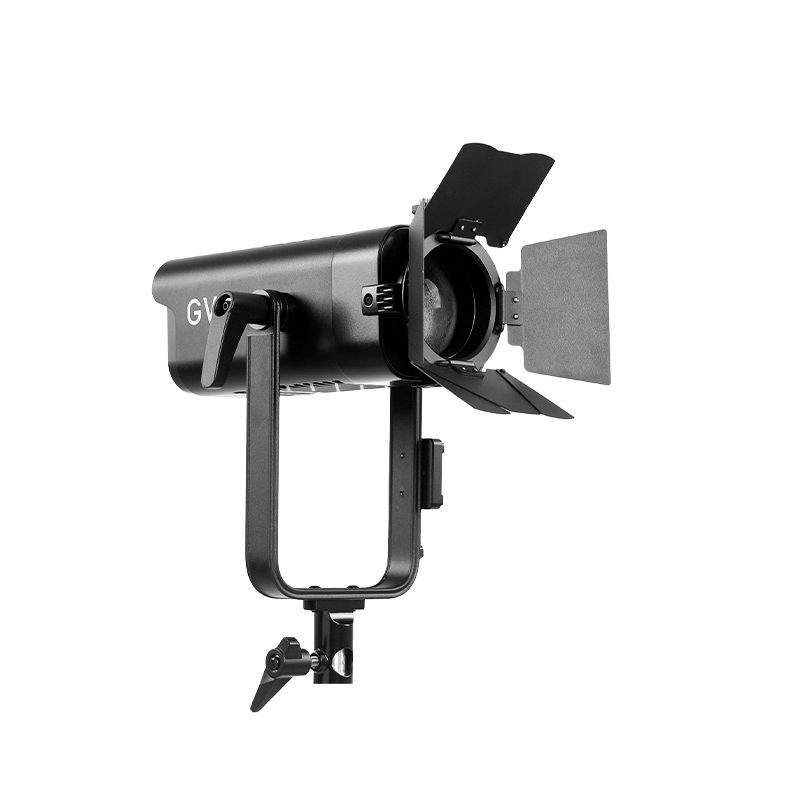
Different Types of Video Lighting
Before zooming in on focusing lights specifically, it helps to understand where they sit among other video lighting types:
- Fixed-beam panel lights — flat LED panels with a set beam angle, typically used for even fill lighting
- COB point-source lights — single-chip fixtures that produce a harder, more directional light, often paired with modifiers
- Fresnel-style lights — traditional cinema fixtures using glass lenses to adjust focus, historically large and heavy
- Ring lights — circular fixtures popular for beauty and close-up work, with limited beam shaping
- Focusable LED lights — COB or hybrid fixtures with an adjustable optical lens for spot-to-flood control in one unit
Focusable LED lights borrow the beam-shaping benefit of a Fresnel without the size or weight penalty, which is why they’ve largely taken over that role in modern kits.
Focus Lights for Photography: What’s Actually Different
Traditional lighting setups typically required a fixed-beam light paired with separate modifiers — a snoot for a narrow beam, a diffusion dome for a wide one — swapped in and out depending on the shot. That approach works, but it’s slow, and it means carrying multiple accessories just to change how hard or soft the light falls.
A focus light for photography and video solves this at the fixture level. By adjusting an internal lens rather than swapping external hardware, you can shift from a tight, punchy spotlight to a broad, even wash without touching a single accessory. The practical advantages are significant:
- Faster setup — no accessory changes between shots
- Consistent color and intensity — the light source itself doesn’t change, only the beam shape
- Lighter kit — one fixture replaces several beam-specific tools
- Creative flexibility — spot-to-flood transitions can even be used live, mid-shot, for depth-of-field-style effects
This is the core reason focusing lights have overtaken fixed-beam-only setups for creators who need to move fast between scenes or locations.
What Makes the Best Video Light
Not every focusable fixture performs the same way. When evaluating the best video light for a working kit, a few specs consistently separate the strong options from the mediocre ones:
- High CRI/TLCI (97+) for accurate, true-to-life color reproduction
- Wide, genuinely useful beam range (not just a marginal 5–10° adjustment)
- Bi-color CCT range to match ambient light without gels
- Stepless dimming with multiple dimming curves for smooth exposure control
- Quiet or silent cooling options for audio-sensitive shoots
- Tragbarkeit — compact size and dual power options (AC + battery) for on-location work
- App or wireless control for adjusting settings without touching the fixture
A light that checks all of these boxes earns its place as genuinely professional gear, not just a novelty spot-to-flood toy.
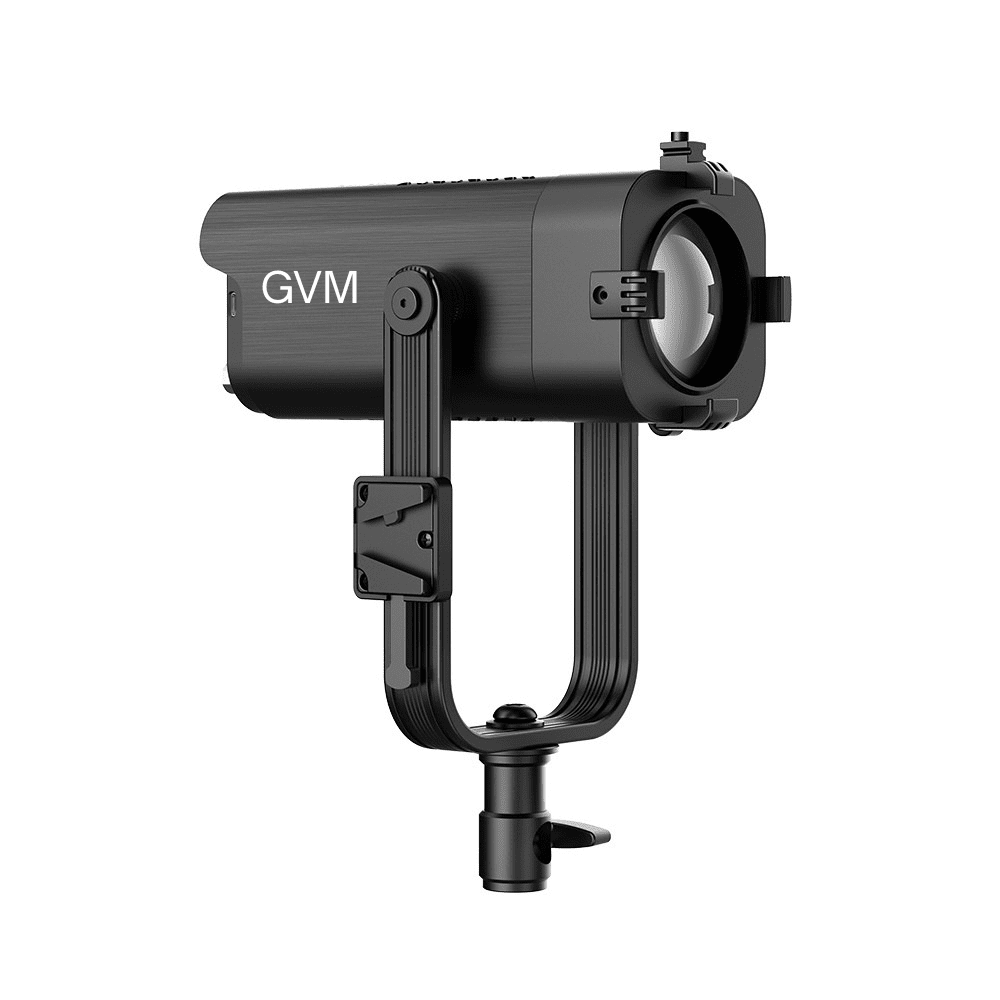
Portable Focusable LED Video Light: GVM PF100B
One fixture that checks every item on that list is the GVM PF100B, a 100W bi-color COB light built specifically around focus control and portability. It uses a custom TIR optical lens to shift smoothly between a 15° spot and a 45° flood via a simple focus knob, while maintaining a CRI and TLCI of 97+ across its full 2700K–6800K color temperature range.
What makes it particularly suited for real production work is its combination of output and control. In Spot mode, the PF100B reaches 30,200 lux at 1 meter — enough throw for mid-distance work — while still offering four dimming curves (Linear, Log, Exponential, S-Curve) for precise exposure transitions. Three lighting modes — CCT, 12-source Source Matching, and 12-effect Effects Mode — are all accessible through the GVM Mesh Bluetooth app, and the light runs on either AC power or an optional V-mount battery for fully on-location shoots.
GVM PF100B Specifications
| Merkmal | Specification / Benefit |
|---|---|
| Energie | 100W Bi-Color COB LED |
| CCT-Bereich | 2700K–6800K |
| CRI / TLCI | ≥97 / ≥97 |
| Abstrahlwinkel | 15°–45° (variable zoom focus, TIR lens) |
| Illuminance (Spot 15°) | 30,200 lux @ 1m / 11,300 lux @ 3m |
| Illuminance (Flood 45°) | 3,460 lux @ 1m / 1,330 lux @ 3m |
| Dimmen | 0–100% stepless, 0.1% steps, 4 curves |
| Lighting Modes | CCT / Source Matching (12 sources) / Effects (12 FX) |
| Cooling Modes | Intelligent / High-Speed / Silent / Passive |
| Steuerung | On-board + GVM Mesh Bluetooth App (≤50m range) |
| Berg | Mini Bowens |
| Netzteil | AC 100-240V or optional V-mount battery |
| Net Weight | 1.53 kg |
| Price | $299 USD (regular $399 USD) |
For creators who need a light that adapts from a tight interview spot to a soft flood fill without carrying separate fixtures, the PF100B’s combination of zoomable optics, high color accuracy, and dual power support makes it a strong pick for a portable focusable LED video light in 2026.
Can You Use Video Lights for Photography?
Yes — and increasingly, photographers are choosing continuous LED video lights over traditional strobes for exactly this reason: what you see is what you get. Unlike a flash, a continuous focusable light like the PF100B lets you preview your exact beam shape, color temperature, and intensity in real time before you ever press the shutter. This makes it especially useful for product photography, portraits, and hybrid photo/video content where lighting consistency across formats matters. The same spot-to-flood control that benefits filmmakers works just as well for a photographer shaping catchlights or controlling falloff on a subject.
Schlussfolgerung
A quality Video LED Focusing Light removes one of the biggest bottlenecks in modern production: constantly changing accessories to control beam shape. With true spot-to-flood optics, high color accuracy, and portable power options, a fixture like the GVM PF100B delivers the flexibility of several traditional lights in a single compact unit — for photography and video alike.
FAQ
What is a Video LED Focusing Light? It’s an LED fixture with an adjustable optical lens that lets you change the beam angle — typically from a narrow spot to a wide flood — without swapping external modifiers.
Is a focusable LED light better than a fixed-beam light? For most working creators, yes. A focusable light adapts to different shots on the fly, reducing the need to carry and swap multiple fixed-beam accessories.
Can the GVM PF100B be used outdoors? Yes. With an optional V-mount battery, the PF100B can run without AC power, making it suitable for on-location and outdoor shoots.
Do focusable video lights work for photography, not just video? Yes. Because they’re continuous light sources, focusable LED lights let photographers preview exposure and beam shape in real time, which is useful for portraits, product shots, and hybrid content.
What’s the difference between Spot and Flood mode on the PF100B? Spot mode narrows the beam to 15° for a stronger, more directional throw (up to 30,200 lux at 1m), while Flood mode widens it to 45° for softer, broader coverage.