Good video depends on more than what happens in front of the camera. A well-composed shot can still fall flat when the dialogue is buried under background noise, clipped by sudden volume changes, or lost because of a weak wireless connection.
For creators, filmmakers, interviewers, educators, and live-streamers, audio needs to be dependable without becoming another piece of equipment to constantly monitor. That is where a capable wireless microphone for video can make a noticeable difference.
Inhaltsverzeichnis
Why Wireless Audio Matters in Video Production?
A wired microphone can deliver excellent sound, but the cable becomes a limitation as soon as the subject needs to move.
Interviews are a good example. The camera may stay several feet away while the subject walks, turns, or interacts with the environment. A wireless system gives the microphone more freedom without forcing the camera operator to follow every movement.
For creators shooting outdoors, the advantage becomes even more obvious. There may be no convenient place to hide a cable, and resetting a shot because the subject moved out of range is rarely ideal.
A reliable wireless microphone for video should therefore do more than simply transmit audio. It should maintain a stable connection, preserve the recording when something goes wrong, and give the creator enough control to react before a small audio problem becomes a ruined take.
Transmission Range Is Only Part of the Equation
Long transmission distance sounds impressive on a specification sheet, but distance alone does not guarantee useful audio.
The environment matters. Walls, people, electronic devices, and other sources of interference can all affect a wireless signal. For video production, stability is usually more valuable than simply having a large theoretical range.
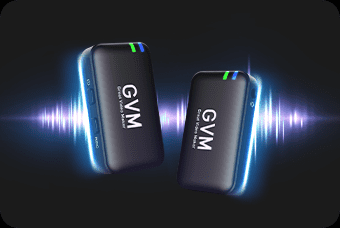
Die GVM-MIC LM2 provides wireless transmission up to 100 meters, giving creators considerably more freedom when working across larger shooting spaces or outdoors. Its 2.4 GHz digital transmission also uses an encrypted channel designed to improve stability and resistance to interference.
That extra room can change how a scene is shot. The camera does not have to stay close to the subject simply because the microphone does.
A Safety Track Can Save a Good Take
One of the less obvious problems with recording dialogue is sudden volume.
A speaker may begin quietly and then become much louder. If the main recording level is set too high, that louder moment can clip. Once the recording is distorted, there is only so much that post-production can recover.
This is where a safety track becomes useful.
Die LM2 records a second track at -6 dB alongside the main track. If the primary recording is affected by unexpected volume peaks, the lower-level track provides another version of the audio to work with.
It is a simple idea, but an important one: sometimes the best audio backup is created before the problem happens.
Onboard Recording Adds Another Layer of Security
Wireless transmission introduces another potential weak point. Even with a stable connection, a receiver can become disconnected, a signal can be interrupted, or an unexpected issue can occur during recording.
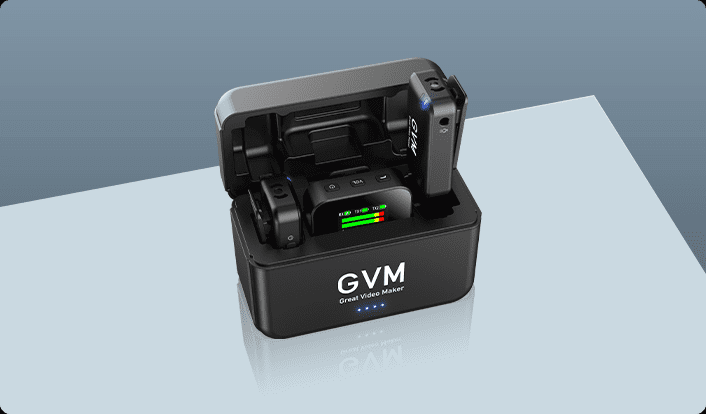
Die LM2 addresses this with onboard recording and built-in memory. The transmitter can record audio locally, so the original sound does not depend entirely on the wireless link reaching the camera.
For interviews and documentary-style work, this can be especially useful. A good conversation often cannot simply be repeated. Once the moment is gone, it is gone.
Local recording gives that moment another layer of protection.
Cleaner Speech Starts With Better Noise Control
Not every shooting environment is quiet.
Air conditioners, traffic, computer fans, room reflections, and outdoor wind can all compete with the speaker. Noise reduction can help, but aggressive processing can sometimes make voices sound unnatural.
Die LM2 combines noise reduction with low-mid frequency voice enhancement, helping bring speech forward while reducing unwanted background sound.
This is particularly useful for talking-head videos, interviews, tutorials, livestreams, and other content where the voice carries most of the information.
The goal is not to make the microphone sound processed. It is to make the words easier to hear.
Battery Life Should Not Dictate the Shooting Schedule
Long-form production has a practical problem that is easy to overlook: battery management.
A microphone that runs out of power halfway through an interview can interrupt the entire workflow. For location shoots, finding a convenient charging point may not be possible.
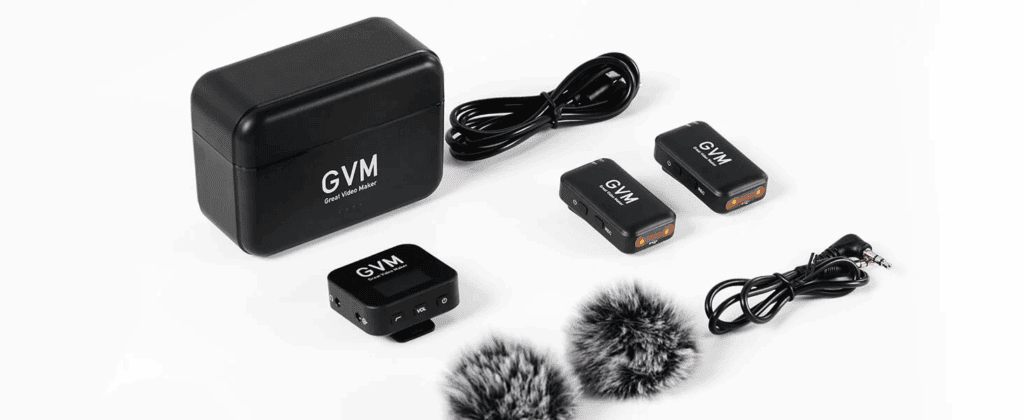
Die LM2 provides around 10 hours of battery life for the transmitter and receiver when fully charged. With its charging case, total battery life can reach up to 30 hours.
That makes it better suited to travel, interviews, livestreaming, and extended shooting days where the equipment needs to keep working in the background.
The charging case also combines storage and charging in one unit, making the system easier to carry between locations.
Designed for Real Shooting Conditions
A microphone does not exist in isolation from the rest of a production.
Die LM2 includes a built-in microphone and supports an external lavalier microphone. It also comes with a windproof cover and camera audio cable, while its 3.5mm TRS and TRRS connections allow it to work with selected cameras and smartphones. Additional adapters can be used for compatible USB-C and Lightning devices.
There is also a 3.5mm headphone output for real-time monitoring, allowing creators to listen to the recording while making adjustments. Its color display provides information such as battery status, connection status, input level, volume, noise reduction, and other settings.
These details may not appear in the final video, but they shape the experience behind the camera.
| Merkmal | GVM GT-80WD |
| Am besten für | Film, Product Shooting & Time-Lapse |
| Track Length | 80cm / 32″ |
| Load Capacity | Up to 5.5 lbs / 2.5kg |
| Material | Carbon Fiber + Aluminum Alloy |
| Motor | Ultra-Silent Stepper Motor |
| Aufnahmemodi | Manual, Auto, Auto Loop & Time-Lapse |
| Steuerungstyp | Bluetooth Remote + APP Control |
| Keyframe Control | Multiple A-B Keyframe Positions |
| Tragbarkeit | Lightweight & Portable Design |
| Stromquelle | NP-F750 Battery |
| Akkulaufzeit | Up to 10 Hours |
| Montage | 1/4″-20 & 3/8″-16 Threads |
A Wireless Microphone Should Disappear Into the Workflow
The best audio equipment is rarely the equipment you think about during every take.
You want the microphone to stay connected.
You want the recording to remain usable.
You want enough battery for the day.
And when something unexpected happens, you want a backup waiting quietly in the background.
A good wireless microphone for video should not draw attention to itself.
It should simply leave you with one less thing to worry about—and a voice that still sounds clear when the camera stops rolling.