A compact camera light used to mean one thing: a long, cylindrical monolight body with a bulky reflector bolted to the front, taking up half your gear bag before you even packed a stand. That standard shape has defined studio and on-location lighting for years, and it still works — but it was never designed with portability in mind.
The newer generation of COB monolights flips that layout entirely. Instead of a long tube, brands like GVM are now building flathead, panel-style monolights that pack the same output into a slim, disc-like housing. For creators who move between locations, shoot solo, or simply don’t have room for oversized cases, this shift in form factor matters as much as the raw lumen count on the spec sheet.
Inhaltsverzeichnis
Why Shape Changed the Compact Camera Light Category
The traditional monolight body exists because early COB LED chips needed deep housings for heat dissipation and ballast components. As thermal management and driver electronics shrank, manufacturers realized the long barrel was no longer structurally necessary — it was just legacy design.
A flathead panel-style light redistributes the same components across a wider, flatter footprint, which:
- Lowers the center of gravity on a stand, reducing tip-over risk
- Reduces the light’s swing radius, making it safer in tight spaces
- Fits into a backpack or rolling case noticeably easier than a long-body unit
For run-and-gun shooters, wedding photographers, and small studio owners who reset their setup multiple times a day, that packing efficiency often outweighs a few hundred extra lux on paper.
What to Look for Before Buying
Not every compact light labeled “portable” earns the term. A few specs separate genuinely field-ready units from ones that are compact only in marketing copy:
| Merkmal | Warum es wichtig ist |
|---|---|
| Adjustable color temperature (2700K–6800K) | One fixture covers both warm interviews and cool exterior fill without swapping gels |
| Stepless dimming (0–100%) | No visible stepping or flicker on camera, especially at slower shutter speeds |
| Standard Bowens mount | Keeps your existing softboxes, reflectors, and grids usable — no proprietary lock-in |
| App and wireless control (Mesh Bluetooth) | Multi-light setups can be dimmed and color-matched from one phone; critical as your kit grows |
| Active cooling with quiet operation | Non-negotiable for on-camera audio, particularly when the light sits close to a boom mic |
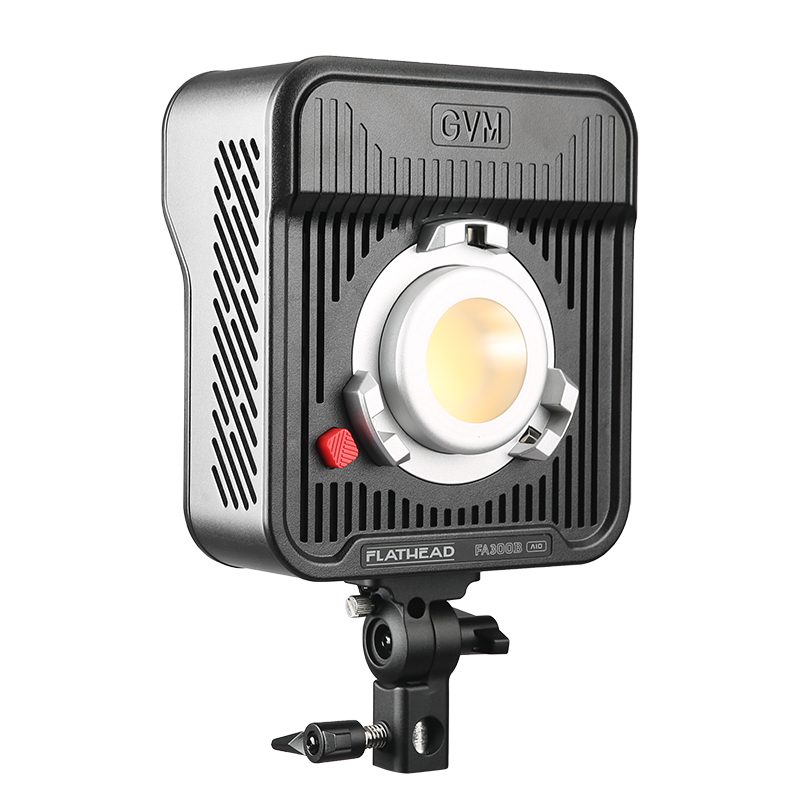
Featured Pick: GVM FA300B AIO
The FA300B AIO is a reference point for where the compact camera light category is heading. It trades the old cylindrical body for a slim, all-in-one flathead housing that still reaches 71,400 lux at 1 meter with the optional reflector — output that used to require a full-size monolight.
| Merkmal | Specification / Benefit |
|---|---|
| Produkttyp | Bi-Color LED Monolight, All-in-One Panel Design |
| Farbtemperatur | 2700K–6800K, adjustable |
| Helligkeit | 0–1001 TP3T stufenloses Dimmen |
| Beleuchtungsstärke | 71,400 Lux @ 1m with reflector (optional) |
| Lichteffekte | 12 built-in simulation effects |
| Preset Light Sources | 12 modes for common environments |
| Wireless Control | Mesh Bluetooth, app-based |
| Berg | Standard Bowens mount |
| Kühlung | Active, quiet-operation cooling system |
| Abmessungen | Approx. 7.76 × 4.8 × 3.82 in |
| Price | $299.00 USD |
Practical Advantages Beyond the Spec Sheet
- Center-axis balance — The flat housing sits closer to the stand’s center axis, so it doesn’t tip or drift under a heavy softbox the way a long-body monolight can.
- No separate ballast box — The integrated power supply removes the external driver unit that many bi-color monolights still require. One less cable, one less thing to lose between shoots.
- Backpack-friendly footprint — At under 8 inches across, it slides into compartments where a traditional monolight simply won’t fit.
How It Compares to Other Compact Options
Buyers researching this category typically cross-shop against Nanlite, Godox, Aputure, Neewer, and Nanlux. A few consistent patterns show up across that comparison set:
| Faktor | GVM FA300B AIO Advantage |
|---|---|
| Price-to-output ratio | Other brands hit similar CCT ranges but ask a noticeable premium for comparable lux — especially once you add mount adapters or proprietary softboxes |
| App ecosystem | Competitors often restrict multi-light grouping to their own accessory line; standard Bowens keeps modifier choice open |
| Cooling trade-offs | Some slim designs cut fan size to save space, introducing audible noise at higher brightness. The FA300B AIO stays quiet at full output |
| Bundled accessories | What ships in the box vs. what’s sold separately changes real-world setup cost on day one |
Weighed across output, mount compatibility, and price, the FA300B AIO lands at the lower end of the cost curve for its lux class — matching or exceeding pricier alternatives without the accessory premium.
Where This Leaves the Decision
If portability and output both matter — and for most working creators, they do — a flathead COB monolight in the FA300B AIO’s range delivers the closest thing to a true one-light kit that still performs like a studio fixture. The combination of high lux-per-dollar, open mount compatibility, and a genuinely compact housing makes GVM the most cost-effective entry point into this design category right now.
Ready to simplify your kit? A single FA300B AIO can realistically replace a two-light setup for interviews, product shoots, and small studio work — start by checking your existing modifiers against its Bowens mount, and build outward from there.

FAQ
1. What makes a compact camera light different from a standard monolight?
A compact camera light redistributes the same LED and driver components into a slimmer, flatter housing instead of the long cylindrical body older monolights use. The GVM FA300B AIO is a prime example: it keeps studio-level output (around 71,400 lux at 1 meter) while fitting into a footprint small enough for location work — without sacrificing Bowens mount compatibility or output quality.
2. Is the GVM FA300B AIO bright enough to replace a full-size studio light?
Yes. With the optional reflector attached, the FA300B AIO reaches 71,400 lux at 1 meter, which matches or exceeds many larger non-compact monolights. Combined with a 2700K–6800K adjustable range and 0–100% stepless dimming, it covers most interview, product, and small studio setups as a single key light — no second fixture needed for typical scenarios.
3. Does a compact camera light like the GVM FA300B AIO work with existing softboxes and modifiers?
Yes, as long as the modifier uses a Bowens mount. The FA300B AIO ships with standard Bowens compatibility, so softboxes, reflectors, and grids already in your kit carry over without needing a proprietary adapter. This keeps your real-world upgrade cost low.
4. How does the flathead “pancake” design affect light quality compared to traditional tube-style monolights?
The shape change is purely structural — it doesn’t compromise optical performance. The COB chip and reflector depth remain the same, so beam angles and light falloff are identical. The real benefit is physical: lower center of gravity reduces stand tip-over risk, and the slim profile fits in tighter spaces (car interiors, small rooms) where a cylindrical body simply won’t go.
5. Can the FA300B AIO be used for professional video work, or is it strictly for photography?
It handles both. The 0–100% stepless dimming eliminates flicker at any shutter speed, and the active quiet cooling means the fan won’t interfere with on-camera audio — critical for interviews and narrative work. The 12 built-in lighting effects and 12 preset source modes also make it a versatile tool for run-and-gun video production.