Choosing the right photography studio lighting comes down to a handful of practical questions: how much light do you actually get, how fast can you set it up, and what does it cost to build a kit around it.
Two fixtures come up constantly in that conversation — the Aputure LS 600d, a long-running favorite among cinematographers, and the GVM SD500B AIO, a newer all-in-one monolight built to eliminate the extra hardware that daylight fixtures usually require. This guide puts them side by side across build quality, output, controls, and value, drawing on both official specifications and independent hands-on testing.
Inhaltsverzeichnis
Why the “All-In-One” Design Matters
Traditional COB monolights like the Aputure 600d separate the lamp head from a control box, connected by a head cable. That design has real advantages — it keeps the head lighter and lets the control box sit at ground level — but it also means more cable to manage, an extra unit to mount or set on a stand base, and more points of failure on location.
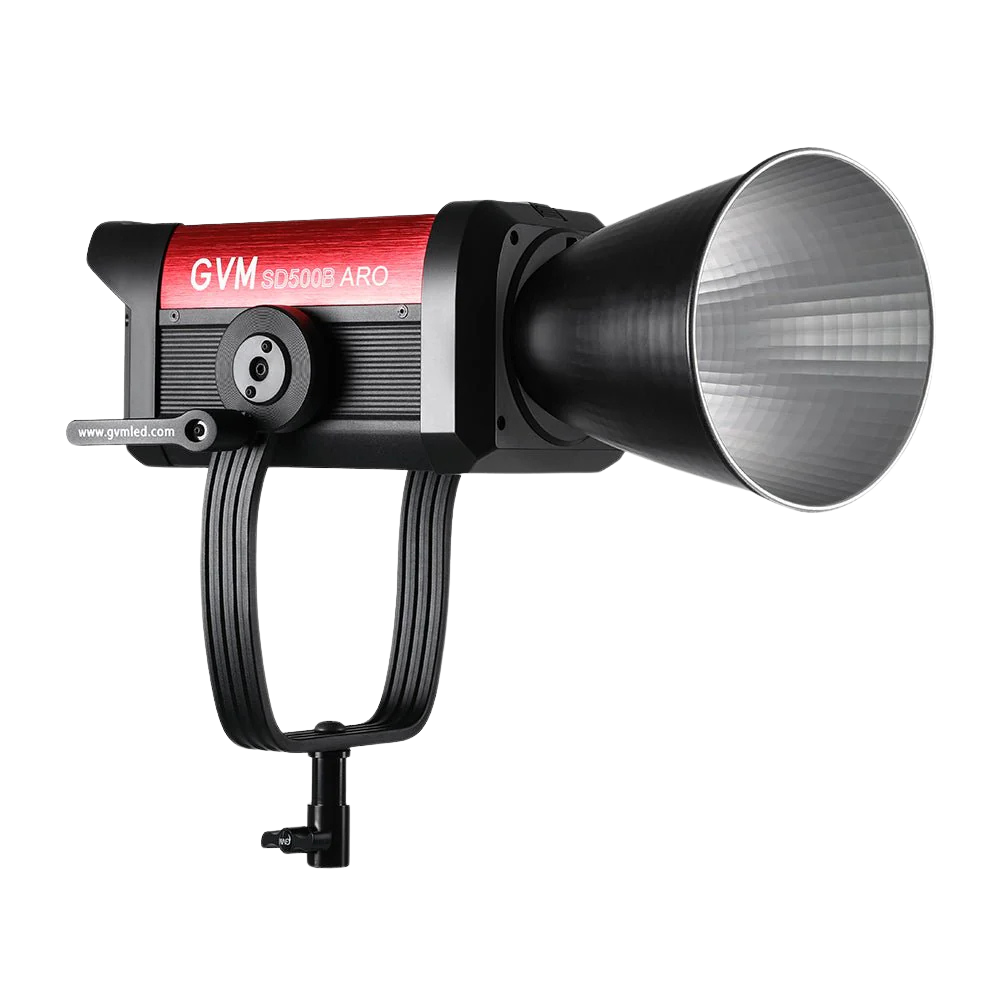
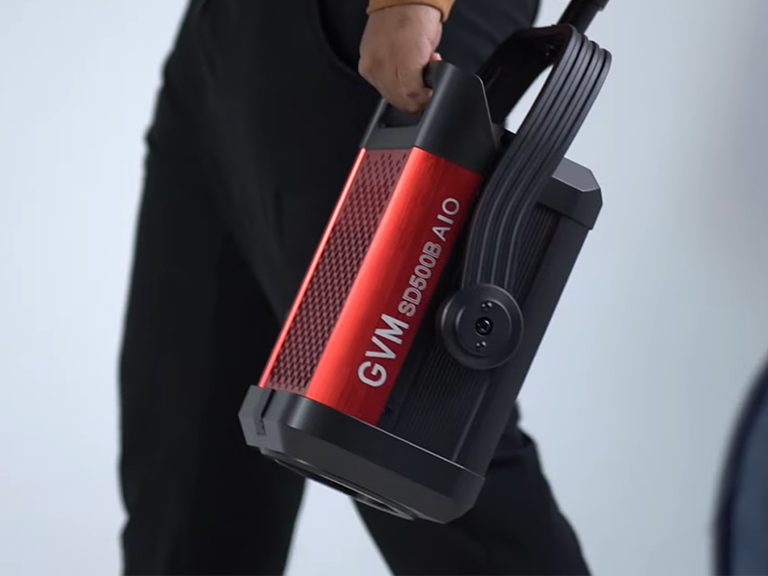
The GVM SD500B AIO folds the ballast, dimmer, and control electronics directly into the lamp head. There’s a single power cable in, and nothing else to hang off the stand. For studio photographers who move lights between setups several times a day, that difference in rigging time adds up fast — and it’s exactly the kind of practical detail that separates good photography studio lighting from gear that just looks good on a spec sheet.
Build, Mount, and Control Layout
Both lights use a metal chassis with a Bowens-style mount, so softboxes, fresnel lenses, and modifiers are largely interchangeable between the two ecosystems — a key consideration when you’re building out photography studio lighting around accessories you may already own.
- Aputure LS 600d: Curved handbrake-locking yoke with 360° rotation, dual junior/baby pin, and a separate control box with 2.4GHz remote, Sidus Link app support, and 5-pin DMX in/out.
- GVM SD500B AIO: All controls sit on a single rear knob offering 0.1% brightness steps and 50K color-temperature increments, plus the GVM Link app for remote adjustment and access to on-board Scene FX effects.
One practical trade-off worth noting: because the SD500B AIO has no separate control box, it also has no V-mount battery plate — it’s AC-only. The Aputure 600d, by contrast, can run on dual V-mount batteries or a 48V external power station, which matters for location shoots without reliable mains power.
Color Temperature and Rendering
This is where the two fixtures diverge most. The Aputure LS 600d is a fixed 5600K daylight source — accurate and consistent, but it needs gels or a fresnel swap to shift color. The GVM SD500B AIO is bi-color, tunable from 2700K to 6800K with a CRI/TLCI rating of 97+, so warm tungsten-style looks and cool daylight looks come from the same fixture without any additional gear.
For photographers who shoot a mix of warm product lifestyle images and clean daylight-balanced catalog shots in the same session, that flexibility removes a step that would otherwise mean swapping accessories mid-shoot.
Output Comparison
Output is usually the deciding factor in any photography studio lighting purchase, so it’s worth looking closely at how these two fixtures actually measure up. Manufacturer figures and independent field tests don’t always align exactly, since testing distance, reflector type, and light meter calibration all affect the reading. Here’s both sets of numbers for transparency.
Manufacturer-rated output at 1m with standard reflector:
| Fixture | Power Draw | Rated Output (1m, reflector) | Color Temp |
|---|---|---|---|
| GVM SD500B AIO | 500W | 227,040 lux | 2700K–6800K |
| Aputure LS 600d | 600W (max 720W draw) | 98,500 lux (at 3.3ft/1m) | 5600K fixed |
Independent reviewer testing at 1m (bare bulb vs included reflector):
| Fixture | Bare Bulb | With Included Reflector |
|---|---|---|
| GVM SD500B AIO | 29,200 lux | 197,800 lux |
| Aputure LS 600d | 27,200 lux | — |
Even accounting for the gap between the manufacturer spec and the reviewer’s field measurement, the pattern holds across both sources: the SD500B AIO produces more usable light output than the 600d while drawing less power, largely because its stock reflector is larger and more tightly focused than the 600d’s Hyper Reflector.
GVM SD500B AIO — Full Product Specifications
| Merkmal | Specification / Benefit |
|---|---|
| Energie | 500W integrated bi-color LED |
| Farbtemperatur | 2700K–6800K, CRI/TLCI ≥97 |
| Output | Up to 227,040 lux at 1m with standard reflector |
| Dimmen | 0.1% increments, 1,000 steps, flicker-free |
| Lichteffekte | 12 built-in Scene FX (Lightning, Paparazzi, TV, Candle, Explosion, SOS, and more) |
| Steuerung | Rear knob + GVM Link Bluetooth app |
| Berg | Bowens-Mount |
| Power Input | AC only |
| Kompatibles Zubehör | DL85R 33″ Lantern Softbox, F60 Fresnel (supports up to 650W), FZ60 Barndoors, Quick Deploy 35″ Softbox |
| Approx. Price | ~$499 |
Pros and Cons
GVM SD500B AIO
- Fastest setup of the two — one cable, no control box
- Higher measured output despite lower wattage
- Bi-color range removes the need for gels
- 0.1% dimming precision for fine exposure control
- No V-mount battery support (AC-only)
- No carrying case included
Aputure LS 600d
- Established ecosystem with wide accessory support (Light Storm line)
- Battery-powered operation via V-mount or external power station
- DMX512 in/out for integration into larger lighting rigs
- Daylight-only (5600K fixed), no bi-color flexibility
- Currently discontinued and largely unavailable at retail (~$872 when found used)
Which One Fits Your Studio?
Picking between these two really comes down to how and where you shoot. If your work happens primarily in a fixed studio space — product photography, portraiture, or commercial video where speed of setup and color flexibility matter more than battery independence — the GVM SD500B AIO covers more ground for less money, and it’s currently in production and readily available. That makes it a strong default choice for anyone building out photography studio lighting from scratch. If your workflow depends on running lights off-grid or you’re already invested in Aputure’s Sidus Link and DMX ecosystem, the 600d’s battery support and remote-control depth are worth the higher price, availability issues aside.
Real-World Use Case: Fast Turnaround on a Multi-Product Shoot
A commercial product photographer working out of a small studio recently switched to the GVM SD500B AIO for a same-day catalog shoot involving over 40 individual products. With a traditional control-box setup, each light change between angles meant repositioning both the head and its separate ballast, then re-routing the head cable — a few extra minutes per setup that added up fast across dozens of product changes.
Because the SD500B AIO has no control box to manage, the photographer was able to move the light between stands, swap softbox and reflector configurations, and adjust color temperature from warm to neutral for different product categories without breaking shooting flow. What normally would have eaten into the schedule as rigging downtime instead stayed shooting time — the entire catalog was completed in a single session that had originally been budgeted for two days.
That’s the practical case for this kind of all-in-one photography studio lighting: on a tight deadline, the light that saves you setup time is often more valuable than the light with the deepest feature set. For studios that turn over shots quickly, that time savings alone can be the deciding factor.
Is the GVM SD500B AIO compatible with Aputure or other Bowens-mount accessories?
Yes. Both fixtures use a Bowens-style mount, so softboxes, fresnel attachments, and grids are largely cross-compatible.
Can the GVM SD500B AIO run on battery power?
No. Because its control electronics are built into the lamp head rather than a separate box, it is AC-powered only.
Why does the GVM SD500B AIO output more lux than a 600W fixture?
Independent testing and manufacturer specs both attribute this to a larger, more tightly focused stock reflector paired with efficient LED design, rather than raw wattage alone.
Schlussfolgerung
For photographers and videographers weighing photography studio lighting options in 2026, the comparison comes down to setup speed and color flexibility versus battery independence and ecosystem maturity. The GVM SD500B AIO delivers higher measured output, bi-color range, and a genuinely faster rig-up at roughly half the price — making it the stronger pick for most studio-based shooters. Browse the GVM SD500B AIO and its compatible softbox and fresnel accessories to build out a complete lighting kit for your next shoot.