A static camera can tell a story. A moving camera can change how that story feels.From product videos and interviews to cinematic establishing shots, controlled camera movement adds depth, reveals details, and creates a stronger sense of space. One of the most practical tools for achieving this is a camera dolly.
Unlike handheld movement, which naturally introduces small variations, a dolly creates a repeatable path for the camera. The result is not simply smoother footage. It is movement that can be planned, repeated, and matched to the rhythm of a scene.So, what should you look for when choosing a camera dolly? And how can motorized movement improve the shooting process?
Here are several practical points worth considering.
What Makes a Camera Dolly Useful?
The basic idea is simple: the camera travels along a controlled path while the subject remains framed within the shot.
But the difference between a basic slider and a more capable motorized system becomes obvious when the camera needs to move repeatedly or for long periods.
A good camera dolly should keep movement smooth and shooting simple. Look for quiet operation, adjustable speed and direction, and repeatable motion for multiple takes. Automated movement and time-lapse support are also useful when the camera needs to work on its own.
For example, a slow lateral movement can gradually reveal a product. A continuous back-and-forth motion can create a looping shot. During a time-lapse, even a small amount of controlled camera movement can turn a static sequence into something much more dynamic.
1. Why Quiet Motorized Movement Matters
Sound is often overlooked when planning camera movement.
A slider may look smooth from behind the camera, but if the motor produces noticeable mechanical noise, it can become a problem for interviews, dialogue scenes, or production environments where the camera microphone is active.
A silent motorized camera dolly addresses this issue by keeping movement controlled without adding unnecessary mechanical noise to the recording environment.
This also changes the way a creator can work. Instead of manually pushing the camera and trying to maintain a constant speed, the motor takes over the movement. The operator can concentrate on framing, lighting, focus, and the subject.
That small change can make a long shooting session considerably easier.
2. Lightweight Construction Makes Location Shooting Easier
Camera movement does not always happen inside a studio.
A product shoot may move between rooms. A documentary setup may require outdoor locations. Even a small commercial production can involve several changes in position throughout the day.
This is where construction becomes important.
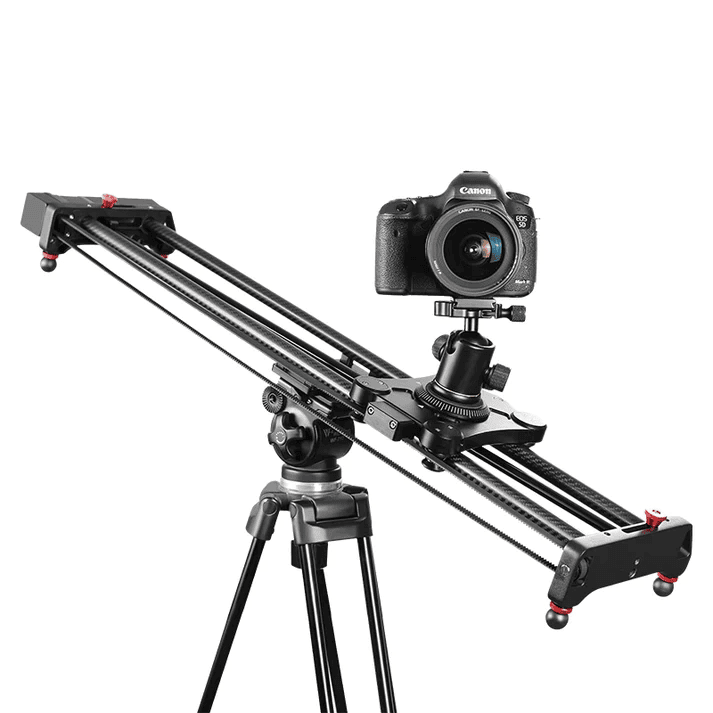
Die GVM GR-80QD uses a lightweight carbon-fiber design while maintaining the structure needed for motorized camera movement. Its 32-inch platform provides a practical travel length for controlled horizontal shots without turning the setup into an unnecessarily large piece of equipment.
For creators who regularly work between locations, reducing equipment weight is more than a convenience. It means fewer compromises when deciding where a shot can be made.
3. Automatic Movement Creates More Consistent Shots
Manual movement can look natural, but consistency is difficult.
Try pushing a camera at exactly the same speed twice. The difference may only be subtle, but it can become obvious when two takes need to be edited together.
Motorized movement solves part of this problem.
Die GVM GR-80QD supports automatic movement modes, including continuous round-trip operation and fixed-point stops. This allows the camera to follow a defined path instead of relying entirely on the operator’s hand movement.
That makes it useful for repeatable product shots, demonstrations, interviews, and scenes where the same movement needs to be captured more than once.
The camera follows the path. The creator can focus on everything else.
5. Camera Movement and Time-Lapse
Time-lapse photography is another area where a motorized camera dolly can make a significant difference.
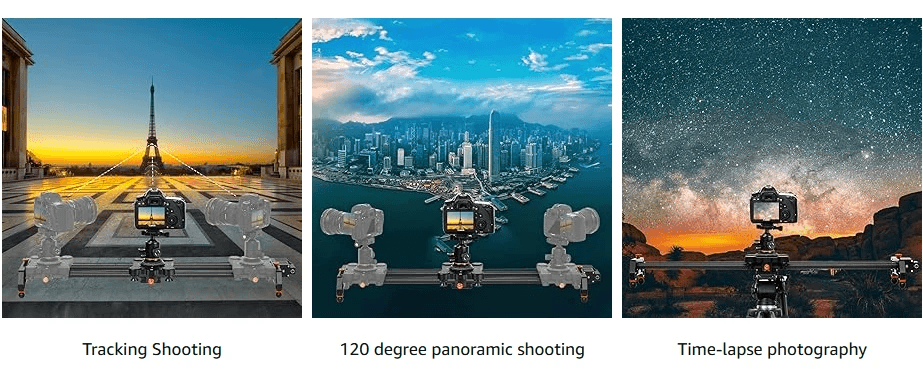
A locked-off time-lapse records the passage of time from a fixed viewpoint. Add controlled camera movement, and the scene begins to unfold spatially as well as temporally.
Imagine a city changing from afternoon to night while the camera slowly travels across the scene. Or a product being assembled while the camera gradually shifts position.
These movements are difficult to reproduce manually over a long shooting period.
Die GVM GR-80QD includes intelligent time-lapse functions through its app-based control system. Parameters can be customized for automated shooting, with support for long-duration operation of up to 24 hours offline.
This makes the system useful not only for conventional video, but also for sequences where the camera needs to keep moving while the scene changes over time.
| Merkmal | GVM GR-80QD |
| Am besten für | Film, Product Shooting & Time-Lapse |
| Track Length | 80cm / 32″ |
| Load Capacity | 11 lbs / 5kg Horizontal |
| Material | 8-lagige Kohlefaser |
| Motor | Ultra-Silent Stepper Motor |
| Aufnahmemodi | Auto, Tracking & Time-Lapse |
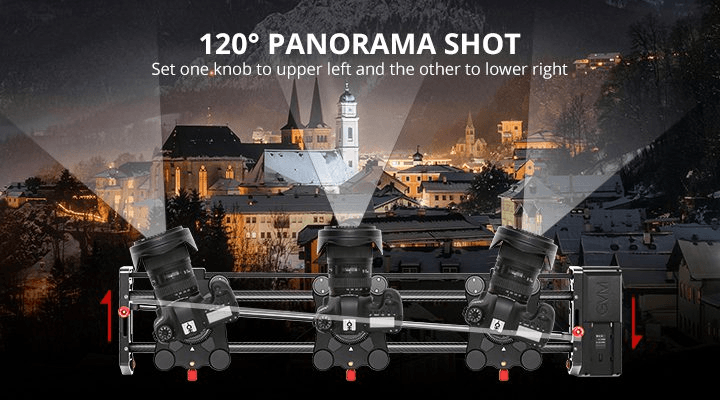
| Panorama | Up to 120° Panoramic Movement |
| Steuerungstyp | Wired Controller + APP Control |
| Stromquelle | 4400mAh NP-F Battery |
| Akkulaufzeit | Up to 5–8 Hours |
| Montage | 1/4″-20 & 3/8″-16 Threads |
Choosing the Right Movement for the Scene
Before using a camera dolly, it is worth asking a simple question:
What should the camera movement communicate?
If the goal is to reveal a product, a slow linear movement may be enough. If the scene needs a sense of scale, a wider panoramic movement may work better. For time-lapse, the movement should remain subtle enough that the passage of time remains the focus.
More movement does not automatically mean better footage.
Good camera movement usually has a reason. It reveals something, changes perspective, creates rhythm, or quietly guides the viewer’s attention.
That is why a motorized dolly can be more than a support accessory. It becomes part of the visual design.
Schlussfolgerung
A camera dolly gives filmmakers another way to control how the viewer experiences a scene.
With stable movement, quiet motorization, lightweight construction, automatic motion, multiple cinematic movement options, and time-lapse capability, the GVM GR-80QD is designed to make controlled camera movement more practical for both studio and location production.
The best movement is rarely the most complicated one. Sometimes it is a slow, almost invisible shift that changes the entire feeling of a frame.
The camera moves.
The scene stays honest.
And somewhere between the two, the story becomes a little more cinematic.