Choosing a lighting fixture for video production involves more than comparing wattage or brightness. The right light needs enough output for the scene, accurate color reproduction, reliable dimming, and a control system that fits the way a production team works.
For smaller studios, a compact LED light may be enough for interviews or tabletop videos. Larger sets, commercial shoots, and scenes that require light to travel across a greater distance demand more output and greater flexibility.
A high power LED video light can provide that extra headroom. It allows filmmakers to shape light with modifiers, balance ambient daylight, and maintain useful brightness when working with diffusion. The key is understanding how to use that power rather than treating brightness as the only measure of performance.
Inhaltsverzeichnis
Why Does High-Power Lighting Matter in Video Production?
Lighting conditions change from one production to another. A product shoot may require a broad, soft source, while a commercial scene might need a concentrated beam that reaches a subject from several feet away. In both situations, the available output affects how much control the filmmaker has.
A powerful fixture offers more room to work. You can soften the source with a large softbox, bounce it off a reflector, or place diffusion between the light and the subject. Each technique reduces the intensity reaching the subject, so having additional output can make the setup easier to manage.
This becomes particularly useful when filming in daylight. Instead of relying entirely on the available light, a high-output fixture can help balance a subject against a bright window or maintain consistent illumination as the scene changes.
Power alone, however, does not guarantee better footage. Light quality, color accuracy, beam control, and the ability to adjust output all contribute to the final image.
What Is a High Power LED Video Light?
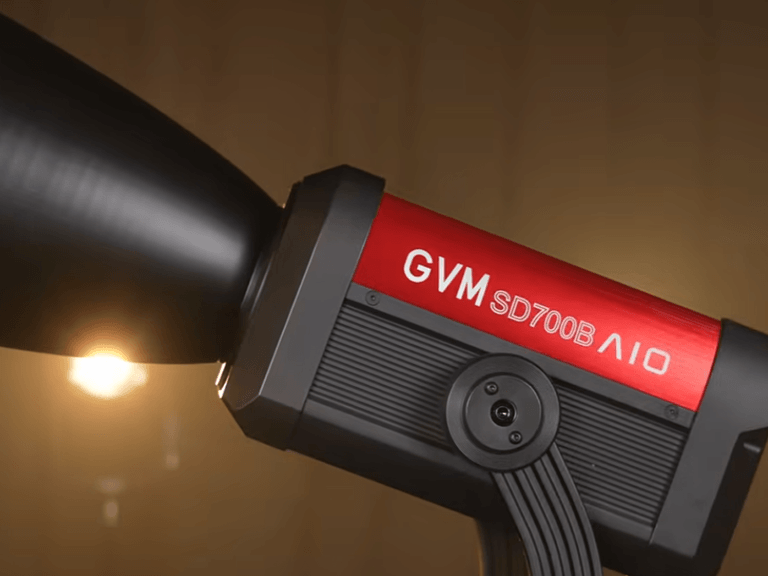
A high power LED video light is a continuous lighting fixture designed to deliver substantial illumination for filmmaking, commercial video, interviews, and studio production.
Many professional fixtures use COB (Chip-on-Board) LED technology. By concentrating the light source into a compact area, COB fixtures can produce a strong beam that works well with reflectors, softboxes, Fresnel attachments, and other modifiers.
LED technology also gives filmmakers direct control over brightness and, with bi-color fixtures, color temperature. Unlike traditional tungsten lights, LEDs generally produce less heat for a comparable lighting task and consume less power than many older lighting systems.
It is important to distinguish electrical power from actual light output. Wattage describes the fixture’s power consumption, while lux measures the illuminance reaching a surface at a particular distance. Reflectors, beam angles, diffusion, and measurement conditions all affect the result. When comparing lights, look at both the rated wattage and the manufacturer’s photometric data.
What Should You Look for in a High Power LED Video Light?
Before choosing a fixture, consider how it will perform during an actual shoot. Three factors deserve particular attention.
Light Output and Practical Flexibility
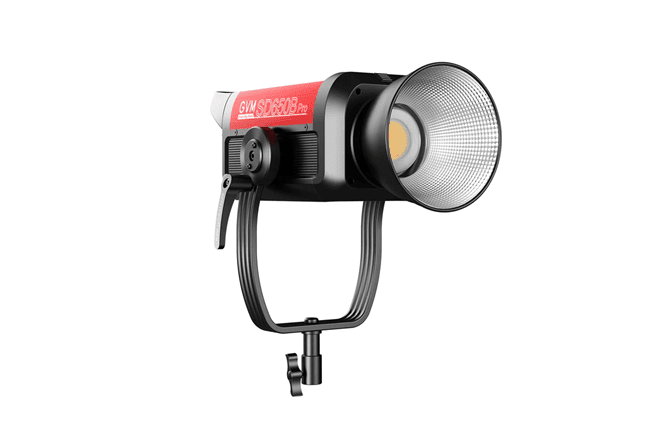
Brightness determines how much flexibility you have when positioning and modifying a light.
A high-output fixture can be placed farther from the subject, used with larger modifiers, or bounced off a surface without losing as much usable illumination. This is valuable in commercial studios, interview setups, and film productions where the light source cannot always sit close to the subject.
Still, the goal is not to use maximum brightness at all times. Extra output gives you options; the lighting arrangement determines how effectively you use them.
Color Temperature and Color Accuracy
Color temperature influences whether a scene appears warm, neutral, or cool. A bi-color light allows you to adjust the balance between warm tungsten-like tones and cooler daylight tones without relying entirely on color gels.
A broad adjustment range is useful when mixing artificial lighting with window light or practical lamps.
Color accuracy matters just as much. High CRI and TLCI ratings indicate strong color-rendering performance, although they do not describe every aspect of color quality. For interviews, product videos, and commercial work, accurate skin tones and product colors help reduce unwanted corrections in post-production.
Dimming and Control Options
Professional lighting rarely stays at one brightness throughout a shoot. Small adjustments can change the mood of an interview, balance a fill light, or prevent highlights from becoming too bright.
Stepless dimming makes these adjustments smoother than relying on a limited number of preset levels. Multiple control options are also useful: onboard controls work well for a single fixture, while app-based or compatible professional data connections can simplify operation when lights are positioned overhead or spread across a larger set.
A practical lighting system should make adjustments straightforward, not introduce extra work between takes.
1. Best High Power LED Video Light for Professional Studio Work
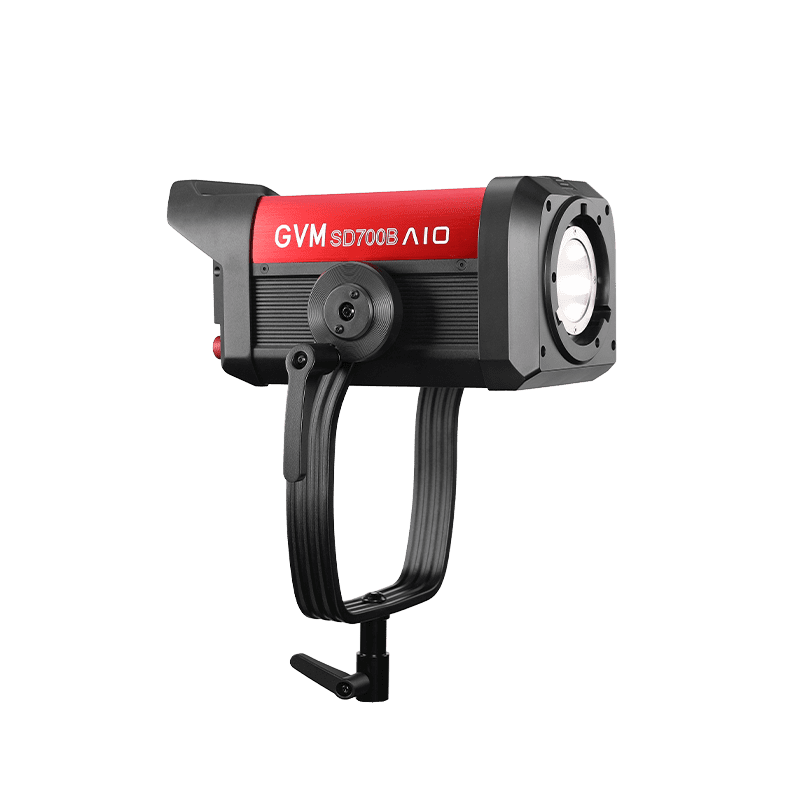
For productions that need substantial output without a complicated equipment arrangement, the GVM SD700B AIO combines a 700W bi-color LED system with an integrated design. It is suited to commercial video, interviews, product photography, and other demanding studio applications.
Rather than treating brightness as its only advantage, the fixture brings together output, simplified setup, and precise control in one unit.
700W Output for Demanding Lighting Setups
The SD700B AIO delivers 700W of rated power consumption and a published open-face output of 28,900 lux at 1 meter. Its performance gives filmmakers more flexibility when using diffusion, positioning the light farther from the subject, or balancing strong ambient light.
The bi-color system covers 2700K–6800K, so the light can be adjusted to suit a warm interior, neutral studio environment, or daylight-dominant scene.
For example, when filming an interview beside a large window, the key light may need to compete with incoming daylight. A powerful fixture gives the crew more room to position and soften the source while maintaining a useful exposure.
All-in-One Design for a Simpler Workflow
High-output lighting systems can involve a separate ballast, controller, and several connecting cables. Those components add setup steps and can make repositioning equipment more cumbersome.
The SD700B AIO integrates the controller and ballast into the light head. This reduces the number of separate components required for the fixture and makes the setup easier to organize.
The advantage becomes apparent on productions where lights need to be moved between scenes. Fewer separate units mean less equipment to position, connect, and manage. The integrated design does not eliminate the need for stands, modifiers, or a suitable power supply, but it simplifies the core lighting setup.
Precise Dimming and Flexible Control
Brightness control becomes increasingly important when a fixture is used across different types of production. The SD700B AIO supports stepless dimming from 0% to 100% in 0.1% increments, allowing fine adjustments rather than forcing the operator to work with broad brightness steps.
Its CRI and TLCI ratings are both 97+, supporting accurate color reproduction for professional video work.
The fixture also offers onboard controls, Bluetooth app control, and a data port for compatible control accessories. CCT, effects, and source-matching modes are available through the mobile app. This gives operators a direct way to make routine adjustments while providing additional flexibility for more involved setups.
Key Specifications at a Glance
| Merkmal | Specification / Benefit |
| Energie | 700W rated power consumption |
| Light Output | 28,900 lux at 1 meter, open face |
| Farbtemperatur | 2700K–6800K bi-color |
| Farbgenauigkeit | CRI 97+, TLCI 97+ |
| Dimmen | Stepless 0%–100%, in 0.1% increments |
| Gestaltung | All-in-one, integrated controller and ballast |
| Steuerung | Onboard controls, Bluetooth app, data port |
| Berg | Bowens-Mount |
| Am besten für | Commercial video, studio shoots, interviews, and product lighting |
How to Use a High-Power LED Light More Effectively
Even a powerful fixture can produce flat or harsh footage when it is poorly positioned. A few basic techniques can make a noticeable difference.
Start With the Key Light
Establish the direction of the key light before adding fill or background illumination. For interviews, placing the light slightly to one side of the subject often creates more depth than positioning it directly in front.
Observe the shadows on the face and adjust the angle until the lighting suits the subject and the tone of the scene.
Use Diffusion to Shape the Source
A bare light source can create hard shadows and strong highlights. A softbox or diffusion frame spreads the light across a larger area, producing softer transitions between light and shadow.
The trade-off is reduced intensity. This is where a high power LED video light becomes useful: the extra output helps compensate for light lost through diffusion, although the amount depends on the modifier and setup.
Match the Color Temperature to the Environment
When working indoors, check the color of practical lamps and other light sources before setting the fixture. In daylight, compare the key light with the window light falling on the subject.
Matching color temperature does not always mean using the same setting everywhere. A deliberate difference can help create depth or separate the subject from the background. What matters is that the contrast looks intentional.
Adjust Brightness After Positioning the Light
It is tempting to set brightness first and then move the fixture until the exposure looks right. A more consistent approach is to establish the light’s direction and distance, choose the appropriate modifier, and then fine-tune output.
This makes it easier to reproduce the setup for another take or a later shooting session.
Schlussfolgerung
Choosing a high power LED video light is ultimately about gaining control over the scene. Strong output provides more options when working with diffusion, greater distances, and changing ambient conditions. Accurate color and precise dimming help make those options usable in practice.
The GVM SD700B AIO brings these considerations together through its 700W bi-color output, integrated construction, and multiple control options. For filmmakers and studio teams who need a capable light without adding unnecessary complexity to the setup, it offers a practical combination of power and operational flexibility.