Lighting is often discussed in terms of brightness, but output is only one part of the equation. On a real set, a light also needs to respond quickly to changing conditions, reproduce colors accurately, and fit naturally into the way the crew works.
This becomes especially important with a professional LED video light. A fixture may look impressive on a specification sheet, yet feel cumbersome once it is surrounded by cables, control boxes, modifiers, and other equipment.
For filmmakers and photographers, the better question is not simply how powerful is the light? It is how much control does that power give you in practice?
What Should You Look for in a Professional LED Video Light?
A useful lighting fixture needs to solve several problems at the same time.
Output Is More Than Just Wattage
Higher power gives you more room to work with. It becomes easier to push light through diffusion, shape it with modifiers, or maintain exposure when the fixture needs to sit farther from the subject.
However, wattage alone does not tell you how useful a fixture will be. Beam control, color accuracy, light quality, and the ability to adjust output all affect the final image.
For larger interview setups, commercial work, narrative productions, and studio shooting, a powerful COB source provides a practical foundation. You can start with a strong source and shape it according to the scene rather than trying to make a small light do more than it was designed for.
Color Control Changes How You Work
Color temperature is another specification that deserves more attention.
A light used in a studio may need to match daylight from a window. On location, it may need to blend with tungsten practicals, LED fixtures, or existing ambient light. A wider CCT range gives you more options before you have to reach for gels or additional fixtures.
Full-color control takes this one step further. Instead of only moving between warm and cool white, RGBWW fixtures allow the lighting itself to become part of the visual design.
That can be useful for background separation, practical-looking color, mood, and subtle color accents.
A Compact System Can Save More Time Than You Expect
There is another factor that is easy to overlook: how much equipment is required before the light can actually be used.
External control boxes and additional cables are not necessarily a problem on a large production. But for smaller crews, location work, or fast-moving shoots, every extra component adds another step to setup and transport.
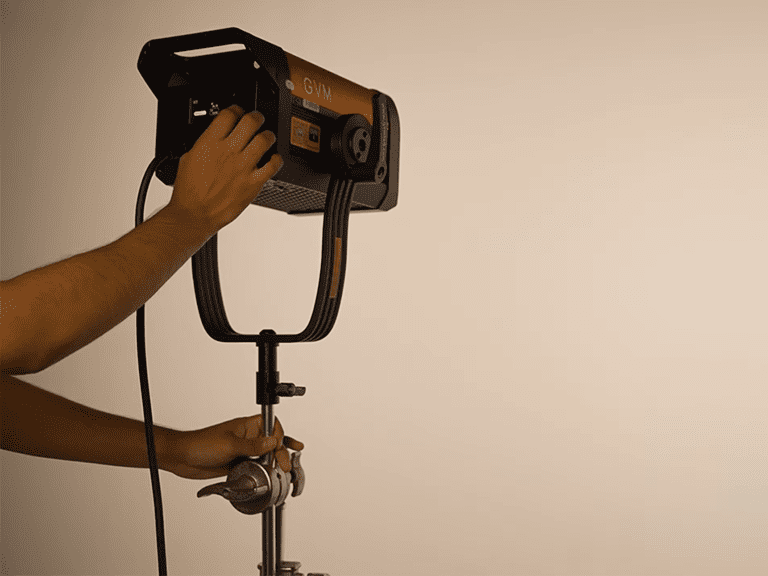
This is where an all-in-one design becomes practical. When the control system and light source are integrated into the fixture, there is less equipment to organize and fewer connections to manage.
The goal is not simply to make the light smaller. It is to make the whole lighting process easier to handle.
Why Full-Color COB Lights Are Becoming More Useful?
Traditional bi-color lights remain extremely useful for everyday lighting. They are straightforward and efficient when the main requirement is matching different white-light sources.
Full-color COB lights offer another layer of control.
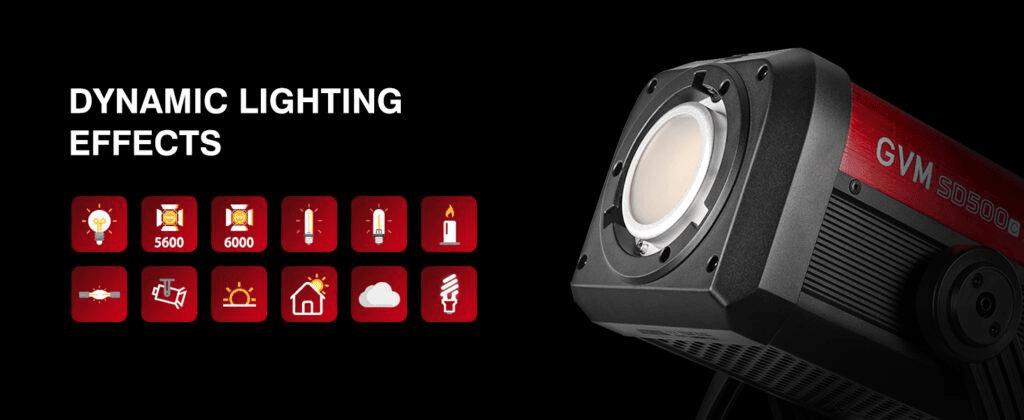
You can begin with a neutral white source for an interview, shift warmer to match an interior practical, or introduce a controlled color into the background without changing fixtures.
The important point is that RGB capability should not come at the expense of usable white light. For professional production, the fixture still needs enough output and color accuracy to handle ordinary lighting tasks.
That balance is what makes a high-power RGBWW COB fixture interesting.
GVM SD500C AIO: 500W Full-Color Output in an All-in-One Design
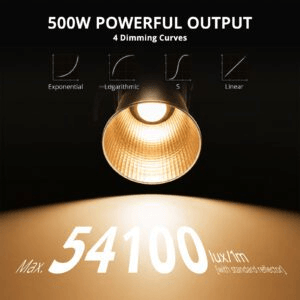
Die GVM SD500C AIO is designed around this idea. It combines a 500W RGBWW COB light source with professional color control and an integrated all-in-one body. GVM specifies CRI and TLCI ratings of 97+, along with CCT control from 2,000K to 10,000K.
Its biggest advantage is the combination of three things that are not always found together: 500W full-color RGBWW output, an exceptionally wide 2,000K–10,000K color-temperature range, and an AIO design that keeps the lighting system self-contained.
500W RGBWW Output
A 500W source gives the SD500C AIO enough output to function as more than a small accent light.
It can serve as a key source, fill source, or stronger background light depending on the modifier and shooting distance. When diffusion is introduced, having more output available also gives you additional exposure headroom.
The RGBWW design means that this power is not limited to white-light applications. HSI and RGB controls allow the light to move into creative color work while maintaining the output expected from a professional COB fixture.
2,000K–10,000K: A Wider Color Window
Die SD500C AIO covers an unusually broad 2,000K–10,000K CCT range.
At the warm end, the light can move toward the appearance of candle-like practical sources. At the other end, it reaches far beyond typical daylight settings.
This range is useful because real shooting environments rarely stay within one lighting standard. A scene may contain warm practical lamps, neutral fixtures, and cool daylight at the same time.
Instead of treating these differences as a problem, a wide CCT range gives you another way to work with them.
AIO Design: Fewer Pieces to Manage
The third advantage is less dramatic on paper, but often more noticeable on set.
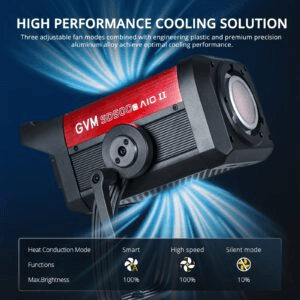
Die SD500C AIO integrates its main lighting system into one fixture, avoiding the need for a separate external control box. That makes the setup cleaner and reduces the number of components that have to travel with the light.
For a studio crew, this can mean faster setup. For a small production team, it can mean less equipment to carry between locations.
The difference may only be a few minutes during one setup. Across an entire shooting day, those small savings begin to matter.
| Produkt | GVM SD500C AIO |
| Typ | 500W RGBWW Full-Color COB LED Video Light |
| Leistung | 500W |
| Farbtemperatur | 2000K–10000K |
| Color Control | RGB / HSI / CCT / Gel |
| Farbgenauigkeit | CRI 97+ / TLCI 97+ |
| Beleuchtungsstärke | 18,400 lux @ 1m |
| Lichteffekte | 16 Lighting Effects |
| Light Source Presets | 12 Practical Light Source Presets |
| Color Gel | 60 Color Gel Options |
| Steuerung | On-Board / GVM App / Bluetooth Mesh |
| Professional Control | DMX / CRMX / Art-Net via optional data box |
| Bluetooth-Reichweite | Up to 50m |
| Dimmen | 0–100%, Stepless |
| Kühlung | Smart / High Speed / Silent |
| Netzteil | AC 100–240V |
| Gewicht | Approx. 8 kg |
| Hauptvorteil | 500W powerful output + full-color RGBWW control + ultra-wide CCT range + AIO design |
| Ideal für | Film & Video / Commercial Production / Photography / Interviews / Studio / Live Streaming |
Abschließende Gedanken
A professional LED video light should not be judged by a single specification.
Output matters, but so does the usable color range. Color control matters, but it becomes more valuable when the fixture can deliver that control without adding unnecessary complexity to the setup.
Die GVM SD500C AIO brings these ideas together with 500W RGBWW full-color output, a 2,000K–10,000K CCT range, and an integrated AIO design.
For filmmakers who want one fixture to cover more of the lighting process, that combination is worth paying attention to. Sometimes the most useful piece of equipment is not the one with the longest specification list, but the one that leaves you with fewer reasons to stop shooting.