If you’re shopping for a Dauerlicht and have ever stared at two LED spec sheets trying to figure out which one is actually brighter, you’ve probably noticed that one says lumensand the other says lux. They’re not the same number, and they’re definitely not interchangeable. Picking the wrong measurement for your photography could mean spending $500 on a light that looks bright on paper but falls short at the distance you actually shoot. Let me clear this up.
Inhaltsverzeichnis
What Is Lux and What Are Lumens?
Lumens (lm) measure the totalamount of visible light a source emits in every direction. It’s a measure of the light’s raw output, full stop. If you’re a flashlight manufacturer, lumens is your number.
Lux (lx) measures the amount of light falling on a specific surface area— specifically, lumens per square meter. So lux is what actually reaches your subject. If you’re a photographer or cinematographer choosing a Dauerlicht, lux is your number.
The relationship is simple: 1 lux = 1 lumen per square meter. The catch is that lux drops dramatically with distance, while lumens don’t.
Why Lux Matters More for Continuous Light
When you’re working with a Dauerlicht in the studio, you don’t care how much light the bulb spits out in all directions. You care about how much light hits the subject standing 1.5 meters away from it. That’s a lux measurement.
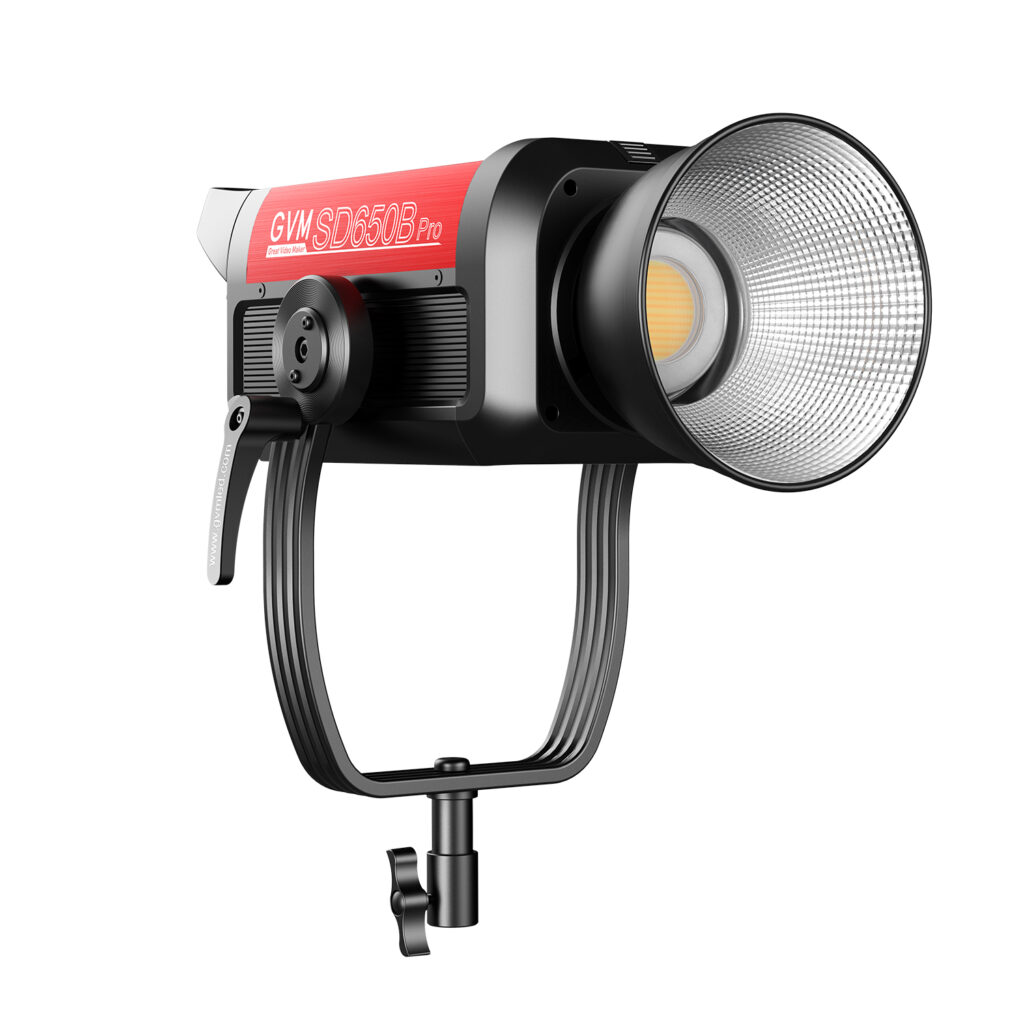
This is also why two continuous lights with the same lumen rating can perform very differently in real use. A bare bulb throwing light in 360 degrees loses most of its output to the walls and ceiling. A Dauerlicht with a reflector — like the GVM PRO SD650B with its standard reflector — focuses 81,300 lux on your subject from 1 meter away, while the same wattage without a reflector would give you a fraction of that.
When you compare two continuous lights for photography, always compare lux at the same distance (1m is the industry standard). If one only quotes lumens, ask for the lux spec or walk away.
How to Calculate Lux for Your Continuous Light Setup
The inverse square law means that every time you double the distance from your Dauerlicht, the lux on your subject drops to one quarter of the original value. So if a Dauerlicht measures 40,000 lux at 1 meter, here’s what you actually get at typical shooting distances:
| Entfernung | Lux (% of 1m value) | Approx. value from 40,000 lux @ 1m |
|---|---|---|
| 1 m | 100% | 40,000 lux |
| 2 m | 25% | 10,000 lux |
| 3 m | 11% | 4,400 lux |
| 4 m | 6.25% | 2,500 lux |
| 5 m | 4% | 1,600 lux |
So if you’re shooting a 3-person interview at 3 meters from your key Dauerlicht, that “40,000 lux spec” gives you just 4,400 lux on the subject. Now do you see why high-lux output matters? It’s the only way to get usable light at a real working distance.
Quick formula: Lux at distance D = Lux at 1m ÷ D² (where D is in meters).
Lux Requirements for Different Genres Using Continuous Light
Different photography and video genres have very different lux needs when using Dauerlicht. Here’s what works in real shoots:
- Portrait (close, 1–2m): 5,000–20,000 lux on the subject. Most modern continuous LEDs handle this easily.
- Group photo / wider setup (3–4m): 15,000–50,000 lux at 1m on the Dauerlicht. The further the subject, the brighter the Dauerlicht needs to be at the source.
- Product photography (close, 0.5–1m): 10,000–30,000 lux. You can stop down for depth of field.
- Video at 4K, 24fps, ISO 800: Around 2,000–5,000 lux on the subject is a comfortable range for low-noise footage.
- Large commercial sets (5m+): 80,000+ lux at 1m. This is where 500W+ continuous fixtures earn their keep.
The mistake I see most often: a creator buys a 100W panel Dauerlicht with a “high lumen” rating and wonders why their group videos look dim and noisy. They needed a Dauerlicht fixture with a much higher lux-at-1m rating, not a higher lumen count.
Best Continuous Lights with High Lux Output
Below are two GVM continuous lights that deliver serious lux output for studio and on-location work.
| Modell | Energie | Max Lux @ 1m | CRI/TLCI | Am besten für |
|---|---|---|---|---|
| GVM PRO SD650B | 650 W | 81,300 lux | 97+ | Studio interviews, large product sets, film lighting |
| GVM SD300B-AIO | 300W | 221,950 lux | 97+ | On-location work needing maximum punch per kilogram |
Die SD650B is the workhorse Dauerlicht for studio shoots — 81,300 lux at 1m means usable light at 4+ meters without maxing out the dimmer. The SD300B-AIO is the engineering standout: 221,950 lux from a 300W Dauerlicht fixture is exceptional, and it weighs a fraction of the bigger monolights, making it the right choice when you need serious output but can’t bring a 650W head. Both maintain 97+ color accuracy, so you don’t trade brightness for color quality.
Why Lux Defines a Quality Continuous Light
Das Beste continuous lights share one thing: they quote their output in lux at a specified distance, not just lumens. A high-quality Dauerlicht like the GVM SD300B-AIO delivers 221,950 lux at 1 meter because its optical design concentrates that output where you need it — on your subject.
When you understand lux vs lumens, you stop comparing continuous lights by wattage alone. You start comparing them by how much usable light they put on your subject at your working distance. That’s the difference between a well-lit set and a disappointing purchase.

FAQ-Continuous Light
Are lumens or lux more important for continuous light photography?
Lux is what matters for Dauerlicht photography. Lumens measure total light output, but lux tells you how much light actually reaches your subject. Always compare continuous lights by their lux rating at 1 meter.
How many lumens do I need for a continuous light studio setup?
There’s no single answer because lumens don’t measure what reaches your subject. A more useful number: aim for a Dauerlicht fixture that delivers at least 20,000 lux at 1 meter for a small studio, and 50,000+ lux at 1m for larger setups.
What is a good lux level for portraits with continuous light?
For portraits, around 5,000 to 20,000 lux on the subject’s face is a comfortable range. You’ll be working at distances of 1–2 meters, so a 200W–300W continuous LED at 1m spec of 30,000+ lux gives you plenty of headroom to dim down for soft, natural-looking light.
How does distance affect my continuous light output?
Lux from your Dauerlicht drops with the square of the distance. Double the distance, you get one quarter of the lux. Triple the distance, you get one ninth. This is why high-lux Dauerlicht fixtures at 1m are essential when you need to light subjects at 3+ meters.
Can I convert lumens to lux for a continuous light?
Not directly, because lux depends on the beam angle and distance. A 5,000-lumen Dauerlicht in a tight 30° beam can deliver a very high lux at the center, while the same 5,000 lumens in a 120° flood will give a much lower lux reading. Always request the manufacturer’s lux-at-distance spec for fair comparison.