Continuous lighting for photography has become the preferred choice for many modern photographers and hybrid creators. Unlike flash, continuous lights let you see exactly how the light falls on your subject before you press the shutter. This real-time feedback makes learning faster, results more predictable, and the same fixtures useful for both stills and video.
In this 2026 guide we explain the differences, the key requirements of a good continuous light, and rank the top three options—with a clear number-one recommendation.
Inhaltsverzeichnis
Continuous Light vs Flash Photography
Many photographers hesitate when buying their first serious light: continuous light or flash?
Flash (strobe) still offers higher peak power and the ability to freeze fast motion. However, for most portrait, product, interview, and hybrid photo/video work, continuous light is the smarter starting point. You see the shadows, highlights, and color temperature in real time. There is no recycle time, no guessing, and the same light works for video. Our recommendation for the majority of creators in 2026 is clear: start with continuous lighting for photography.
What Is a Continuous Light in Photography?
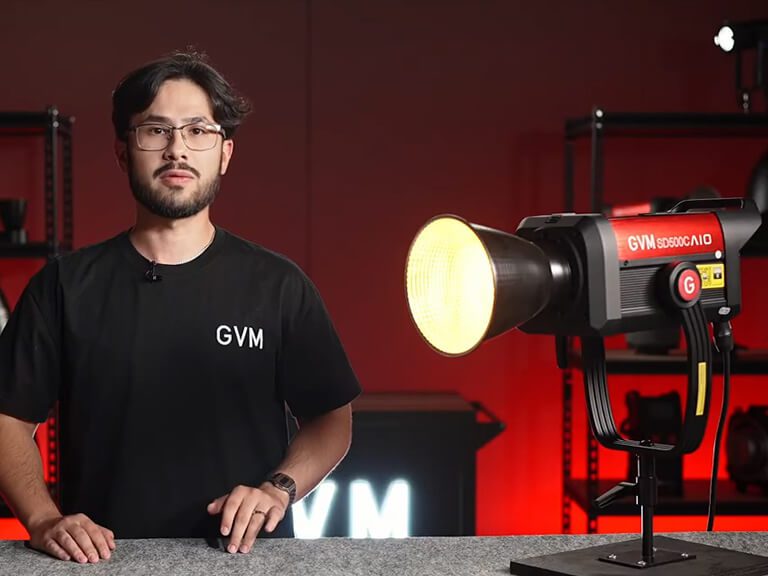
A continuous light stays on the entire time you are shooting. Modern versions are almost always LED—either COB monolights or panels. Because the light is always visible, what you see is what you get. This makes continuous lights especially beginner-friendly and ideal for anyone who shoots both photos and video.
What Makes the Best Continuous Light for Photography?
The best continuous light for photography should offer:
- High color accuracy (CRI/TLCI 97+)
- Strong, usable output (ideally in the 500W–700W class for serious work)
- Precise, flicker-free dimming
- Bi-color or full-color flexibility
- Quiet operation
- Bowens mount for modifiers
- Reliable control options (app, DMX, etc.)
Lights in the 500W to 700W range strike the best balance: enough power to overpower ambient light or act as a strong key/rim outdoors, yet still manageable in size and heat compared with older high-wattage fixtures.
Continuous Lighting for Portrait Photography
For portraits, continuous lighting shines. Place a softboxed 500W–700W light at 45 degrees as your key, add a reflector or second light as fill, and you can refine the look in real time. The ability to see catchlights, shadow density, and skin-tone rendering before shooting is a major advantage over flash, especially for beginners and hybrid shooters.
Best Continuous Lighting for Photography Top 3 in 2026
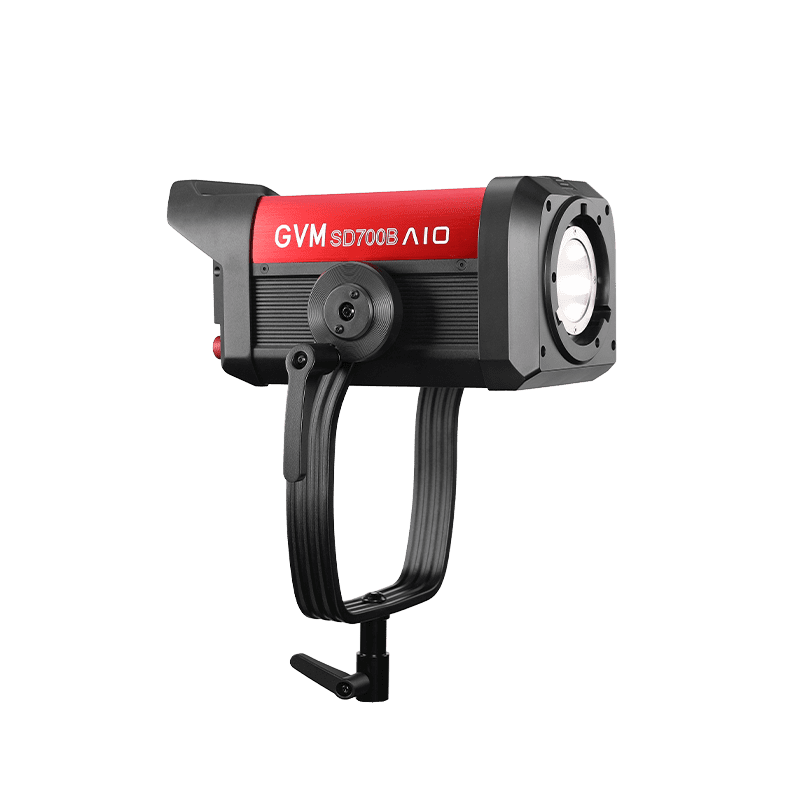
1. GVM SD700B AIO – Best Overall Continuous Light for Photography
The GVM SD700B AIO is a 700W all-in-one bi-color LED monolight built for professional photography and film work. It delivers strong output (approximately 26,200–29,100 lux at 3 m with reflector), CRI/TLCI 97+, a 2700K–6800K range, and ultra-smooth 0.1%–100% flicker-free dimming.
The true all-in-one design means no external ballast—just plug in and shoot. It offers 12 cinematic lighting effects, universal Bowens mount, Bluetooth app control, and professional CRMX + DMX connectivity. Compact, travel-ready, and quiet, it is designed for both studio and location use.
Vorteile: Excellent color accuracy (97+), true all-in-one convenience, precise dimming, strong 700W-class output, quiet operation, future-proof control options.
Nachteile: Premium positioning compared with lower-powered lights.
Am besten für: Serious portrait, commercial, and hybrid photo/video work that needs reliable power and color.
2. Nanlite FC-720B – Strong High-Output Contender
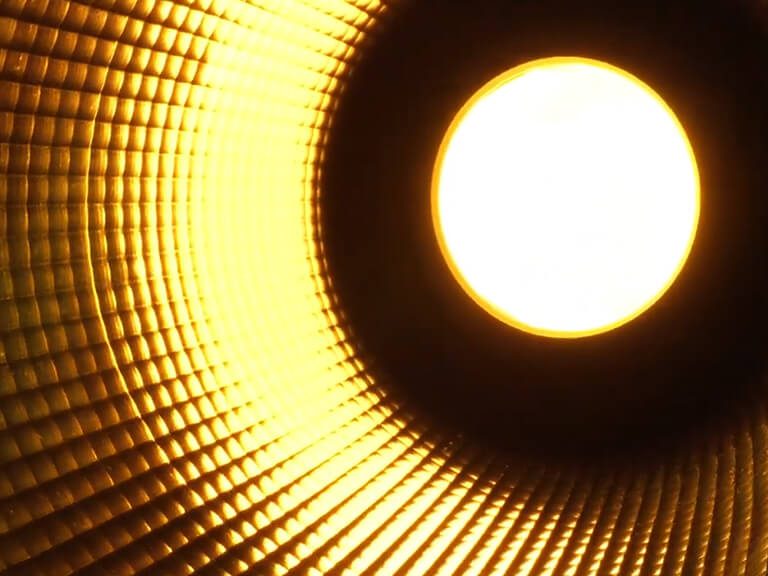
The Nanlite FC-720B is a 750W bi-color LED spotlight (2700K–6500K) with impressive output (up to 133,800 lux at 3.3 ft / 1 m with reflector), CRI 96 / TLCI 98, Bluetooth + DMX/RDM control, 12 effects, and a Bowens mount. The head and power supply are separate, which keeps the lamp head lighter but adds a second unit to manage.
Vorteile: Very high measured output, solid color accuracy, good ecosystem, professional control options.
Nachteile: Separate controller/ballast, CRI slightly lower than the top pick, less “all-in-one” convenience.
Am besten für: Users who prioritize peak output numbers and already work within the Nanlite ecosystem.
3. GVM SD500C AIO – Best Full-Color Option
The GVM SD500C AIO is a 500W full-color COB light with CRI 97+, a wide 2000K–10,000K range, HSI/RGB control, 16 lighting effects, Bluetooth Mesh, and optional DMX/CRMX. It is an excellent choice when creative color and effects are priorities alongside solid output.
Vorteile: Full RGB + ultra-wide CCT, good power, modern control.
Nachteile: Slightly less pure output focus than dedicated high-power bi-color lights.
Am besten für: Creators who need extensive color control for stylized or creative work.
Product Comparison Table
| Modell | Energie | Farbbereich | CRI/TLCI | Gestaltung | Hauptvorteil | Am besten für |
|---|---|---|---|---|---|---|
| GVM SD700B AIO | 700W | 2700–6800K | 97+ | True all-in-one | Color + convenience + control | Overall best choice |
| Nanlite FC-720B | 750W | 2700–6500K | 96/98 | Separate ballast | Very high peak output | High-output bi-color |
| GVM SD500C AIO | 500W | 2000–10,000K + RGB | 97+ | All-in-one | Full creative color | Color-focused work |
Real-World Case Study: Outdoor Daylight Fill & Rim
On an overcast outdoor day shoot, a photographer used the GVM SD700B AIO as an “artificial sun” to add contour and separation. Positioned as a rim/edge light, the 700W output cut through the flat ambient light and gave the subject clear definition and dimensionality—something lower-powered 300W lights struggled to achieve with the same presence. The continuous nature of the light allowed real-time adjustment of intensity and angle until the rim looked natural yet intentional. This is exactly where 700W-class continuous lighting for photography shows its value.
Direct Comparison: GVM SD700B AIO vs Nanlite FC-720B
Both lights sit in the high-output bi-color category and perform well. The Nanlite FC-720B offers very strong measured lux figures and a mature ecosystem. However, the GVM SD700B AIO holds clear advantages for most photographers: higher CRI/TLCI (97+), true all-in-one design (no separate ballast), smoother low-end dimming, and excellent integrated control options including CRMX. For creators who value color accuracy, setup speed, and a cleaner workflow, the SD700B AIO is the more practical and refined choice.
Best Continuous Lighting for Photography – Final Conclusion
After comparing output, color accuracy, design, and real-world usability, the GVM SD700B AIO stands out as the best continuous lighting for photography in this group. It combines professional-grade color, genuine all-in-one convenience, precise control, and enough power to act as a dominant key or rim light even outdoors.
The Nanlite FC-720B remains a strong alternative if peak output numbers are your top priority, and the GVM SD500C AIO is excellent when full RGB creativity is required. For the majority of photographers seeking a reliable, high-performance continuous light in 2026, the GVM SD700B AIO is the clearer and better overall choice.
FAQ
Is continuous light better than flash for beginners?
Yes. Real-time preview makes learning lighting much faster and more intuitive.
Why choose a 700W-class light?
It provides enough power for outdoor fill/rim work and large softboxes while remaining more manageable than older high-wattage fixtures.
Can these lights be used for video as well?
Absolutely. All three are continuous LED lights designed for both photography and video.