Every filmmaker eventually hits the same fork in the road: 1200W COB lights have become the new baseline for serious shoots, but two fixtures at the same power class can sit worlds apart in price and practicality.
When you’re shopping for the best lighting for filming this year, the GVM AIO 1200B and the Aputure STORM 1200x are two of the most talked-about options at this wattage. Both can punch through a large diffusion frame, bounce off a distant ceiling, or hold their own against daylight outdoors — but one gets you there faster, lighter, and for a lot less money.
Arten von filmischem Licht
Before comparing specific fixtures, it helps to know where they fit. Most cinematic lighting for filming falls into three broad categories.
Point-source (COB) lights produce a hard, directional beam that’s easy to shape with reflectors, fresnels, and modifiers. They’re the workhorse for key lighting. Panel lights spread soft, even illumination across a wide area, which makes them fast to deploy in tight interiors. Tube lights are typically reserved for rim light, background accents, or practical-looking sources inside the frame.
LED technology has largely replaced tungsten and HMI across all three categories, thanks to lower heat output, longer fixture life, and far more precise control.
Within COB fixtures, you’ll also choose between bi-color (switching cleanly between tungsten and daylight without gels), tunable white with green-magenta correction (a wider color range for color-critical work), and RGBWW (stylized color output, usually at the cost of raw brightness). Power class matters too — a single 1200W head can replace several smaller units stacked together, which is exactly why this comparison matters for anyone weighing large-format lighting for filming.
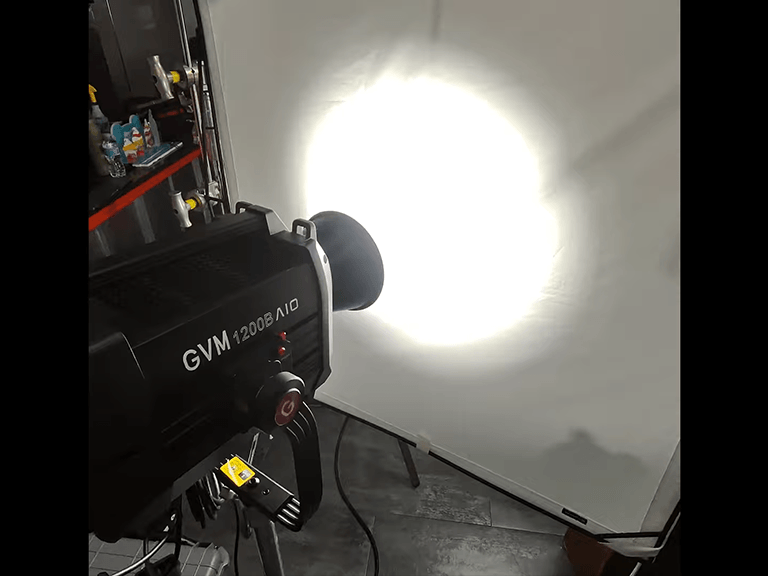
GVM AIO 1200B: All-in-One Power for Every Setup
The GVM AIO 1200B is built around a genuinely integrated design — the ballast and controller live inside the lamp head itself, with no external box or extra cabling to manage. That means faster setup, faster teardown, and one less case to carry on location, which adds up fast for solo shooters and small crews running back-to-back setups.
On performance, it offers bi-color output that spans the common tungsten-to-daylight range with excellent color accuracy (CRI above 97), smooth stepless dimming that stays flicker-free even at low output, and a standard Bowens mount with a safety lock for secure accessory attachment. It ships with built-in lighting effects and light-source simulation modes, multiple fan settings including a silent option, and control through the unit itself or a Bluetooth app. Professional lighting protocols are available through an optional external control box, so you only pay for that layer of the ecosystem if you actually need it.
| Merkmal | Specification / Benefit |
|---|---|
| Energie | 1200W max, all-in-one (no external ballast) |
| Color | Bi-color 2700K–6800K, CRI >97 |
| Output | Up to 42,800 lux @ 3m with standard reflector |
| Dimmen | 0.3%–100%, stepless and flicker-free |
| Berg | Bowens mount with safety lock |
| Gewicht | 10 kg (22 lbs) |
| Steuerung | On-board, Bluetooth app; DMX/CRMX/Art-Net via optional GVM BOX |
| Kühlung | 3 fan modes, including silent |
For independent filmmakers, documentary crews on tour, rental houses, and anyone building out their first serious lighting kit, the AIO 1200B’s pitch is straightforward: strong output per dollar, a lighter footprint, and one fewer bag to check.
Aputure STORM 1200x: Color Science and Weather-Sealed Reliability
The STORM 1200x takes a different approach, built around a five-color BLAIR (Blue/Lime/Amber/Indigo/Red) light engine rather than a standard bi-color array. That extra channel spread produces high-fidelity white light and a wide range of green-magenta correction, and calibrated indigo emitters help the light render fluorescent materials more naturally.
At the same power class, the STORM 1200x pushes a higher peak output on paper, with color rendering and spectral similarity scores that sit near the top of the category. It’s also IP65-rated, with a fully sealed lamp head and control box, which matters for productions that shoot outdoors in unpredictable weather. The trade-off is a split design — a separate lamp head and control box mean more to carry, more cable to run, and a meaningfully higher price tag before you’ve added a single modifier. Dimming runs smooth down to very low output, and control options extend to DMX/RDM, wireless CRMX, Art-Net/sACN, and a full app ecosystem.
| Merkmal | Specification / Benefit |
|---|---|
| Energie | 1200W (1550W max draw), tunable white |
| Color | 2,500K–10,000K, CRI ≥95, TLCI ≥95 |
| Green-Magenta | ±G 100% (full ASC MITC range) |
| Weather Rating | IP65, sealed head and control box |
| Berg | ProLock Locking Bowens Mount |
| Gewicht | 9.5 kg head + 5.92 kg control box |
| Steuerung | Sidus Link app, DMX/RDM, CRMX, Art-Net/sACN |
This is the fixture for productions that specifically need certified weatherproofing or the widest possible color-tuning range and have the budget to match — a narrower use case than it might first appear.
Case Study: Stretching the GVM AIO 1200B with the 3X Optical Intensifier
One of the more practical advantages of the GVM ecosystem shows up once you start adding accessories. On a recent interview shoot that needed to punch a key light across a wide room and still keep the source small enough to hide, a single GVM AIO 1200B was paired with the GVM FPXG3BJ 3X Optical Intensifier — a Bowens-mount lens attachment that boosts COB output by up to 300% with no extra power draw.
With the intensifier mounted and the included honeycomb grid attached, the same 1200B AIO that normally acts as a wide key light became a tightly focused, cinematic spotlight capable of reaching much further across the set without any loss of color accuracy. The uniform beam control eliminated the harsh central hotspot that basic Fresnel attachments can introduce, which kept skin tones even and reflective surfaces free of blown-out highlights. Setup took seconds — the lens locks onto the standard Bowens mount and can be swapped out just as quickly for the next scene.
For $299, the FPXG3BJ effectively turns one 1200B AIO into two different tools: a broad key light for interviews and a long-throw spotlight for dramatic, contrast-heavy shots — without buying a second fixture. It’s a good example of how the GVM system is built to be extended cheaply, rather than requiring a larger (and pricier) light for every new lighting problem.
| Merkmal | Specification / Benefit |
|---|---|
| Compatible Models | 1200B AIO, FH400B, R1200B, SD650B, 500B and other Bowens mount lights |
| Brightness Increase | Up to 300% (3X), no added power draw |
| Abstrahlwinkel | 35° |
| Included Accessory | Honeycomb grid for tighter beam control |
| Berg | Universal Bowens Mount |
| Gewicht | 2.05 kg |
| Price | $299 USD |
Best Lights for Filmmakers: Head-to-Head
| Dimension | GVM AIO 1200B | Aputure STORM 1200x |
|---|---|---|
| Power class | 1200W | 1200W |
| Peak output | Strong, and extendable with accessories like the 3X Intensifier | Higher out of the box |
| Color temperature range | Bi-color, covers the range most shoots need | Wider, with full G/M correction |
| Color accuracy | Excellent CRI | Excellent CRI + TLCI |
| Form factor | All-in-one, lighter to carry | Split head + control box |
| Weather protection | None rated | IP65 sealed |
| Control ecosystem | App + optional protocol box | Full native protocol support |
| Price | Lower, with a cheaper path to more output | Higher, both up front and to scale |
By scenario: For interviews and studio setups, GVM’s color accuracy, silent fan mode, and faster rigging make it the practical pick. For large venues and big diffusion frames, its all-in-one build, lighter footprint, and accessory options like the 3X Optical Intensifier win out. For outdoor, wet, or rugged environments, Aputure’s IP65 rating is the deciding factor. For color-critical work needing the widest tunable range, Aputure’s BLAIR engine has the edge. For large multi-light rigs run over DMX or Art-Net, Aputure’s protocol support is more complete out of the box.
Aputure still leads on peak factory output, weatherproofing, and color tunability. But for most indoor productions — which is most productions — GVM closes that gap for a fraction of the cost, and its accessory ecosystem means you’re not locked into a single fixture’s ceiling.
Film Lighting Brands
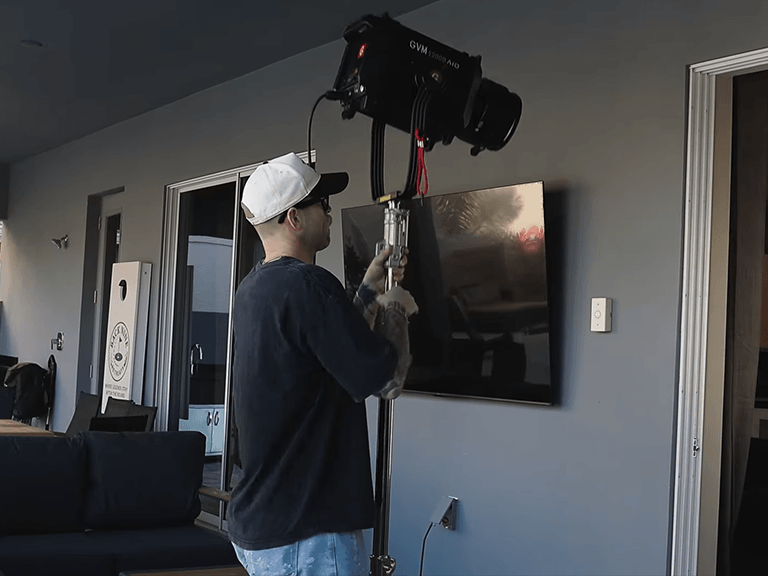
Aputure remains a well-known name, with a deep accessory ecosystem and wide rental-house availability. GVM has carved out real momentum on value, using all-in-one designs and an affordable accessory lineup to cut cost and complexity without cutting output. Godox covers the mid-range across both flash and continuous lighting. NEEWER serves entry-to-mid-level buyers with a strong accessory catalog. ARRI, Litepanels, und Nanlux sit above both fixtures compared here, at rental-grade pricing most independent creators won’t need. When choosing a brand, weigh the ecosystem — mount type, accessories, and control app — as heavily as raw output on a spec sheet.
FAQ
Is 1200W overkill for independent creators? Only if you’re not pushing large diffusion or fighting daylight outdoors — otherwise it’s genuinely useful headroom.
Does either light need an external ballast? The GVM AIO 1200B doesn’t; the Aputure STORM 1200x does, via its separate control box.
Which has better color? GVM posts stronger raw CRI numbers; Aputure offers a wider color temperature range and slightly better spectral quality overall.
Can I increase a GVM light’s output without buying a bigger fixture? Yes — accessories like the FPXG3BJ 3X Optical Intensifier boost output up to 300% on a Bowens-mount GVM light for a fraction of the cost of stepping up to a larger unit.
Schlussfolgerung
Both fixtures earn their place in this power class, but they’re solving different problems. The Aputure STORM 1200x is the choice when certified weather sealing or the widest possible color range is a non-negotiable requirement, and the budget supports it. For everyone else — independent filmmakers, documentary crews, studios, and rental houses building out a kit — the GVM AIO 1200B delivers comparable everyday performance, faster setup, and a genuinely lower cost of entry, with the added advantage of an accessory system like the 3X Optical Intensifier that lets one fixture do more work instead of buying a second light. For lighting for filming that has to earn its keep on every shoot, that combination of output, portability, and price is hard to match.