Continuous LED lighting has quietly taken over most photo and video sets, and a video LED focusing light for photography is now a standard part of that shift in 2026. Instead of guessing how a strobe will look before the flash fires, photographers can dial in the exact beam — spot or flood — and see the result in real time on the subject’s face.
That single change, seeing the light before you shoot it, is why focusing LED fixtures have become the default recommendation for portrait, product, and hybrid photo/video work this year.
Continuous Lighting for Photography in 2026
A few years ago, continuous LED was seen as a compromise — useful for video, but not quite bright or color-accurate enough to replace a flash. That gap has closed. Modern COB LED chips now push high CRI and TLCI ratings, tight beam control through TIR optical lenses, and enough raw output to hold their own against window light or a shaded outdoor scene.
For photographers, the appeal comes down to control. You see the shadow falling across a jawline exactly as the camera will record it, adjust the angle, and shoot — no test flash, no chimping between frames to check if the highlight blew out. This is especially useful for photographers who shoot both stills and behind-the-scenes video on the same booking, since one fixture now covers both jobs instead of carrying a flash kit and a separate video light.
What the Best Lights for Photography Need to Deliver
Not every continuous light is built for this. A fixture worth carrying into a paid shoot generally needs a few things in place.
Color accuracy above CRI 95 is the baseline — anything lower and skin tones start to shift under editing. A genuine focus or zoom mechanism, not just brightness adjustment, matters just as much: the difference between a tight spot for dramatic rim light and a wide flood for fill is what lets one fixture replace two or three single-purpose lights. Stepless, flicker-free dimming keeps exposure consistent when you’re shooting video alongside stills. Quiet cooling stops fan noise from bleeding into on-camera audio during interviews. And a standard modifier mount — Bowens is the common choice — means the light can take a softbox, grid, or dome without an adapter hunt.
Portability rounds out the list. The best lights for photography in this category are light enough for a one-person kit, run on both AC and battery power, and set up in minutes rather than requiring a full grip truck.
Photography Light Box and Diffusion Accessories
A focusing LED light gets most of its practical range from what’s mounted in front of it, and this is where a photography light box — a softbox, dome diffuser, or softball attachment — does the real work.
A hard COB source on its own throws a small, punchy hotspot, which is useful for rim light but harsh for a main light on a face. Add a softbox or a round softball diffuser and that same fixture spreads into an even, wrapping source with a much softer shadow edge — closer to a window or an overcast sky. A honeycomb grid does the opposite job, narrowing spill and adding contrast for a more directional, cinematic look. Because these lights use a standard mount, swapping between a tight beam for background separation and a soft box for the main light on a face takes seconds, not a full re-rig.
For photographers building a kit around one core fixture, the light box isn’t an accessory — it’s what turns a single focusing LED into three or four different lighting looks over the course of a shoot.
Focus Lights for Photography: Inside the GVM PF100B
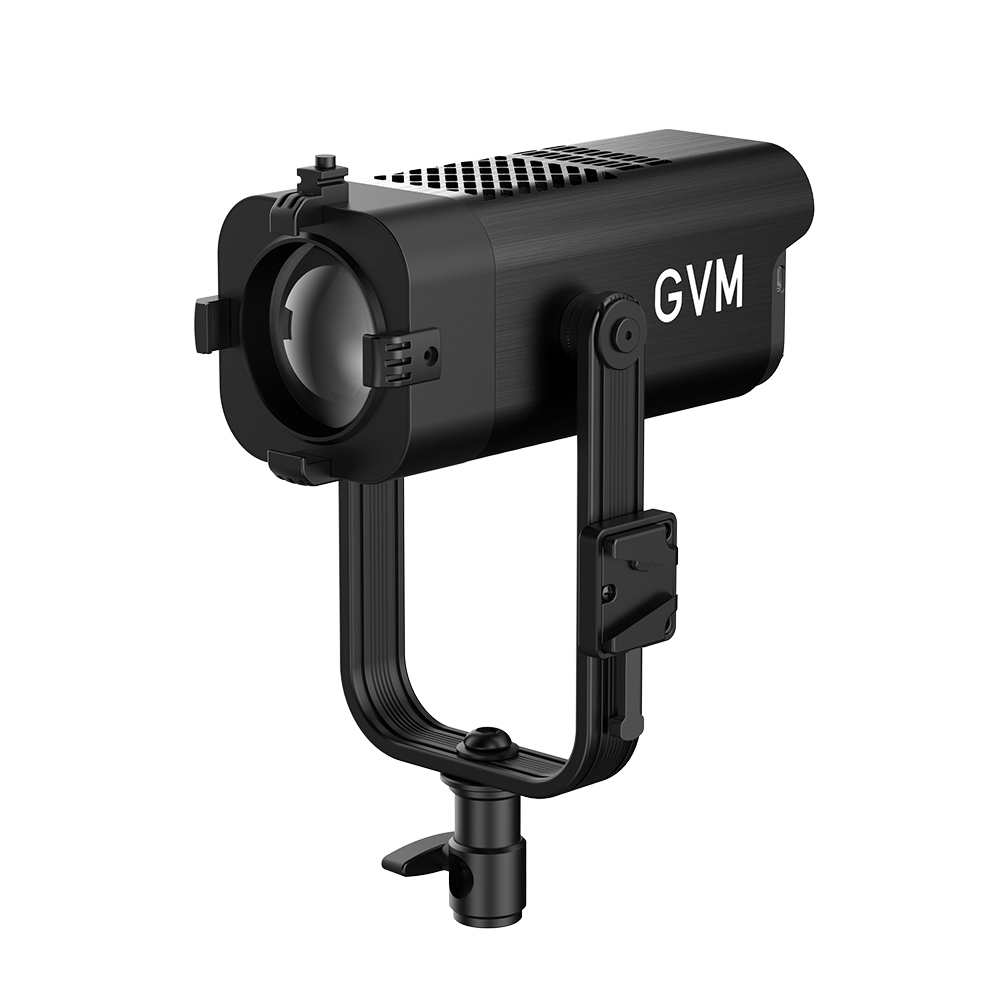
Among the current wave of focusing LEDs, the GVM PF100B is a good reference point for what the category looks like at the 100W tier. It pairs a bi-color COB chip with a TIR optical lens and a manual focus knob that moves smoothly from a 15° spot to a 45° flood, so the beam spread is a physical adjustment rather than a software crop.
Color output sits at CRI and TLCI 97+, with a 2700K–6800K range that covers tungsten through daylight without gels. Dimming runs 0–100% in 0.1% steps across four selectable curves (Linear, Log, Exponential, S-Curve), which matters for anyone doing slow fades on camera rather than just picking a brightness and leaving it. The controller is built into the light head, so there’s no external box to carry, and it runs from either AC power or an optional V-mount battery for locations without an outlet.
| Spezifikation | Details |
|---|---|
| Energie | 100W Bi-Color COB |
| CCT-Bereich | 2700K–6800K |
| CRI / TLCI | ≥97 / ≥97 |
| Abstrahlwinkel | 15°–45°, zoom focus (TIR lens) |
| Output (Spot) | 30,200 lux @ 1m |
| Dimmen | 0–100% stepless, 4 curves |
| Berg | Mini Bowens |
| Netzteil | AC 100–240V or V-mount battery |
| Steuerung | On-board + Bluetooth app (≤50m) |
| Gewicht | 1.53 kg |
Case Study: A Riverside Portrait at Dusk, With One 100W Light
A recent booking called for a set of portraits along a riverside walking path — warm, natural, a little cinematic. It was a golden-hour session with no assistant, so the entire kit had to fit in one car and go up fast: a 100W bi-color COB light, a compact softbox, a two-sided reflector, a lightweight stand with a sandbag, and a portable power pack.
The light was set up directly behind the subject, low over the water, which meant two problems at once. The rim light on the hair was free — the setting sun handled that on its own. But the subject’s face was sitting nearly two stops darker than the sky behind it. Expose for the face and the sky burns out white; expose for the sky and the subject turns into a silhouette.
The fix wasn’t to overpower the sun — a 100W fixture simply isn’t going to out-muscle direct sunlight, and trying only wastes time. The better approach was to treat it as a close-range key light instead: at two meters or less from the subject, the softbox produces enough wrap and softness to lift the face without looking lit. Move the same light back to four or five meters and the output falls off fast, losing any of that softness.
With that in mind, the light went camera-left, about 45 degrees off-axis and slightly above eye level, angled down with the softbox edge feathered across the face rather than aimed square at it — enough to lift skin tone without flattening the backlight. A reflector sat low on the opposite side to bounce a little light back into the shadow, keeping detail in the dark side of the face instead of letting it go flat black. The result held detail in both the sky and the face in a single exposure, with the golden-hour color doing most of the emotional work and the LED simply closing the gap the sun left behind.

FAQ
Is 100W enough for outdoor portraits?
Yes, but only at close range — inside about two meters with a softbox — since a fixture this size can’t compete with direct sunlight from farther back.
What’s the real advantage of a focusing LED over a fixed-beam light?
Being able to switch between a tight spot and a wide flood without changing fixtures means one light can act as a rim light, a key light, and a background accent across a single shoot.
Do I need a light box or softbox for portrait work?
For a main light on a face, yes — a bare COB source throws a harsh, small hotspot, while a softbox or dome diffuser spreads it into a much more flattering, even source.
Can these lights run without a wall outlet?
Most 100W-class focusing LEDs, including the PF100B, support V-mount battery power for locations without AC access.