A great video isn’t just about the camera. Once lighting and audio are set, the real challenge begins: delivering a script naturally without breaking eye contact. That’s where a teleprompter comes in. But not every teleprompter delivers the same results. In this guide, we break down what to look for in a professional teleprompter and why the GVM TQ-LD stands out for studio, interview, and livestream use.
Creating a polished video is rarely just about the camera. Once the framing, lighting, and audio are under control, another problem often appears: what should the presenter say, and how can they say it naturally without constantly looking away from the lens?
That is where a teleprompter becomes useful.
A well-designed teleprompter does more than display a script. It creates a visual bridge between preparation and performance, allowing creators to stay informed without breaking eye contact. For interviews, tutorials, livestreams, corporate videos, and educational content, this small change can make a noticeable difference.
But not every teleprompter works equally well. Screen size, lens compatibility, optical quality, mounting, and control methods all affect the shooting experience.
Wenn Sie nach dem best online teleprompter, it is worth understanding what actually matters before choosing one.
Why Eye Contact Matters More Than Perfect Memorization?
A presenter does not necessarily need to memorize every sentence.
What matters more is maintaining a natural connection with the camera.
When someone repeatedly looks down at notes or shifts their eyes toward a separate monitor, the audience notices. The information may still be correct, but the delivery feels less direct.
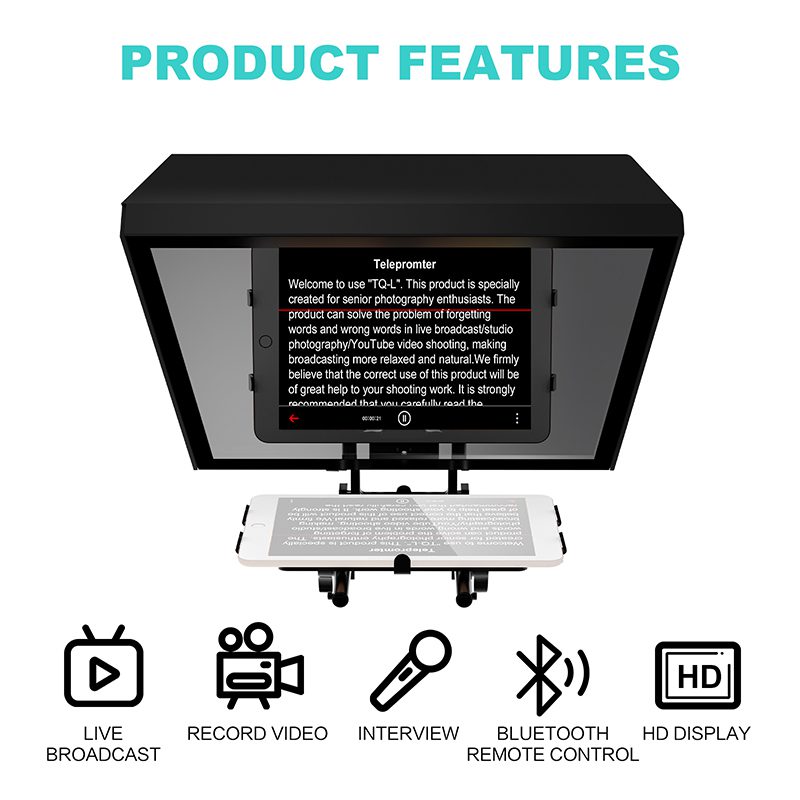
A teleprompter solves this by placing the script close to the camera’s optical axis. Instead of looking away to read, the presenter can follow the text while continuing to face the lens.
It’s especially useful for interviews, talking-head videos, online courses, product demos, and livestreams—anywhere you need to stay on script without losing eye contact.
A good teleprompter should feel almost invisible. The audience should focus on what you’re saying, not on how you’re reading it.
Screen Size: Bigger Is Not Always Better, but Too Small Can Be a Problem
One of the first things to consider when choosing a teleprompter is the display.
A small screen may work for a short script and a close shooting distance. However, as the distance between the presenter and camera increases, readability becomes more demanding. Small text can force the presenter to concentrate on reading instead of communicating.
A larger display gives you more room to adjust font size and text spacing without making the script difficult to follow.
For professional setups, an 18.5-inch display can offer a practical balance. It provides enough screen area for comfortable reading while remaining suitable for studio, interview, and content-creation workflows.
The principle is simple: the script should be easy to read, but it should never become the visual focus of the shot.
Wide-Angle Compatibility: The Overlooked Part of Teleprompter Design
A teleprompter may look perfect on a standard lens and still become problematic when paired with a wider lens.
This is because the optical path and physical structure of the prompter can potentially introduce vignetting or restrict the camera’s field of view.
For interviews, group presentations, and studio work, that limitation can become frustrating. You may want to move the camera closer or use a wider focal length, only to discover that the teleprompter has become the limiting factor.
A better design should accommodate a wider field of view while keeping the text readable.
This is an important consideration when comparing options for the best online teleprompter. Lens compatibility should be evaluated alongside screen size, not after it.
Optical Quality: The Text Should Be Clear, Not Distorted
The display itself is only one half of the equation.
The other half is the glass.
A teleprompter works by reflecting the script toward the presenter while allowing the camera to shoot through the glass. If the beam-splitter introduces visible distortion, color shifts, or an unclear reflection, the reading experience suffers.
Professional teleprompters therefore need a beam-splitter designed for clear text reproduction and reliable light transmission.
That matters during longer shoots. When the text remains stable and legible, the presenter can focus on pacing, expression, and the person behind the camera rather than fighting the equipment.
The Best Teleprompter Should Fit Your Camera, Not the Other Way Around
A teleprompter should adapt to the production rather than forcing the production to adapt to it.
Different creators use DSLR and mirrorless cameras, camcorders, DV cameras, and other configurations. A useful teleprompter therefore needs flexible mounting options and enough adjustment range for different setups.
Standard mounting points can make a significant difference here.
For creators who move between studio shoots, interviews, livestreams, and on-location production, this flexibility can save considerable setup time.
Smart Control: Reading the Script Is Only Half the Workflow
Imagine filming alone.
The camera is recording. The lights are positioned. The microphone is ready. Then the script needs to slow down.
Without remote control, someone has to reach toward the prompting device. That small interruption can break concentration and sometimes force another take.
Smart control changes the workflow.
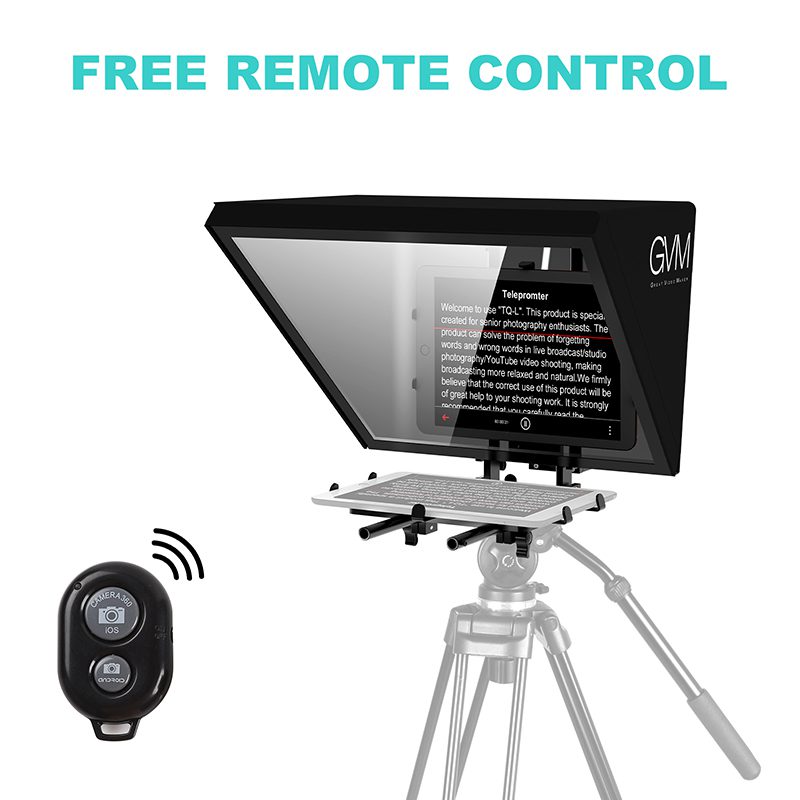
A modern teleprompter can allow the operator to adjust scrolling speed, text size, alignment, and other settings without physically repositioning the main unit.
For solo creators, this is more than a convenience. It means fewer interruptions between takes.
Why an All-in-One Design Makes Sense for Modern Creators?
Traditional production setups often grow one accessory at a time.
A screen here. A mounting bracket there. Another control device on the side.
Eventually, the setup works—but it also becomes something that needs to be assembled, adjusted, and transported every time you shoot.
An integrated design takes a different approach.
This is especially useful for interviews, live streaming, educational production, and multi-person shoots, where setup time can quickly become part of the production cost.
GVM TQ-LD: A Practical Teleprompter for Modern Video Production
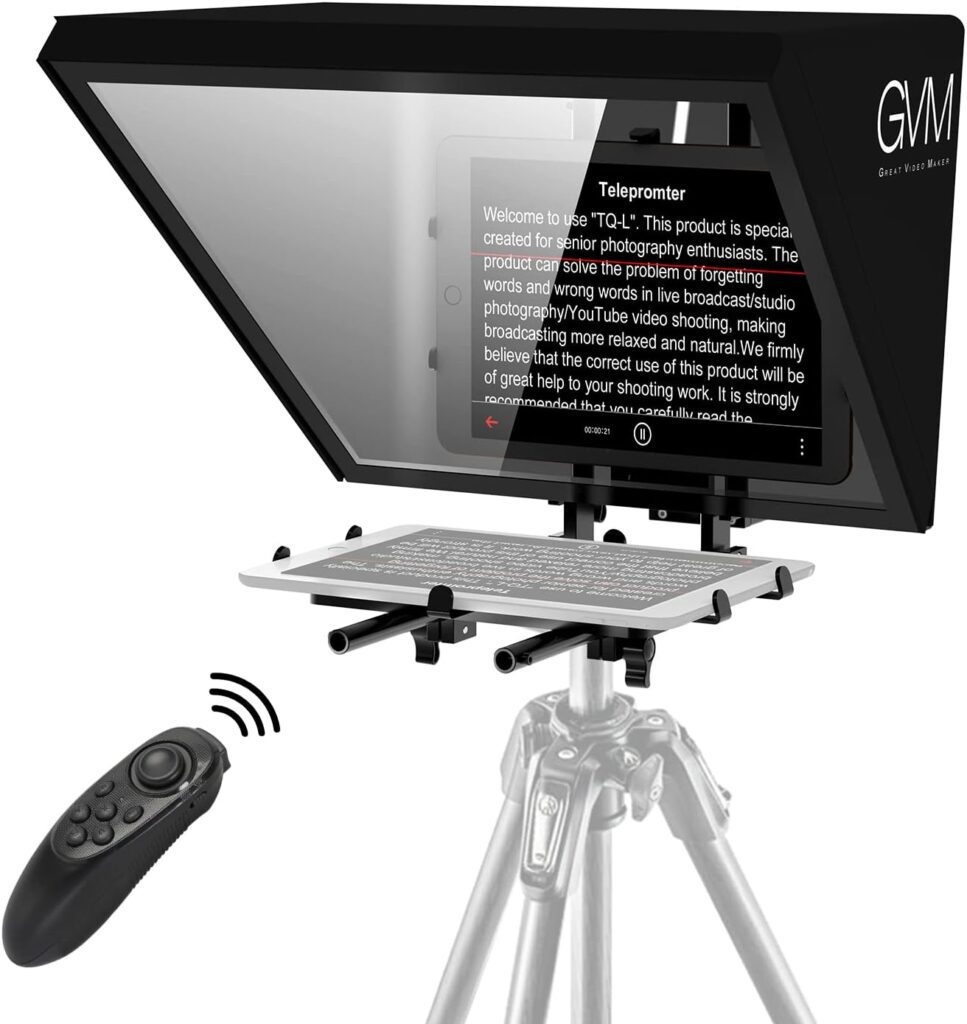
For creators who need a larger display without giving up flexible shooting options, the GVM TQ-LD brings several of these considerations together.
Its 18.5-inch all-in-one Android display provides a large reading area, while the wide-angle-friendly optical design supports broader compositions. The professional beam-splitter is designed for clear, distortion-free prompting, and the aluminum structure provides a balance between stability and portability.
Control is handled through the GVM Teleprompter APP and Bluetooth remote, allowing the script to be adjusted without constantly reaching for the main unit.
It is not about adding another piece of equipment to the camera.
It is about removing one more reason for the presenter to look away.
| Merkmal | GVM TQ-LD |
| Am besten für | Studio, Interviews & Live Streaming |
| Display | 18.5″ Android All-in-One Screen |
| Optical Quality | HD, Distortion-Free Beam-Splitter |
| Wide-Angle Support | Vignetting-Free Wide-Angle Design |
| Viewing Distance | Up to 15 ft (4.5 m) |
| Camera Compatibility | DSLR, Mirrorless, Camcorder & Professional Cameras |
| Montage | 1/4″ & 3/8″ Standard Screw Mounts |
| Steuerungstyp | APP & Bluetooth Remote |
| Smart Control | Font Size, Scroll Speed, Background & Alignment |
| Load Capacity | Up to 10 kg |
| Material | Aluminium-Legierung |
| Product Weight | 7.5 kg |
| Abmessungen | 575 × 415 × 380 mm |
Conclusion: The Best Teleprompter Is the One You Stop Noticing
Good prompting technology should feel almost invisible.
The audience should not notice the scrolling text. They should not notice the beam-splitter. Ideally, they should not even think about the teleprompter.
They should see someone who appears prepared, focused, and comfortable speaking directly to them.
That is why choosing the best online teleprompter is less about finding the biggest screen or the longest feature list. It is about finding the right balance between readability, optical clarity, camera compatibility, control, and practical setup.
The best equipment often leaves the smallest footprint in the final image.
When the technology steps quietly out of the way, the presenter has room to do what matters: look into the lens, find the right rhythm, and tell the story.
Entdecken Sie noch heute das gesamte Sortiment an professionellen Beleuchtungslösungen von GVM.
The best teleprompter is the one you stop noticing. It lets you focus on your message, not the mechanics of reading. Whether you’re filming interviews, tutorials, or live streams, choosing the right teleprompter can transform your delivery. Explore the GVM TQ-LD and find the tool that fits your workflow.