Continuous light is the first fork in the road for a lot of photographers setting up a new shoot, and deciding between a continuous light and a flash trips up beginners and working creators alike. A flash freezes motion with a short, powerful burst, while a continuous light stays on the whole time, letting you see exactly how highlights and shadows fall before the shutter ever clicks.
That real-time feedback is exactly why continuous lighting has become the default for video, livestreaming, and a growing share of portrait and product work. Two 300W-class options dominate the conversation this year — the GVM SD300B AIO and the Godox Litemons LE300Bi — and the differences between them come down to price, brightness, and how fast each one gets set up on set.
Indice dei contenuti
Continuous Light vs Flash Photography
A flash delivers a brief, intense burst of light synced to the shutter, which is why it’s long been favored for freezing fast motion or shooting in bright ambient conditions where a weaker continuous source would get overpowered. Continuous light, by contrast, stays on at a fixed output, so the photographer sees the final lighting effect in real time rather than guessing how a flash pop will render. That makes continuous light far better suited to video, since flash isn’t usable for anything beyond a single frame, and it also removes the guesswork for beginners who are still learning how light falls across a face or product.
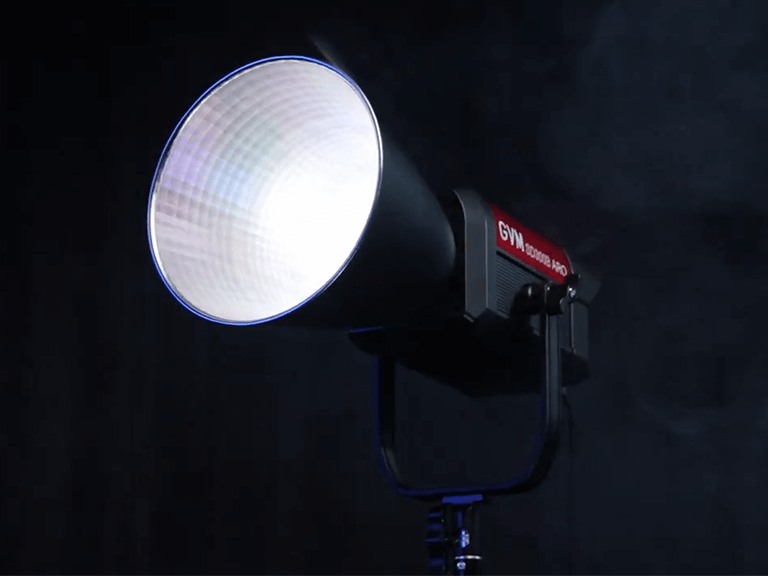
The trade-off has traditionally been raw power — flash units can output far more light in an instant than an LED can sustain continuously. Modern bi-color LEDs like the GVM SD300B AIO close that gap considerably, delivering 221,950 lux at 1 meter with the standard reflector, which is enough brightness for most studio, portrait, and product setups without ever needing a flash-sync workaround.
What Is a Continuous Light in Photography?
A continuous light in photography is any fixture that stays illuminated the entire time it’s powered on, rather than firing in a single burst like a flash or strobe. Bi-color LED panels and monolights are the most common form today, since they let a shooter dial in both brightness and color temperature and watch the effect update instantly on the subject. This is especially valuable when working with color temperature: the GVM SD300B AIO covers 2700K to 6800K with stepless dimming, so a photographer can shift from a warm tungsten look to a cooler daylight balance and see the exact result before the camera ever fires.
Because the light stays on continuously, it also does double duty for both stills and video, which is a major reason continuous lighting has become the default choice for content creators who shoot both formats in the same session.
Migliore luce continua per la fotografia neonatale
Newborn photography puts specific demands on a light source: it needs to stay soft, consistent, and quiet, since sudden flashes or loud fan noise can startle a sleeping infant and end a session early. A continuous light with stepless, flicker-free dimming lets a photographer ease brightness up and down gradually rather than triggering an abrupt flash, and a wide bi-color range makes it easy to match warm nursery tones without harsh color shifts.
The GVM SD300B AIO’s CRI/TLCI rating of 97+ also matters here, since newborn skin tones are unforgiving of poor color accuracy, and its all-in-one compact body means it can be positioned close to a nursing setup or a small in-home studio without a bulky separate power box crowding the space. For a category where gentleness and control matter more than raw output, a 300W-class continuous light with fine dimming control is consistently the safer choice over flash.
Best Continuous Light for Photography
Choosing between continuous lights ultimately comes down to price at a given wattage, real brightness output, and how quickly the fixture gets you shooting. Here’s what the GVM SD300B AIO brings to that comparison:
| Parametro | Specifiche |
|---|---|
| Potenza | 300W |
| Luminosità | 221,950 lux at 1 meter (standard reflector) |
| Temperatura del colore | 2700K–6800K bi-color, stepless adjustment |
| Rendering del colore | CRI ≥ 97, TLCI ≥ 97 |
| Effetti di luce | 12 effetti integrati |
| Controllo | APP remote control, multi-light linking |
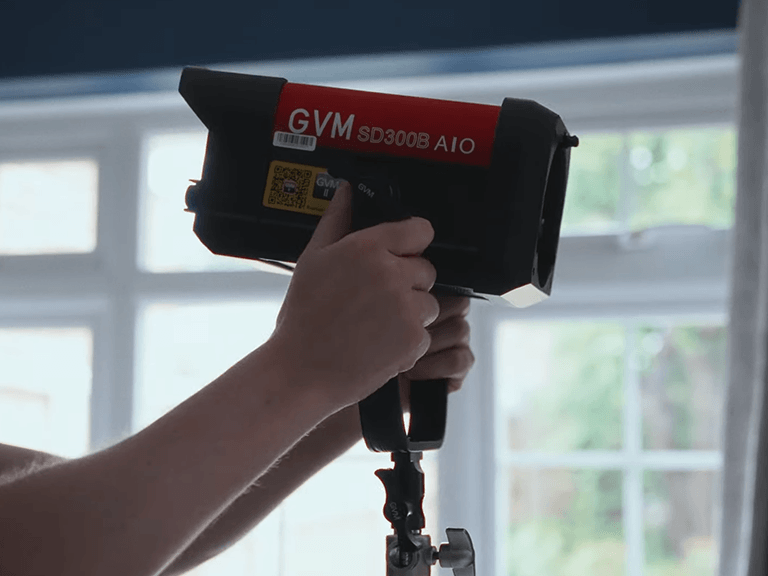
| Design | All-in-one unit for fast setup |
The Godox Litemons LE300Bi sells for $239 at 320W, with 58,900 lux at 3.3 feet, a CRI/TLCI of 98/98, and Bluetooth, NFC one-tap, and wired DMX control. At essentially the same wattage tier, the SD300B AIO undercuts that price while delivering dramatically more usable brightness, giving it a clear edge on brightness-per-dollar. Both fixtures use an integrated power supply rather than a separated head-and-ballast design, but the SD300B AIO’s compact all-in-one body and app-based multi-light linking make it faster to deploy and sync across several units on set, which matters when a shoot is running against the clock.
Conclusione
Both the GVM SD300B AIO and Godox Litemons LE300Bi are capable 300W-class continuous lights with strong color accuracy and app-based control, but weighing price against wattage and brightness against dollars spent puts the SD300B AIO ahead as the most cost-effective option in this comparison. Lower cost at a comparable power tier, substantially higher output, and a compact one-unit design built for fast setup make the GVM SD300B AIO the continuous light worth choosing for photography and video work this year.