In photography, light is often discussed in terms of brightness, color temperature, CRI, beam angle, or modifier compatibility. Physical size tends to receive less attention.
That is understandable. A light is supposed to illuminate the subject, not win a design award.
Yet the physical form of a fixture can quietly influence almost every part of a shoot. Where it can be placed. How quickly it can be assembled. Whether it fits into a small studio. How close it can get to a wall. Even how much equipment you need to carry through a hotel lobby at 6 a.m.
This is why the idea of “The thinnest photography light” is more interesting than it first appears.
The goal is not simply to make a light thinner. The real challenge is preserving the performance of a professional fixture while removing the bulk that makes traditional lighting difficult to move and position.
Why Does the Physical Size of a Light Matter?
Imagine two lights producing a similar amount of illumination.
On paper, they may look almost identical.
On set, they can behave very differently.
A conventional high-output fixture may require a separate power supply or control box, additional cables, and enough clearance around the body for mounting and cooling. None of these components are technically part of the light source itself, but they become part of the lighting system you have to transport and manage.
This becomes particularly noticeable in small studios.
A light placed close to a wall can save valuable floor space. A fixture that fits inside a compact case can change how much equipment you bring. A thinner body can also make overhead or narrow-angle positioning easier.
In other words, size affects lighting decisions before the light is even switched on.
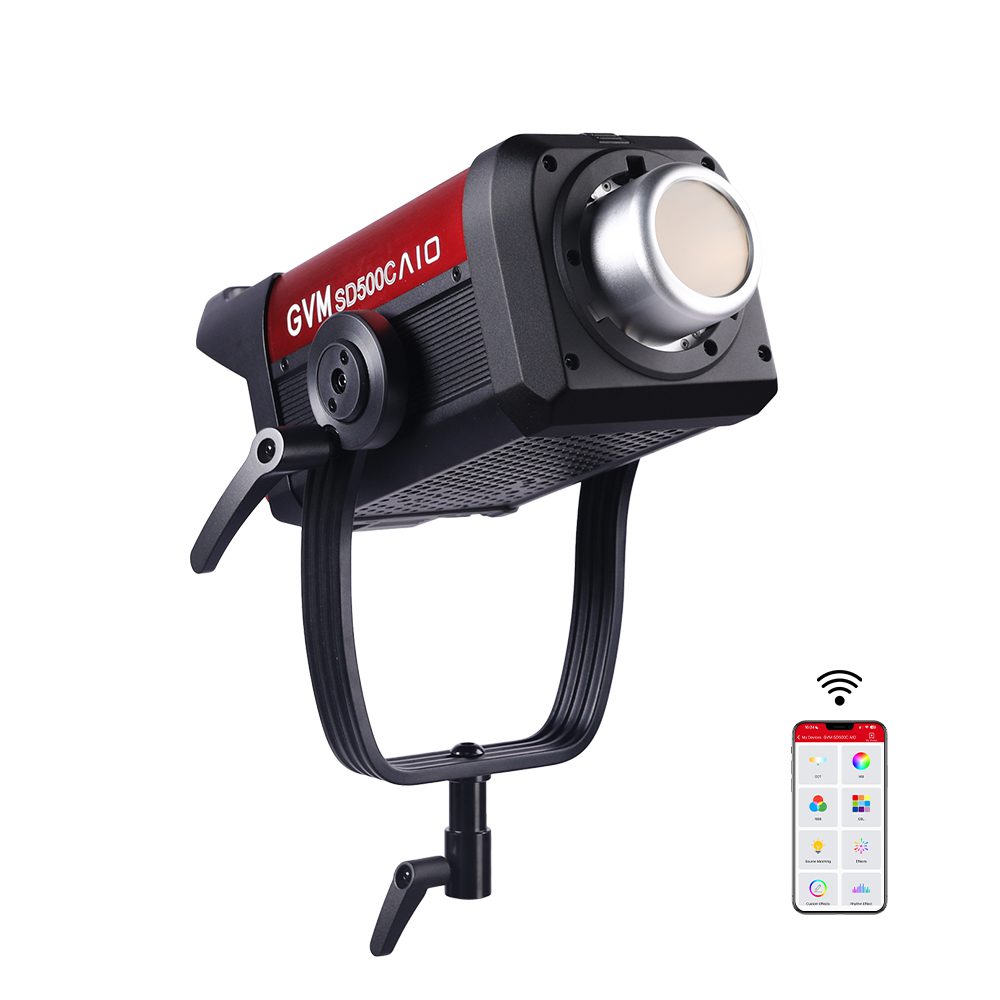
The Trade-Off Between Power and Portability
For years, professional lighting followed a fairly predictable formula:
More power meant more hardware.
A high-output fixture needed larger thermal-management components, power electronics, structural support, and often a separate ballast or control box. As power increased, portability usually suffered.
This created a practical divide.
Smaller lights were easy to carry but limited in output. Larger lights delivered the intensity required for professional work but demanded more space, more setup time, and more transportation capacity.
Modern LED engineering has begun to challenge that assumption.
The question is no longer simply, How much light can we produce?
It is also:
How much of the hardware can we remove without compromising the light?
That is where integrated designs become important.
What Does “All-in-One” Actually Change?
An All-in-One fixture brings components that were traditionally separated into the light body itself.
The concept sounds straightforward, but its practical effect is significant.
Instead of carrying a lamp head, external power supply, and control unit as separate pieces, the system is consolidated into one fixture. The result is a cleaner setup with fewer components to mount, connect, and pack away.
This is especially useful for photographers and filmmakers who work alone.
Consider a simple portrait session. You arrive with a camera, lenses, stands, modifiers, and one powerful key light. Every additional box and cable adds another decision to the setup.
A compact integrated fixture removes some of that friction.
The fewer things that need to be connected, the less time is spent preparing to shoot.
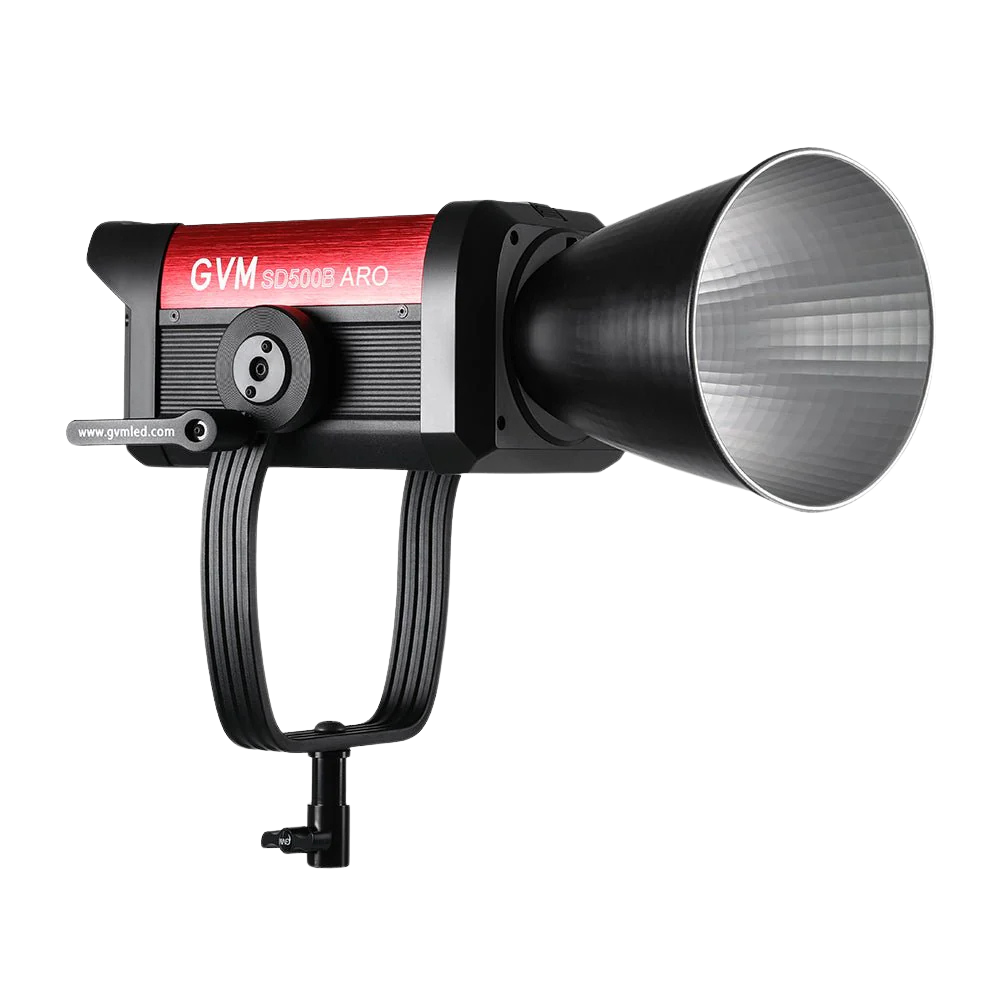
Why Flat-Top Designs Are Interesting
The shape of a lighting fixture is closely connected to how it manages space.
Traditional COB lights tend to have a deeper lamp-head structure because the light engine, heat management, reflector geometry, and other components are arranged along a relatively deep optical path.
A flat-top design approaches that problem differently.
Instead of extending deeply from the front to the back, the fixture is engineered around a much slimmer profile. This does not automatically make a light better. A thin fixture still has to deal with heat, power, optical performance, and structural strength.
That is the engineering challenge.
The benefit appears when the light leaves the studio.
A slimmer fixture can be easier to stack in a case, easier to transport between locations, and easier to position in spaces where a conventional light would feel oversized.
For location photographers, those small differences accumulate quickly.
Does Smaller Mean Less Powerful?
Not necessarily.
Power and physical dimensions are related, but they are not the same measurement.
A 500W fixture can be physically compact if its power system, LED engine, thermal structure, and housing have been engineered efficiently. Conversely, a physically large fixture is not automatically more powerful or more efficient.
This distinction matters when evaluating modern lighting equipment.
A light’s size only tells you how it fits into your setup. What matters more is how it performs—its output, color accuracy, cooling, control, and compatibility with the modifiers you already use.
A compact fixture is useful. A compact fixture that delivers consistent, professional results is what really counts.
Where Color Performance Enters the Equation
Portability would mean very little if the light sacrificed color quality.
For photography, the subject is often the final judge.
Skin tones need to remain believable. Product colors need to stay consistent. Fabrics, makeup, and subtle tonal differences can all reveal weaknesses in a light source that may not be obvious when looking at the fixture itself.
This is an important point about portable lighting:
Portability should reduce the equipment you carry, not the quality you capture.
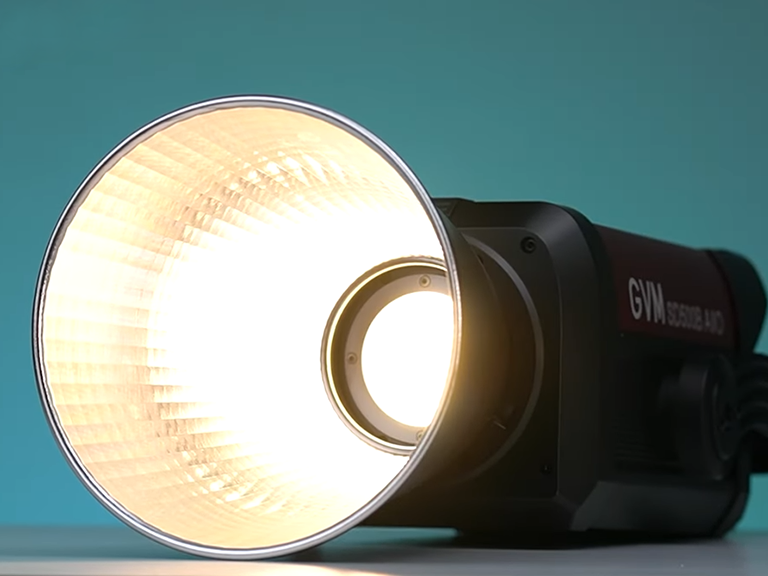
A Closer Look at the GVM FA500B AIO
Il GVM FA500B AIO takes this approach and pushes it into the 500W class.
Its defining idea is simple: put professional-level output into a thin, integrated body rather than making the user build a lighting system around a separate control box.
Il FA500B AIO combines the controller, power system, and cooling components into its AIO housing. A single AC connection is enough to get the fixture running, reducing the collection of boxes and cables normally associated with high-output lighting.
It delivers up to 500W of output while retaining a flat, slim profile. GVM lists an output of up to 98,300 lux at 1 meter with the reflector, placing it firmly in the professional 500W category.
The light also keeps a full-size Bowens mount, so the thinner body does not require photographers to abandon the modifier ecosystem they already know. Softboxes, reflectors, Fresnels, and other Bowens accessories remain available.
That combination is what makes the design useful.
500W performance, professional color, and a form factor built around mobility.
Thin Does Not Mean Minimal
A useful professional light should not force you to choose between portability and control.
Il FA500B AIO illustrates this balance. Its 2700K–6800K bi-color range allows the color temperature to be adjusted continuously rather than relying on physical gels for every change. Its high-frequency dimming system is designed for demanding photographic and video applications, while its Bowens mount keeps the fixture compatible with a broad range of modifiers.
The point is not to remove features.
It is to remove unnecessary bulk.
That distinction is important.
Good equipment often feels simple not because less technology is inside it, but because the technology has been arranged more intelligently.
| Caratteristica | GVM FA500B AIO |
| Il migliore per | Studio, Film & Video, On-Location |
| Potenza in uscita | 500W Professional Output |
| Temp. colore | 2,700K – 6,800K |
| Modalità di colore | Bicolore |
| CRI / TLCI | 97+ / 98+ |
| Oscuramento | Stepless 0–100% |
| Portabilità | Ultra-Slim Flat-Top AIO Design |
| Peso | 3.7kg / 8.15lb |
| Control Type | On-Board + GVM App / Bluetooth |
| Montaggio | Attacco Bowens standard |
| Alimentazione | AC 100–240V |
| Raffreddamento | Heat Sink + Cooling Fan |
The Future of Portable Lighting May Be Flat
Lighting technology has always been shaped by constraints.
Photographers want more output, but less weight. More control, but fewer cables. Larger modifiers, but smaller cases. Professional performance, but equipment that can still fit inside a working creator’s kit.
Those demands seem contradictory until engineering finds a way to bring them together.
That is what makes the evolution toward thin, integrated lighting worth watching.
Il GVM FA500B AIO does not attempt to make 500W of professional lighting disappear. Instead, it makes the hardware surrounding that power less intrusive—putting the controller, power system, cooling, and light source into a single flat, portable body.
And perhaps that is the more useful definition of The thinnest photography light.
Not simply a light that takes up less space.
A light that gives some of that space back to the photographer.