Walk into any online forum where new video shooters are asking about gear and you’ll find the same confusion repeating itself: rows of LED panels, COB monolights, ring lights, and tube fixtures, all claiming to be “the” light to buy. For anyone just starting out, that wall of options is genuinely paralyzing.
The fixture that actually cuts through the noise for most working setups in 2026 is the video focusing led light — a single COB source that adjusts its beam from a tight spot to a wide flood, doing the job of two or three older-style fixtures at once. This breakdown walks through why that category has taken over, what to check before buying one, and a real interview setup where a focusing light solved a problem a fixed-beam panel couldn’t.
Indice dei contenuti
Continuous Lighting for Photography in 2026
Continuous lighting used to mean compromise — a fixed beam, a fixed color temperature, and a lot of clip-on diffusion trying to make a raw source usable. That’s not where the category sits anymore. A modern COB fixture can shift color temperature at a dial, run cool enough to sit close to a subject, and — increasingly — zoom its own beam angle without a separate lens accessory. Testing a handful of these fixtures side by side on interview and product setups this year, the difference between a fixed panel and a focusing COB shows up immediately: less time re-rigging between shots, and more consistent output as the beam angle changes rather than as a brightness step.
What Makes the Best Lights for Photography
Not every spec on a product page matters equally once a light is actually in use. A few things consistently separate a genuinely good fixture from one that just looks good on paper:
- High CRI and TLCI, both in the high 90s — the gap between accurate skin tones and skin tones that need correcting in post.
- A workable CCT range, ideally spanning warm tungsten through daylight, so one fixture covers most interior and exterior scenarios.
- Real stepless dimming, with more than one dimming curve, so fades and subtle exposure pulls don’t look mechanical.
- Quiet cooling, since fan noise bleeding into a dialogue track is one of the most common — and most avoidable — audio problems on a set.
- Beam control, ideally adjustable rather than fixed, which is exactly where focusing lights pull ahead of standard panels.
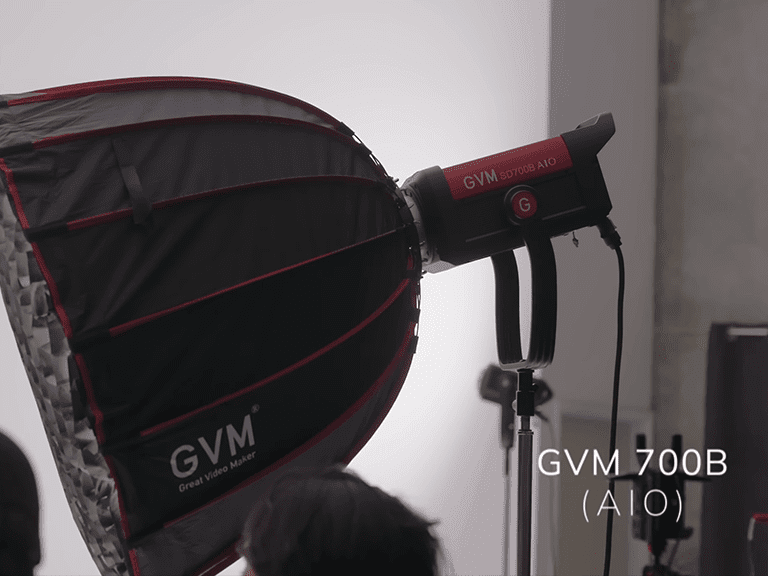
Photography Light Box vs. Focus Lights
For a long time, the answer to “how do I make this light usable” was to attach something to the front of it — a softbox, a diffusion dome, a light box built specifically to knock down harsh output from a raw panel or COB reflector. That approach still has its place, but it was always solving one problem: softness. It never solved control over where the light actually goes.
A focusing led light approaches the same problem from a different angle. Instead of always softening the beam, it lets you physically narrow or widen it at the source. A softbox makes a light softer everywhere; a focus knob lets you decide how tight or how broad the light should be for that specific shot, then adjust again without swapping hardware.
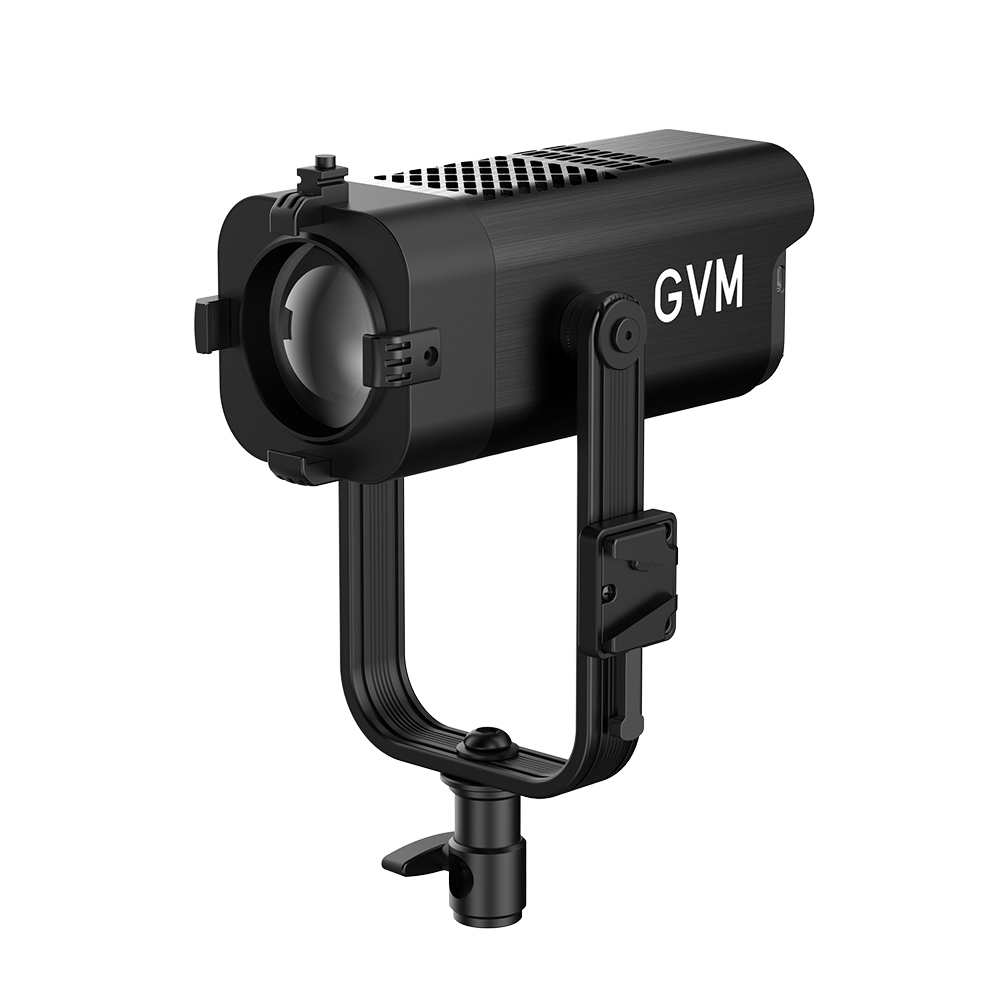
Focusable Video Light: Why This Category Took Over
This is where the GVM PF100B earned a permanent spot in testing rotation. It’s a 100W bi-color focusing COB light that zooms from a 15° spot to a 45° flood using a TIR optical lens, with CRI and TLCI both rated above 97 — numbers that held up consistently across repeated interior test shoots rather than only in a single best-case reading. Output reaches 30,200 lux at 1 meter in spot mode, more than enough punch for a key light at real working distance, and the CCT range runs 2700K to 6800K so it covers warm practicals through daylight without a gel change.
What matters just as much day-to-day is the integrated design — no separate ballast box, no extra cable run, just the light head with everything built in. Silent Mode kills the fan entirely for quiet dialogue takes (output drops to 10–20W while active, worth knowing before relying on it as a key light), and four dimming curves — Linear, Log, Exponential, S-Curve — mean a fade actually reads as a fade instead of visible steps.
| Caratteristica | GVM PF100B Specification |
|---|---|
| Potenza | 100W Bi-Color COB |
| Intervallo CCT | 2700K–6800K |
| CRI / TLCI | ≥97 / ≥97 |
| Angolo del fascio | 15°–45° (zoom focus, TIR lens) |
| Output (Spot) | 30,200 lux @ 1m |
| Oscuramento | 0–100% stepless, 4 curves |
| Modalità di illuminazione | CCT / Source Matching (12 sources) / Effects (12 FX) |
| Raffreddamento | Intelligent, High-Speed, Silent, Passive |
| Montaggio | Mini Bowens |
| Opzioni risparmio energia | AC 100–240V or V-mount battery |
| Peso | 1.53 kg |
| Controllo | On-board + GVM Mesh Bluetooth app (≤50m) |
| Prezzo | $299 (promo, regular $399) |
How to Focus an LED Light: A Real Interview Setup
The case where a focusing light stops being a nice-to-have and becomes the obvious choice is a single-subject documentary-style interview. On a recent setup like this, the beam was dialed to a tight 15–20° spot and aimed directly at the subject’s face — narrow enough to build genuine eye light and carve separation between the face and the background without needing a second dedicated rim light. A second look at the same shot, zoomed out to a 40–45° flood, laid down soft, even coverage across the background wall instead, giving the frame a clean base tone without a second fixture running.
The real payoff came when the interview shifted from a wide shot to a tighter close-up mid-conversation. On a fixed-beam panel, that shift usually means stopping to re-rig — moving the light, adding or removing diffusion, re-metering. With the beam angle adjustable at the fixture itself, the same light stayed in place and simply refocused between spot and flood as the framing changed, keeping the setup intact and the subject comfortable instead of interrupting the flow of the conversation for a lighting adjustment.
Best Portable Focusable LED Video Light for 2026
Weighing everything against real shoot conditions rather than spec-sheet bragging rights, the case for a focusing COB light over a traditional fixed panel comes down to fewer fixtures doing more jobs. The GVM PF100B in particular earns its place in a portable kit specifically because the ballast-free, integrated build keeps total weight down to 1.53 kg while still delivering enough output and beam range to handle both key and background duties from a single head — a genuine advantage for anyone who has to carry their own gear between locations.
Conclusione
A video focusing led light isn’t a niche upgrade anymore — it’s becoming the default choice for anyone who needs one fixture to behave like several. Between accurate color rendering, adjustable spot-to-flood control, and an integrated build that skips the extra ballast box, a light like the GVM PF100B removes a lot of the re-rigging that used to eat into shoot time. For photography and video work heading into 2026, that adaptability is worth more than another few thousand lux on a spec sheet.

FAQ
What is a video focusing led light?
It’s a COB LED fixture with an adjustable lens that zooms the beam from a tight spot to a wide flood, letting one light handle both directional key lighting and broader fill without swapping modifiers.
Is a focusing light better than a light box or softbox setup?
They solve different problems. A softbox or light box softens output; a focusing light controls beam width at the source. Many setups still use both together.
How does the GVM PF100B perform for interview lighting?
Zoomed to a tight spot, it can build eye light and subject-background separation on a single person; zoomed to flood, the same fixture can evenly light a background wall, useful when a shoot moves between wide and close framing.
Does Silent Mode affect brightness on the PF100B?
Yes — with the fan disabled for quiet audio, output drops to roughly 10–20W, which is worth planning around if the light is doing double duty as a key source.
Is the PF100B suitable for on-location shoots?
Yes. It supports AC power for studio use and an optional V-mount battery for location work, and its integrated, ballast-free design keeps it light enough to move between setups quickly.