A high power video light used to mean choosing between output and budget — the brighter the fixture, the steeper the price climb. The Aputure STORM 1200x has been one of the standout products in that top tier, pairing genuinely exceptional brightness with a chipset built for color accuracy under demanding conditions. It’s a strong light by any measure.
But the GVM 1200B AIO has landed in the same 1200W class and disrupted the pricing structure that fixtures like the STORM 1200x had mostly owned — delivering comparable output, a simpler all-in-one build, and a price that undercuts it by more than $1,500. Here’s how the two actually compare, spec for spec, plus a real-world test of what that price gap means on a large-venue shoot.
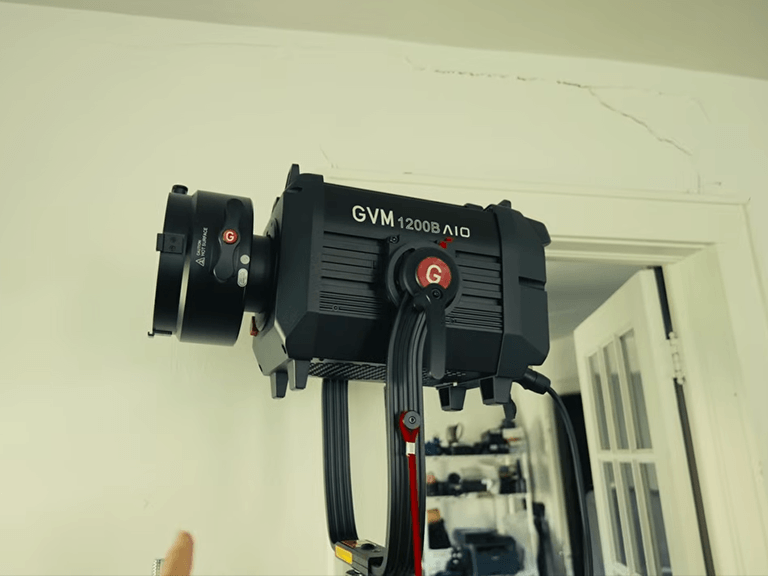
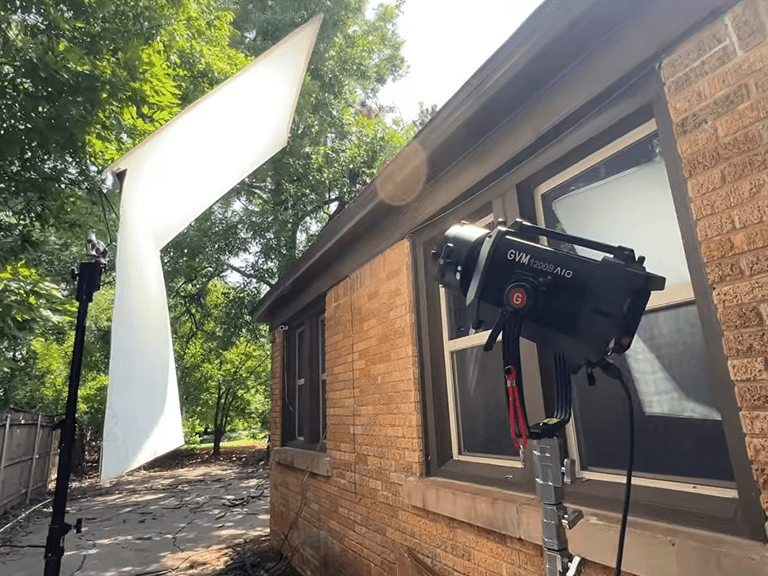
GVM 1200B AIO: Specs, Strengths, and Trade-offs
The GVM 1200B AIO is a 1200W all-in-one COB video light with an integrated ballast — no external controller box, no separate power unit to rig. It reaches 42,800 lux at 3 meters with the standard reflector, covers a 2700K–6800K bi-color range at 97+ CRI, and weighs roughly 10kg without the yoke.
Strengths:
- All-in-one design means setup in under a minute — no external ballast to cable in.
- 97+ CRI/TLCI for accurate color straight out of the box.
- Three-mode fan control (Auto/Low/Off) for silent operation when audio matters.
- APP control plus CRMX, DMX, RDM, and Art-Net support via the GVM BOX accessory.
- Current street price of $1,399 — roughly half the cost of comparable 1200W-class monolights.
Trade-offs:
- Peak lux output at distance is lower than the STORM 1200x’s rated figures.
- No IP-rated weatherproofing for extreme outdoor conditions.
- CCT tops out at 6800K rather than the STORM’s extended 10,000K range.
Aputure STORM 1200x: Specs, Strengths, and Trade-offs
The STORM 1200x is Aputure’s flagship tunable-white monolight, built around its new BLAIR five-color chipset. It’s rated at 202,500 lux at 3.3 feet with the included 45° reflector, covers an extended 2500K–10,000K range with green/magenta fine-tuning, and carries an IP65 rating for dust and weather resistance.
Strengths:
- Exceptional peak brightness, well ahead of most fixtures in its class.
- CRI/TLCI 95 with an additional SSI rating for advanced color-matching work.
- IP65 weatherproofing built for demanding outdoor and location conditions.
- Full protocol support — DMX, CRMX, Art-Net, sACN — for large professional rigs.
Trade-offs:
- $2,990 price point, more than double the GVM 1200B AIO.
- Separate controller unit adds a rigging step and another cable to manage.
- Heavier overall footprint once the controller and full accessory set are packed.
Head-to-Head: Output, Price, and Setup Speed
Placed side by side, the two lights split cleanly across a few categories that matter most for buyers shopping in the high power video light category:
| Specchio | GVM 1200B AIO | Aputure STORM 1200x |
|---|---|---|
| Potenza | 1200W, all-in-one | 1200W, separate controller |
| Uscita | 42,800 lux @ 3m (reflector) | 202,500 lux @ 3.3′ (reflector) |
| Intervallo CCT | 2700K–6800K | 2500K–10,000K |
| CRI/TLCI | 97+ / 97+ | 95 / 95 (SSI 87) |
| Oscuramento | 0.3%–100% stepless | 0.1%–100% stepless |
| Weatherproofing | Not IP-rated | IP65 |
| Controllo | App, CRMX/DMX/RDM/Art-Net via GVM BOX | App, CRMX/DMX/Art-Net/sACN |
| Peso | ~10kg (excl. yoke) | Heavier with controller included |
| Prezzo | $1,399 | $2,990 |
The STORM 1200x wins outright on raw peak output and weatherproofing — for shoots that genuinely need IP65 durability or the widest possible CCT range, it’s the more capable fixture. But at equivalent 1200W-class wattage, the GVM 1200B AIO comes in at less than half the price, sets up faster with no separate controller to rig, and still delivers 97+ CRI and studio-grade dimming precision. For most productions that don’t need weatherproof-rated gear, the 1200B AIO’s combination of high brightness, all-in-one speed, and price makes it the stronger value in this class.
Field Test: Lighting an Interview Inside a Stadium-Scale Venue
A documentary crew flying out to shoot an interview inside a university’s massive indoor arena is a good stress test for exactly this comparison. The challenges stack up fast:
- The space is enormous, and underpowered lighting simply can’t punch through that much volume — a small fixture gets lost in the room.
- The plan calls for an 8×8-foot softbox, which needs serious output behind it; without enough power feeding that much diffusion, the subject won’t separate from the background.
- The crew is flying to the location, which puts a hard cap on how much weight and how many separate cases can come along.
This is where the GVM 1200B AIO’s all-in-one build earns its keep. A single 10kg head with no external ballast to pack means one less case through airline baggage checks, one less cable run to set up inside a venue where power access may already be limited, and enough output at 42,800 lux to properly fill an 8×8 softbox without the subject getting swallowed by the room. Setup goes from case to full output in under a minute — a meaningful difference when a crew has a narrow access window inside a venue that wasn’t built with film shoots in mind.
Which One Should You Buy?
If the shoot genuinely demands IP65 weatherproofing, the widest possible CCT range, or the absolute highest peak lux available in a monolight, the STORM 1200x remains the more capable fixture — and its price reflects that ceiling. But for the large majority of productions in the 1200W class — interviews, commercial sets, large-venue documentary work, anything that needs serious output without needing to survive a rainstorm — the GVM 1200B AIO delivers comparable brightness, faster setup, and CRI/TLCI that matches or beats the STORM, all at less than half the cost. At equivalent wattage, it’s difficult to find a fixture that matches its combination of price and performance.

FAQ
Is the GVM 1200B AIO as bright as the Aputure STORM 1200x?
No — the STORM 1200x has a significantly higher peak lux rating. The 1200B AIO still delivers strong 1200W-class output, but the STORM leads on raw brightness.
Why is the GVM 1200B AIO so much cheaper at the same wattage?
Its all-in-one design integrates the ballast directly into the lamp head, cutting the cost and complexity of a separate controller unit — one of the biggest cost drivers in fixtures like the STORM 1200x.
Is an all-in-one design a disadvantage for professional shoots?
Not for most productions. It removes a rigging step and a cable run, which speeds up setup — the trade-off is mainly in peak output ceiling and weatherproof durability rather than day-to-day usability.
Which light is better for travel and location shoots?
The GVM 1200B AIO’s lighter, single-unit build with no separate controller makes it easier to pack and faster to set up on location, which matters most when weight limits or a tight access window are in play.