Finding the best professional studio lighting isn’t as simple as picking the brightest fixture on a spec sheet. A suitable continuous lighting for photography setup has to balance two things that usually pull in opposite directions: price and how the light actually gets used on set.
A fixture that’s affordable but underpowered forces compromises on aperture and ISO; one that’s powerful but overpriced eats into a budget that could have gone toward modifiers, stands, or a second head. Getting this balance right is exactly what separates a studio that runs efficiently from one that’s constantly working around its own gear.
Indice dei contenuti
What Is a Continuous Light in Photography?
A continuous light is any fixture that stays on and produces a steady output, as opposed to a flash or strobe that fires a single burst. In practical terms, this usually means an LED panel or COB (chip-on-board) spotlight with adjustable brightness and, in most modern fixtures, adjustable color temperature as well.
The appeal is straightforward: what you see through the viewfinder or on a monitor is what you get. There’s no guessing at flash exposure or chimping through test shots to dial in a look — the light is already visible and adjustable in real time. Most professional-grade continuous LEDs today also include bi-color or full RGB control, CRI/TLCI ratings above 95, and some form of app, DMX, or onboard control for fine-tuning brightness without walking back to the fixture.
Product Photography Lighting
Product photography has changed shape over the last few years. It’s no longer just about capturing a clean still image for a listing page — most product content now needs to double as short-form video, whether that’s a 360° spin, an unboxing clip, or a quick demo for social. That shift is a big part of why continuous lighting has become the default choice for product work rather than flash.
A flash-based setup can deliver excellent stills, but the moment a client asks for video from the same setup, a strobe becomes useless — it only fires for photos. A continuous LED, on the other hand, lights the product identically whether the camera is capturing a single frame or rolling video, which means one lighting setup covers both deliverables without a second rig.
Continuous Light vs Flash Photography
The comparison usually comes down to a few practical differences:
- Video capability: Continuous lights work for both photo and video; flash only works for stills.
- Power output: Flash units can still hit higher peak output per burst, which matters for freezing fast motion or overpowering bright ambient light.
- Heat and modeling: Continuous LEDs let you see shadow falloff and highlight placement in real time; flash requires a modeling lamp or test shots to judge the same thing.
- Battery/run time: Continuous fixtures draw power constantly, so battery-based rigs need to account for sustained draw rather than short bursts.
- Workflow speed: For fast-paced shoots that mix stills and video in the same session, continuous light removes the need to reconfigure between formats.
For most product, portrait, and interview work, continuous LED wins on flexibility. Flash still holds an edge in pure-stills, high-motion, or overpowering-daylight scenarios.
Product Photography Light Box
For small products — jewelry, electronics, cosmetics — a light box (or light tent) paired with a continuous LED source is one of the most efficient setups in product photography. The diffusion material of the box scatters the light evenly around the product, eliminating harsh shadows and hot spots without needing multiple fixtures.
The key is matching the light box to a source with enough output and an accurate color temperature to begin with — a dim or color-inaccurate LED forces long exposures or heavy color correction in post, which defeats the purpose of using a light box in the first place. A single bi-color or full-spectrum COB source positioned above or beside the box is usually enough to cover most small-product setups.
Best Continuous Light for Photography
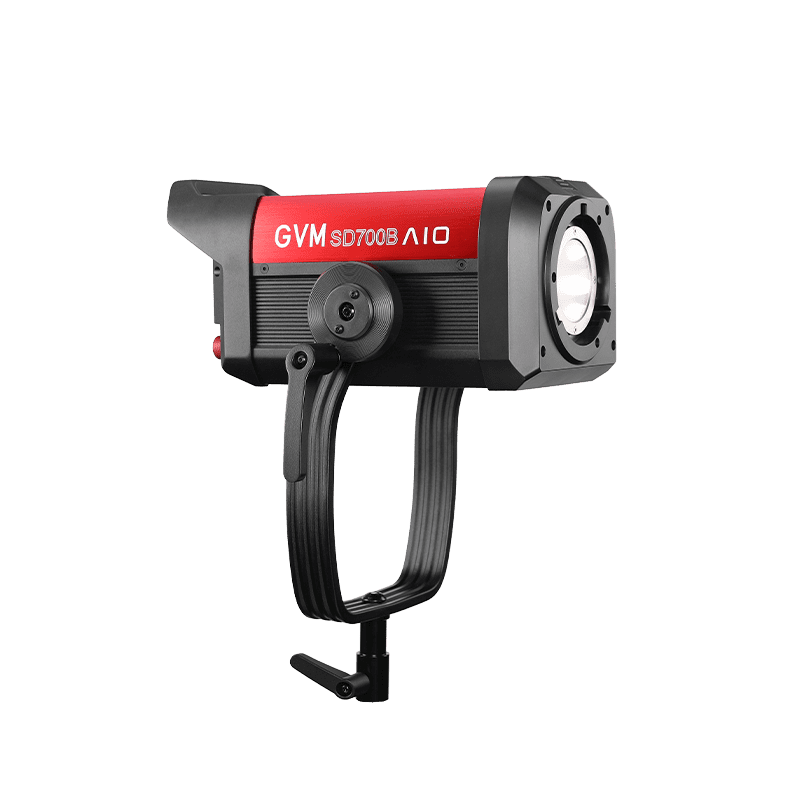
When it comes to picking the best professional studio lighting for continuous work, the GVM SD700B All-in-One is one of the strongest all-in-one options available in 2026. It’s a 700W bi-color LED with app control, a CRI/TLCI rating of 97+, and 29,100 lux output — specs that put it squarely in professional territory for interviews, product shoots, and film sets that need flicker-free precision.
The SD700B AIO’s all-in-one body means there’s no separate power supply to rig, which keeps setup fast and the footprint small on a busy set. Stepless dimming from 0.1% to 100% holds color temperature steady at every intensity level, and the 2700K–6800K range covers both warm and cool scenarios without swapping gels. Twelve built-in cinematic effects — Lightning, Paparazzi, TV Flicker, Candlelight, Explosion, Welding, and more — add creative options without needing separate gear, and a Bowens mount keeps it compatible with softboxes, reflectors, and diffusers already in most studios.
| Caratteristica | GVM SD700B All-in-One |
|---|---|
| Potenza | 700W bi-color, all-in-one integrated design |
| Temperatura del colore | 2700K–6800K |
| Precisione del colore | CRI ≥ 97, TLCI ≥ 97 |
| Uscita | 26,200 lux at 3m (standard reflector); 29,100 lux rated output |
| Oscuramento | 0.1%–100% stepless, flicker-free |
| Effetti | 12 built-in cinematic effects |
| Controllo | Bluetooth app, 5-pin DMX, CRMX wireless |
| Montaggio | Bowens mount, compatible with softboxes and modifiers |
| Build | Compact, all-in-one with integrated carry handle |
How It Compares to Other Pro-Grade Continuous Lights
At the higher end of the continuous lighting market, the Nanlite FC720B is a common comparison point. It’s a capable 750W fixture with a similarly wide CCT range and strong DMX/RDM control, but it separates the light head from its power supply, and its $499 street price sits meaningfully above the SD700B AIO’s positioning for a comparable feature set.
| Specchio | GVM SD700B All-in-One | Nanlite FC720B |
|---|---|---|
| Potenza | 700W, all-in-one | 750W, separate head/power supply |
| Intervallo Temperatura Colore | 2700K–6800K | 2700K–6500K |
| CRI/TLCI | 97+ / 97+ | 96 / 98 |
| Oscuramento | 0.1%–100% stepless | 0–100% in 0.1% increments |
| Controllo | App, DMX, CRMX wireless | App, DMX/RDM, 2.4GHz |
| Design | Integrated, no separate power box | Separated head and power supply |
| Price Positioning | Lower cost for comparable output | $499 street price |
Both fixtures land in similar performance territory, but the all-in-one design of the SD700B AIO removes a rigging step the FC720B still requires, and it does so at a lower price point for a comparable feature set — which is exactly the combination that matters most when the goal is the best professional studio lighting per dollar spent rather than the highest number on a spec sheet alone.

FAQ
Is continuous LED lighting good enough for professional photography?
Yes — modern continuous LEDs with CRI/TLCI ratings above 95 and wide bi-color ranges are now standard in professional studios, especially for work that mixes stills and video.
Do I need flash if I already have continuous lighting?
Not necessarily. Flash still has an edge for freezing fast motion or overpowering bright daylight, but for most studio, product, and interview work, continuous LED covers the job on its own.
What wattage do I need for product photography?
A single 200–700W bi-color LED is typically enough for most product setups, especially when paired with a light box or softbox to spread the output evenly.
Can one continuous light cover both photo and video needs?
Yes — this is the main advantage of continuous light over flash. The same fixture and exposure work for both stills and rolling video without reconfiguring the setup.
Conclusione
The best professional studio lighting for 2026 isn’t necessarily the fixture with the biggest number on the spec sheet — it’s the one that balances output, color accuracy, and workflow speed at a price that makes sense for how it’ll actually be used. The GVM SD700B AIO checks all three boxes: professional-grade brightness and color accuracy, an all-in-one design that skips extra rigging, and a price that undercuts comparable fixtures without giving up control options. For studios shooting both stills and video from the same setup, it’s a continuous light that earns its spot in the kit.