Finding the right light for content creators isn’t just about brightness — it’s about how fast a light gets set up, how well it adapts between locations, and whether it actually fits the way you shoot.
We tested and compared dozens of fixtures across studio and on-location shoots before narrowing this list down, and one thing became clear fast: the best light for content creators isn’t the one with the flashiest spec sheet — it’s the one that keeps up with how you actually shoot, session after session.
Whether you’re recording talking-head videos in a home studio, running a mobile vlog setup, or building an RGB-lit backdrop for short-form content, the wrong light slows you down before the camera even rolls. This guide breaks down what makes video lighting effective and reviews three lights built around different creator workflows.
Indice dei contenuti
What Is the Best Type of Light for Video?
The best light for video recording checks a few boxes regardless of budget or brand: consistent, flicker-free output at your working color temperature, a CRI/TLCI rating high enough to render skin tones accurately, and a form factor that doesn’t fight your space. Bi-color or fully tunable lights are especially valuable, since they let you match ambient room light or shift moods without swapping gels. Portability also matters more than most creators expect — a light that takes ten minutes to rig isn’t a light you’ll actually use every session.
Video Recording Lighting Equipment
A functional video lighting setup usually includes one key light, a modifier (softbox, diffusion panel, or bounce), and a stand capable of holding the fixture at eye level or slightly above. Beyond the core light, creators increasingly rely on companion app control for remote dimming and color adjustment, along with built-in effects presets that simulate real-world light sources — useful for matching a scene’s mood without manually dialing in settings shot by shot. The equipment list has gotten lighter over the past few years as manufacturers move control electronics directly into the lamp head, cutting down on the extra boxes and cables that used to define professional setups.
Migliori luci video per videografia
For videography specifically — where a light often needs to move between locations within a single session — setup speed and color accuracy tend to matter more than raw output. A videographer shooting interviews, product demos, or branded content benefits from a light that can go from case to camera-ready in under a minute, with color temperature control precise enough to match whatever ambient light is already in the room. That’s the lens we used to pick the three lights below.
Best Video Recording Lighting: Top 3 Compared
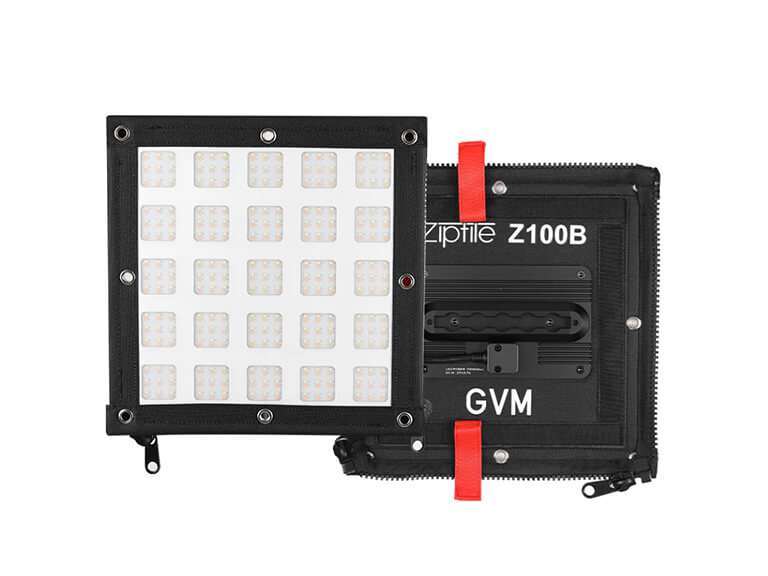
1. GVM Z100B Bi-Color LED Panel
The Z100B is built around a modular zipper-connection system — multiple panels snap together tool-free to expand coverage for larger sets, which makes it the most scalable option of the three. It offers a fully tunable 2,700K–6,800K color range and 12 professional lighting presets covering both artificial sources (HMI, tungsten, sodium vapor) and natural ones (sunset, overcast sky, candlelight), so creators can match a scene’s look with one touch instead of manual dialing. Its integrated control box sits directly on the back of the panel, eliminating extra cables.
| Caratteristica | Specifiche |
|---|---|
| Potenza | 100W bi-color LED |
| Temperatura del colore | 2,700K–6,800K |
| Lighting Presets | 12 (artificial + natural sources) |
| Connettività | Modular zipper connection, no tools required |
| Controllo | Integrated on-panel control box |
| Il migliore per | Expandable studio setups, consistent key lighting |
Pro: Tool-free scalability, wide preset library, clean integrated design.
Contro: As a panel light, it’s less suited to tight run-and-gun setups than a compact AIO monolight.
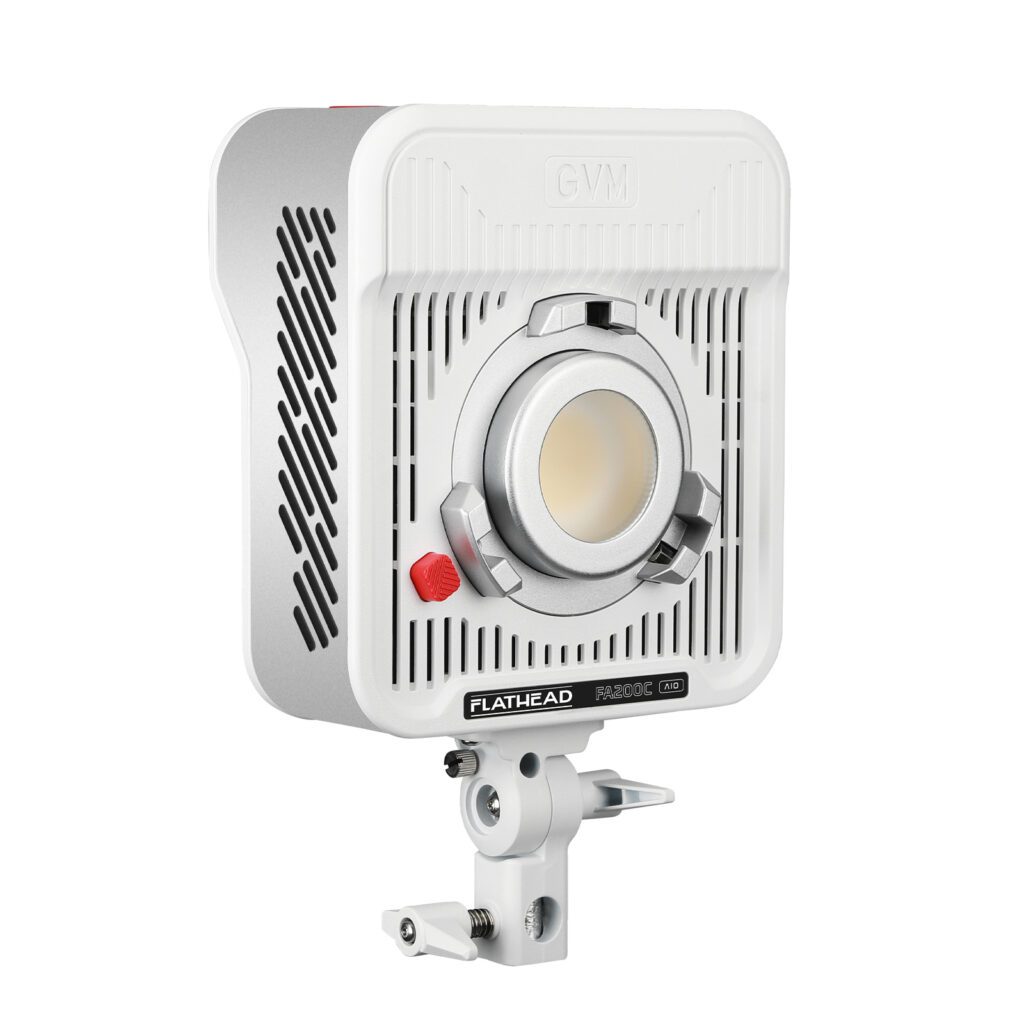
2. GVM FA200C AIO Portable Monolight
The FA200C AIO is built for creators who move between locations often. Its all-in-one panel-style design folds the lamp head, control system, and power supply into a single compact body, keeping the kit down to one cable and making it quick to break down between setups. Beyond CCT, it supports HSI, RGB, and GEL modes, so it doubles as both a clean key light and a color effects light. A mesh Bluetooth system also lets multiple GVM fixtures sync through the same app — useful once a creator’s kit grows beyond a single light.
| Caratteristica | Specifiche |
|---|---|
| Design | All-in-one panel-style monolight |
| Modalità di illuminazione | CCT / HSI / RGB / GEL |
| Temperatura del colore | 2,000K–10,000K |
| Illuminamento | 41,300 lux @ 1m (with optional reflector) |
| FX Effects | 16 built-in (Lightning, TV, Fireworks, Candle, Paparazzi, Emergency, etc.) |
| Controllo | Onboard + mobile app (mesh Bluetooth) |
| Montaggio | Attacco Bowens |
| Oscuramento | 0–100% stepless |
| Prezzo | ~$399 |
Pro: Fast breakdown and setup, single-cable design, wide 2,000K–10,000K range plus full RGB in one fixture.
Contro: As a single panel, output is lower than a modular setup for covering very large sets.
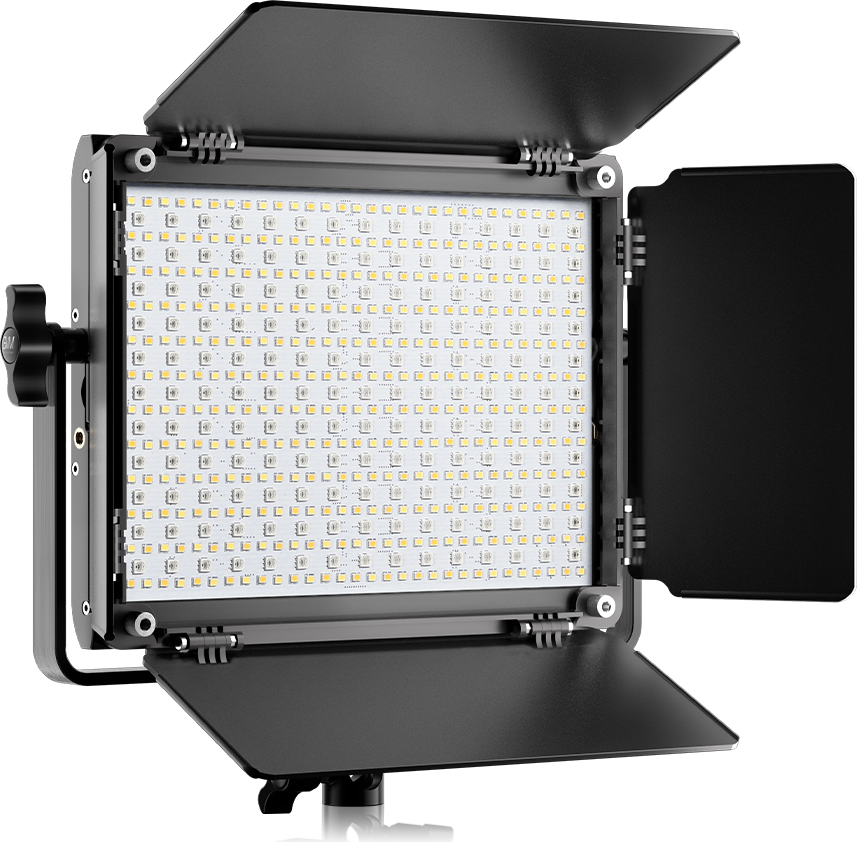
3. GVM 680RS RGB Full-Color Panel
The 680RS trades a single-purpose key light role for full RGB color output, making it the pick for creators who want mood lighting, colored backgrounds, or accent lighting for short-form video and streaming. Built around 560 LED beads for even output, it covers a 3,200K–5,600K bi-color range alongside full-range RGB, and includes practical touches — a built-in LCD display, integrated four-leaf barn doors, and an aluminum housing for heat dissipation — that make it easy to dial in on set. It’s less of a primary key light and more of a creative layer added on top of a main light source like the Z100B or FA200C AIO.
| Caratteristica | Specifiche |
|---|---|
| Design | RGB panel light, aluminum housing |
| LED Count | 560 LED beads |
| Temperatura del colore | 3,200K–5,600K (bi-color) |
| Controllo del colore | Full-range RGB (hue, saturation, brightness) |
| FX Effects | 18 built-in lighting effects |
| Controllo | Onboard LCD display + mobile app |
| Extras | Integrated four-leaf barn doors |
Pro: Full-color creative flexibility, on-fixture LCD for quick adjustments, barn doors included for spill control.
Contro: Narrower CCT range than the other two — not built to be a sole key light for accuracy-critical shoots.
Migliore Luce per Content Creator
There isn’t one single best light for content creators — the right pick depends on whether you’re shooting fixed studio content, moving between locations, or building a stylized backdrop. For creators building a first serious lighting setup, the GVM Z100B is the strongest all-around starting point: its scalability and preset library cover the widest range of shooting scenarios. The FA200C AIO is the pick for creators who need one fixture that handles both a clean key light and full RGB effects without carrying two lights, and it’s the highest-output option of the three at 41,300 lux. Add the 680RS when a project calls specifically for RGB backdrop or accent color. Together, the three cover the situations most video creators actually run into, without requiring a full studio’s worth of gear to get professional-looking results.

Domande frequenti
What is the best light for content creators on a budget?
For most content creators, a single bi-color panel like the GVM Z100B offers the best balance of price and versatility — its tunable 2,700K–6,800K range and built-in presets cover interviews, talking-head videos, and basic product shots without needing multiple fixtures.
Do I need more than one light for video recording?
Not always. A single well-placed key light with a modifier is enough for most talking-head or interview-style content. Multiple lights become useful once you add background separation, RGB accent color, or need to light a larger set.
What color temperature is best for video recording?
Most indoor video recording looks natural between 3,200K (warm/tungsten) and 5,600K (daylight). A bi-color or fully tunable light lets you match whatever ambient light is already in the room instead of being locked to one setting.
Is an RGB panel necessary for video recording lighting?
No — RGB panels like the 680RS are a creative add-on for mood lighting or colored backgrounds, not a replacement for a primary key light. Most setups only need RGB once the core lighting (key and fill) is already handled.
What’s the difference between a panel light and an all-in-one (AIO) monolight?
A panel light like the Z100B spreads LEDs across a flat surface for soft, even output and is easy to scale by adding more panels. An AIO monolight like the FA200C consolidates the lamp head, power supply, and controls into one compact body, prioritizing portability and fast setup over modular expansion.