
LED cinema lighting decisions usually come down to four practical needs: output, light control, color accuracy, and deployment speed. Both the GVM FA500C AIO and the GVM PRO-SD500B are strong 500W-class options, which is exactly why many buyers struggle to choose between them.
They are not duplicates. One is a compact full-color all-in-one monolight. The other is a higher-output bi-color system with a separate controller and stronger studio-oriented features. The better choice depends on workflow, not just wattage.
Indice dei contenuti
Positioning Difference: Portable Full-Color vs Split Professional Bi-Color
| Caratteristica | GVM FA500C AIO | GVM PRO-SD500B |
|---|---|---|
| Design | Flat all-in-one compact body | Split head + separate controller/ballast |
| Potenza | 500W | 500W |
| Color System | Full-color: CCT / HSI / RGB / GEL | Bi-color focused |
| Intervallo CCT | 2000K–10,000K | 2700K–6800K |
| Precisione del colore | CRI ≥97 / TLCI 97+ | CRI 97+ / TLCI 97 |
| Uscita | 19,000 lux @ 1 m (bare) | 16,800 lux @ 1 m bare / 61,600 lux @ 1 m with reflector |
| Peso | 3.7 kg | Fixture 5 kg + controller 2.6 kg |
| Opzioni risparmio energia | AC integrated | AC + V-mount battery support |
| Controllo | Onboard + App Mesh + NFC | Onboard + App Mesh + DMX/RDM |
| Montaggio | Bowens | Bowens |
| Best Fit | Solo creators, mobile teams, creative color work | Studio setups, realistic lighting, DMX environments |
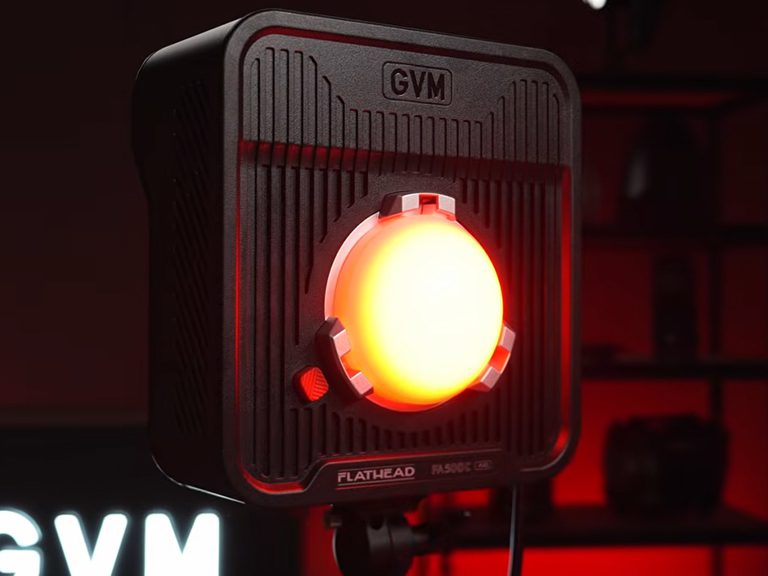
GVM FA500C AIO: Compact Full-Color Cinema Light
The FA500C AIO is built around speed and flexibility. Its flat all-in-one body removes the external ballast, making it easier to move between rooms, small studios, and location setups.
Strengths
- True full-color system with CCT, HSI, RGB, and GEL
- Wide 2000K–10,000K range for both practical matching and creative looks
- Compact 3.7 kg body with integrated controls
- NFC and app control for fast setup
- Strong enough for interviews, portraits, product work, and compact cinema setups
Limitations
- AC-powered only
- Lower peak reflector-assisted output than the PRO-SD500B
- Silent mode reduces output significantly when the fan is restricted
Best use
Choose the FA500C when the priority is mobility, fast deployment, and color versatility in one fixture.
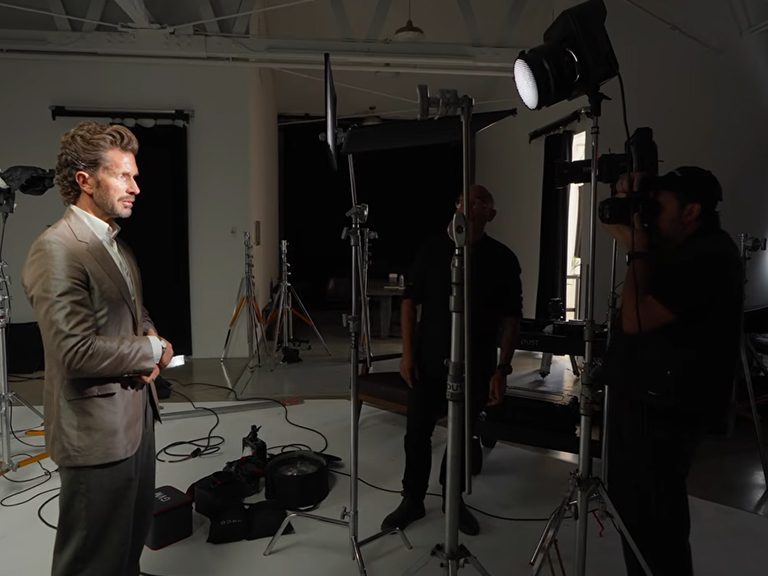
GVM PRO-SD500B: Studio-Oriented Bi-Color Power System
The PRO-SD500B is the more traditional professional path. It uses a separate controller and focuses on high usable output, precise dimming, and studio integration.
Strengths
- Very high output with reflector: up to 61,600 lux at 1 m
- Fine 0.1% dimming for precise exposure control
- Dual power support: AC and V-mount battery
- DMX and RDM for professional lighting control systems
- Quiet dual-fan cooling design for dialogue-sensitive sets
Limitations
- Heavier and less compact because of the split controller
- Bi-color only, so less suitable for advanced RGB/GEL creative work
- Takes more space and cable management than an all-in-one light
Best use
Choose the PRO-SD500B when the priority is maximum punch, realistic white-light work, battery flexibility, and DMX-based studio control.
Output and Control in Real Production
If the job is a clean interview or compact commercial setup, both lights can work. The difference appears in how you deploy them.
Il FA500C is faster to place as a soft key light with a Bowens softbox. Its wider CCT range and full-color modes also help when the scene needs gel-like accents, practical source matching, or stylized effects without extra fixtures.
The PRO-SD500B is stronger when you need higher intensity through modifiers, long-throw key light, or integration into a broader control network. With reflector-assisted output and DMX support, it behaves more like a core studio instrument than a travel-first monolight.
Which One Should You Choose?
Choose the FA500C if you need:
- solo or small-team operation
- fast setup in tight spaces
- full-color creative control
- a lighter all-in-one cinema light for mobile work
Choose the PRO-SD500B if you need:
- fixed or semi-permanent studio deployment
- maximum bare/reflector output for realistic scenes
- V-mount battery flexibility
- DMX/RDM control in a professional lighting system
For many teams, the two are complementary rather than competitive. FA500C can serve as a mobile key or accent light, while PRO-SD500B anchors the main studio rig.

FAQ
Is the FA500C good for LED cinema lighting?
Yes. Its 500W COB output, high color accuracy, and Bowens mount make it suitable for interviews, compact film setups, and creator cinema work.
Why does the PRO-SD500B look brighter on paper?
Because its reflector-assisted output is significantly higher. Measured performance depends heavily on modifiers and distance.
Does full-color matter more than bi-color?
Only if your work needs creative color, gel simulation, or stylized effects. For standard interviews and natural commercial lighting, bi-color is often enough.
Which is better for location shooting?
FA500C is easier to move as a single unit. PRO-SD500B is better when battery power and higher punch are required.
Can both use the same softboxes?
Yes. Both support Bowens mount modifiers.
Verdetto finale
The question is not which light is universally better. It is which LED cinema lighting workflow you are building.
Il GVM FA500C wins on compactness, full-color flexibility, and fast all-in-one deployment. The GVM PRO-SD500B wins on peak usable output, battery options, and studio-style control.
If your production moves often and needs creative color, start with the FA500C. If your production is built around high-output white light, DMX control, and studio reliability, the PRO-SD500B is the stronger core fixture. In many professional kits, the smartest answer is using both where each one performs best.