A kit di illuminazione that works perfectly in a home studio can fall apart the moment it has to survive an airport, a rental car trunk, and three different Airbnbs in a week. Travel changes the entire calculus of what makes lighting gear good — weight matters more than wattage, battery life matters more than app features, and a fixture that can’t fit in a carry-on becomes dead weight the moment checked baggage gets lost or delayed. Creators who film on location regularly learn this the hard way, usually after lugging a studio-oriented kit through security once and vowing never to do it again.
Below is what actually separates a travel-ready lighting kit from a studio kit that just happens to be smaller, how to pack one within airline carry-on limits, a pre-flight checklist worth running through before every trip, and a specific compact fixture built around exactly this use case.
Indice dei contenuti
What Makes a Lighting Kit Actually Travel-Friendly
“Compact” gets used loosely in gear marketing, but a genuinely travel-friendly lighting kit needs to clear a few specific bars that have nothing to do with a fixture simply being smaller than a studio light.
Weight matters more than output. A creator hauling a camera body, lenses, a laptop, and audio gear has a limited weight budget left for lighting. A light that adds noticeable heft to a bag gets left behind more often than one light enough to disappear into a side pocket — and a light left at home produces zero output, regardless of its specs.
Power flexibility isn’t optional. Outlets abroad vary, voltage isn’t guaranteed, and hotel rooms rarely have convenient plug placement near where you actually need light. A kit that depends entirely on AC power is a kit that fails the moment you’re somewhere without easy outlet access — which, on the road, is often.
Durability has to account for real handling, not studio handling. Gear that lives in a padded bag between two fixed points in a studio experiences a very different life than gear stuffed into a backpack, jostled through security scanners, and set up on uneven outdoor surfaces. Travel lighting needs to tolerate being handled like travel gear, not display gear.
Setup speed matters when you don’t control your schedule. A studio shoot can be planned around your lighting setup time. A travel shoot often can’t — golden hour doesn’t wait, and a subject won’t stand still while you troubleshoot a multi-piece rig. Fast, simple setup isn’t a convenience for travel work, it’s often the difference between getting the shot and missing it.
Packing a Lighting Kit That Fits Airline Carry-On Rules
Most international carriers cap carry-on bags around 22 x 14 x 9 inches (roughly 56 x 36 x 23 cm), though limits vary by airline and route — always check your specific carrier before a trip, since enforcement and exact dimensions differ more than people expect.
Prioritize lights with a small footprint over lights with a small “packed” claim. Some fixtures market themselves as compact but still require a stand, a separate ballast, and a case — check the actual combined footprint of everything you’d need to bring, not just the light head itself.
Batteries have their own rules, separate from bag size. Lithium batteries above certain watt-hour thresholds face restrictions on many airlines, and most require batteries to travel in carry-on rather than checked luggage regardless of size. Confirm your specific battery’s watt-hour rating against your airline’s policy before packing.
Pack lighting gear in the bag you’re least likely to be separated from. Checked baggage gets delayed or lost far more often than carry-on. If a shoot depends on having light on day one of a trip, that light belongs in the bag that stays with you through security, not the one that disappears into cargo.
Soft mounting and modifier accessories often take up more room than the light itself. A tabletop tripod, a small dome diffuser, or a mini clamp mount usually pack down smaller and more flexibly than a full light stand — worth prioritizing when carry-on space is the constraint, not the light itself.
Weigh your full kit before you leave, not just the light. Airlines increasingly enforce carry-on weight limits in addition to size, and a lighting kit that seemed light in isolation can push a bag over the limit once combined with camera gear.
Travel Lighting Kit Checklist Before You Fly
Run through this before every trip, not just the first one — travel requirements and battery rules change, and a checklist prevents the assumption that “it worked last time” carries over automatically.
- Confirm your airline’s current carry-on and battery watt-hour limits. Policies change and vary by carrier — don’t rely on memory from a previous trip.
- Check the plug and voltage standard for your destination. Confirm whether your light’s power adapter handles the local voltage automatically or needs a separate converter, not just a plug shape adapter.
- Pack a backup power option if the shoot is time-sensitive. A spare battery or a USB-C power bank compatible with your light removes the risk of a single depleted battery derailing a scheduled shoot.
- Test your full setup at home before departure, not on location. Confirm your light, its mount, and any modifiers actually work together as packed — discovering a missing adapter or incompatible mount is far cheaper to fix at home than abroad.
- Weigh your packed bag, not just estimate it. Combined with camera gear, a lighting kit that seemed reasonable in isolation can push a carry-on over the limit.
- Keep your light and its charging cable in the same pocket or pouch. Separated cables are one of the most common reasons travel gear ends up unusable on location despite being packed correctly.
Best Compact Lighting Kit for Traveling Creators
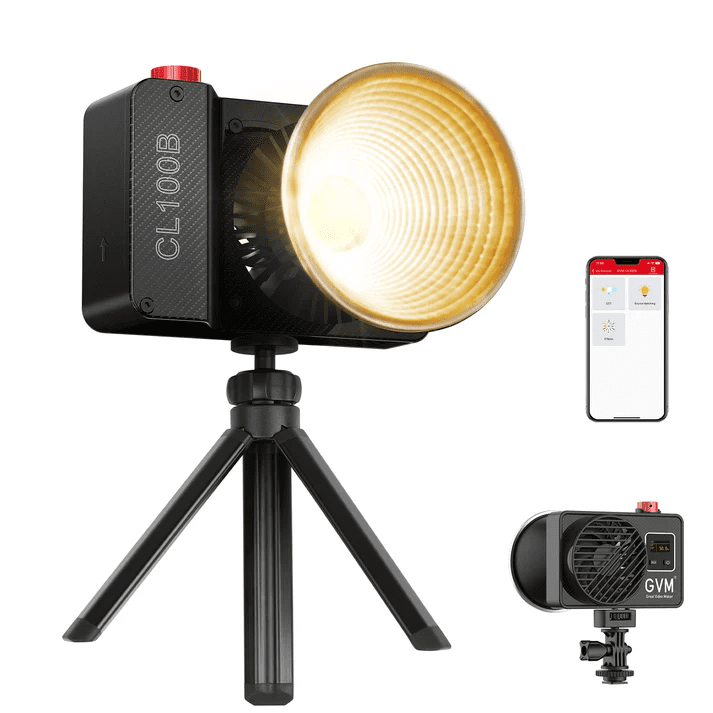
For creators who need a light that genuinely disappears into a travel kit rather than just claiming to be portable, the GVM-CL100B Portable Bi-Color LED Monolight is built specifically around this use case.
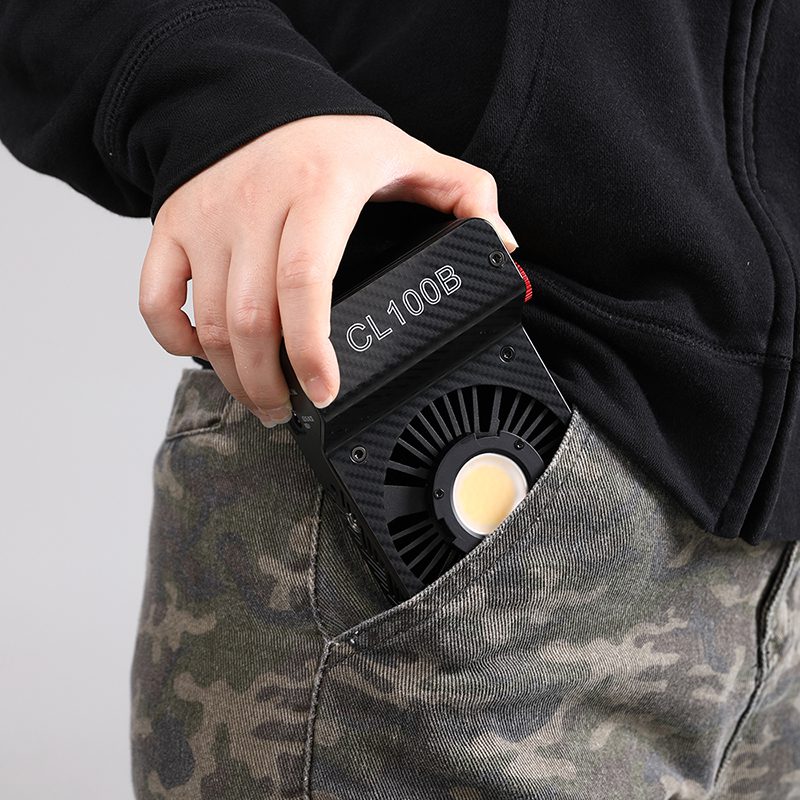
At just 357g — roughly the size and weight of a mirrorless camera body — it fits into a jacket pocket or a small compartment in a camera bag without meaningfully adding to your carry weight, while still delivering 100W of output and 18,500 lux at 1 meter, enough to function as a genuine key or fill light rather than a token accessory. Its triple power supply system directly addresses the outlet-access problem that trips up so much travel lighting: it runs on a standard AC adapter when a wall outlet is available, NP-F batteries for fully wireless operation, or USB-C PD charging from the same portable power bank many creators already carry for their phone or camera.
Color accuracy holds up at CRI and TLCI ratings of 97+, so footage shot in a rented apartment or an unfamiliar location doesn’t suffer from the color inconsistency that cheaper travel lights are prone to. The included kit — a silicone light dome, small reflector, tabletop tripod, and universal 1/4″-20 mount — covers most on-location lighting needs without requiring a separate stand, and its three fan modes, including a Silent option, keep it usable for audio-sensitive interviews shot in quiet hotel rooms or small spaces.
| Caratteristica | Specification / Benefit |
|---|---|
| Modello | GVM-CL100B |
| Peso | 357g — fits in a jacket pocket or small bag compartment |
| Uscita | 100W, 18,500 lux @ 1m |
| Precisione del colore | CRI ≥ 97, TLCI ≥ 97 |
| Opzioni risparmio energia | AC adapter, NP-F battery, or USB-C PD power bank |
| Controllo | Onboard LCD/knobs plus Bluetooth app (50m mesh range) |
| Included Kit | Silicone light dome, small reflector, tabletop tripod, 1/4″-20 mount |
| Il migliore per | Travel vlogging, on-location interviews, run-and-gun filmmaking |
Conclusione
A travel lighting kit succeeds or fails on details that have nothing to do with raw output — weight, power flexibility, and how well it survives being handled like travel gear rather than studio equipment. Checking airline battery and carry-on rules before every trip, keeping backup power close at hand, and testing a full setup before departure prevents the kind of on-location surprises that ruin a scheduled shoot. For creators who need a light that genuinely earns its spot in a carry-on, the GVM-CL100B delivers real output and color accuracy in a form factor built around the actual constraints of shooting on the road.
Ready to build a lighting kit that travels well? Explore the GVM-CL100B to see how much light fits in a pocket-sized fixture.