適切な選択 movie lights can make or break a production, especially when a single fixture needs to carry an entire scene. Two of the most capable high-output LEDs available today are the GVM AIO 1200B and the Godox KNOWLED MG1200Bi — both excellent 1200W bi-color fixtures built for serious filmmaking.
This guide breaks down the fundamentals of cinematic lighting, how to build a studio setup, a real-world case study in extreme conditions, and a direct comparison between these two flagship movie lights.
What Is Cinematic Lighting
Cinematic lighting is built around three core elements: direction, texture, and color.
- Direction shapes depth by defining where light falls relative to the subject.
- Texture determines whether shadows are hard-edged or softly diffused.
- Color sets mood and tone through temperature and hue.
Most sets rely on the three-point lighting method — a キーライト as the primary source, a フィルライト to soften shadows, and a バックライト to separate the subject from the background. This foundation applies whether you’re lighting an interview, a product shot, or a full narrative scene.
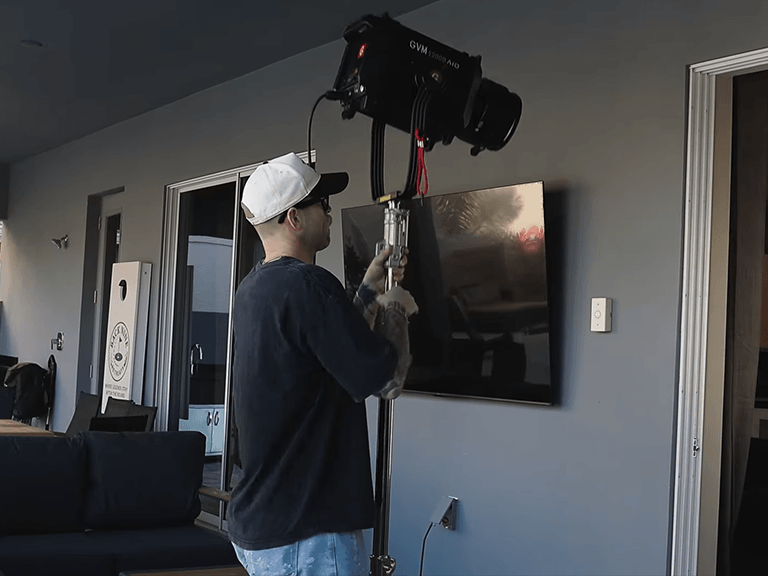
Movie Studio Lights
Studio lighting needs shift depending on the shoot:
- 面接 generally use a soft key close to the subject, gentle fill, and a rim or hair light for separation.
- Product photography benefits from broad, even lighting with diffusion to avoid harsh reflections.
- Green screen work requires flat, uniform lighting across the entire backdrop for clean keying.
A dependable studio combination pairs one high-output key light with one or two softer fill lights and a dedicated background light. High-power bi-color COB fixtures are commonly chosen as the key light in these setups, since they can push enough output through diffusion to properly expose a scene at distance.
Movie Lights
Real-world productions often push movie lights to their limits, and one striking example comes from a commercial shoot filmed in a snowbound cabin at Lake Tahoe. The crew needed two very different moods in the same production: a warm, nostalgic glow for interior shots and a cold, moonlit look for an outdoor night scene — all while working in heavy snow and freezing temperatures.
For the daytime interior scenes, the lighting was set to a warm color temperature to mimic natural sunlight, using the surrounding snow to bounce additional ambient light into the room. For the nighttime outdoor hot tub scene, the color temperature was shifted to a cool 6500K, with the fixture positioned outside the frame and aimed at a 6×6 bounce board to recreate the look of natural moonlight.
Throughout the shoot, the crew relied heavily on smartphone app control to adjust brightness and color temperature remotely. Because the light was often mounted outdoors or at height, being able to make instant adjustments from a phone let the director and cinematographer confirm the look on a monitor in real time without physically repositioning the fixture. The production team noted that a single powerful fixture could light an entire space rather than just one corner, giving actors much more freedom to move throughout the scene. At high output, even fine 0.1% dimming precision became essential — and app-based control made it possible to manage those adjustments smoothly, even in extreme outdoor conditions.
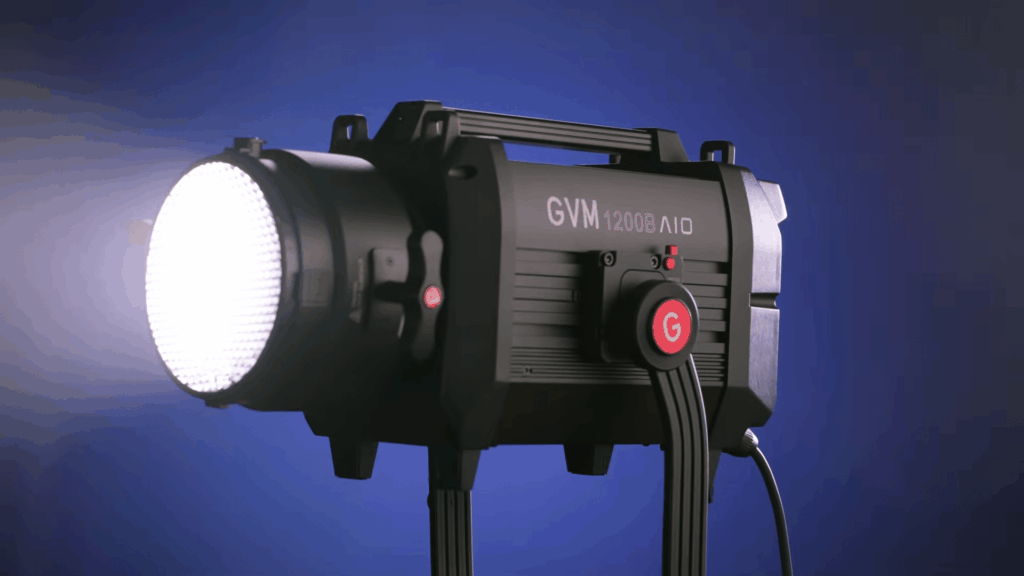
Cinematic Lighting Kit
Cinematic lighting kits generally break down into three tiers:
Entry-level kits are compact, affordable LED panels well suited to beginners, vloggers, and small home setups.
Intermediate kits typically combine a mid-power COB light (300–600W) with softboxes, stands, and basic wireless control for semi-professional productions.
Professional kits are built around a high-output 1000W+ bi-color fixture — like the GVM AIO 1200B or Godox KNOWLED MG1200Bi — paired with modifiers, a full stand setup, and app or DMX control for coordinating multiple lights. These kits are designed for large sets and demanding commercial productions that need one fixture to light an entire room or throw output across long distances.
映画製作における最適な照明
Both the GVM AIO 1200B and the Godox KNOWLED MG1200Bi are genuinely strong 1200W bi-color LEDs, and each is capable of anchoring a professional lighting setup. Here’s how they compare.
GVM AIO 1200B — Pros:
- All-in-one integrated design with no external ballast, simplifying rigging and setup
- Lighter overall footprint at roughly 10kg (22 lbs)
- Wide bi-color range of 2700K–6800K with CRI above 97
- Wireless app control plus CRMX, DMX, RDM, and Art-Net support via the optional GVM BOX
- 12 built-in FX modes and 12 simulated light-source presets
GVM AIO 1200B — Cons:
- Maximum lux output with a standard reflector is lower than Godox’s peak spec, which is measured using an optional Fresnel lens attachment
Godox KNOWLED MG1200Bi — Pros:
- The fixture claims roughly 29,100 lux at 3 meters with a standard reflector at 5600K, and Godox states it can reach around 78,800 lux at 3 meters when paired with an optional Fresnel lens
- Offers fine 0.1% dimming increments and an IP54 weatherproof rating
- Supports DMX, LumenRadio CRMX, and Bluetooth app control through the Godox Light app
Godox KNOWLED MG1200Bi — Cons:
- Uses a separate light head and controller, with the head alone weighing about 16kg and the controller adding roughly 6.68kg more — notably heavier and bulkier to rig than an all-in-one fixture
- Requires managing external cabling between the head and ballast on every setup
For productions that prioritize fast setup, portability, and an integrated build, the GVM AIO 1200B’s single-unit design removes the extra rigging step that Godox’s separate ballast system requires. Paired with a typically more accessible price point for the wattage class, the AIO 1200B is a strong choice for crews that need to move quickly between locations without giving up 1200W-class output.
GVM AIO 1200B — Product Specifications
| 機能 | Specification / Benefit |
|---|---|
| Max Power | 1200W COB LED |
| 調光 | 0.3%–100%, stepless PWM dimming |
| 明るさ | 42,800 lux @ 3m with standard reflector (6800K) |
| クリ | >97 |
| 色温度 | 2700K–6800K bi-color |
| Design | All-in-one, no external ballast required |
| 制御 | GVM APP; CRMX, DMX, RDM, Art-Net via GVM BOX |
| 組み込みエフェクト | 12 FX modes + 12 light source simulations |
| 冷却 | 3 fan modes (Auto / Low / Off) |
| 重さ | 10kg (22ポンド) |
| 山 | Bowens mount with safety lock, detachable U-yoke |
よくある質問
What are the best movie lights for professional productions?
High-output bi-color LEDs with wide color temperature ranges and precise dimming, such as the GVM AIO 1200B, are commonly used as key lights on professional sets.
Can movie lights be controlled remotely?
Yes. Many modern fixtures, including the GVM AIO 1200B, offer smartphone app control, allowing brightness and color temperature to be adjusted without touching the fixture directly.
How does the GVM AIO 1200B compare to the Godox KNOWLED MG1200Bi?
Both are 1200W bi-color LEDs. The GVM AIO 1200B integrates its power supply into a single lighter unit, while the Godox MG1200Bi uses a separate ballast and can reach a higher peak output rating with an optional Fresnel lens.
Are all-in-one movie lights better than lights with a separate ballast?
All-in-one designs are generally faster to set up and lighter to transport, since there’s no external power unit or extra cabling to manage on location.
What color temperature range do professional movie lights typically offer?
Most professional bi-color fixtures range from around 2700K to 6800K, covering warm tungsten-like tones through cool daylight tones.