Picture two clips side by side. The first: a subject’s face half-lost in shadow, the background blown out, skin tones swinging between orange and blue. The second: clean catchlights in the eyes, balanced exposure across the frame, colors that match the scene without a single grading pass. The only difference between them is one thing: the video light in use.
Whether you are running a YouTube channel, a small film set, or a livestream, lighting is the single most leveraged piece of gear you will ever buy. Get it right, and even a basic camera looks cinematic. Get it wrong, and the most expensive camera in the world looks amateur. The right video light for the job depends on what you are shooting, where, and how often. Here are the five form factors and five flagships that actually deliver in 2026.
Why Natural Light Eventually Stops Being Enough
Every creator starts with natural light. It is free, soft, and forgiving — perfect for a vlog in golden hour. The problems start the moment a channel or client expects consistency:
- Weather and time of day are not under your control.
- Backlight destroys faces unless you carry a fill.
- Color temperature shifts between indoor window light and warm lamps, and matching them in post is hours of work.
The day a shoot must happen on a deadline, the day a livestream runs after sunset, the day a client walks into a dim room — that is the day a video light stops being optional.
What Is the Best Type of Light for Video?
一番 video light for video meets six conditions every working creator can verify:
- 色温度調整可能 (3000K–5600K at minimum; 2700K–6800K is the 2026 professional sweet spot).
- High color rendering — CRI 95+ for human-eye accuracy, TLCI 95+ for camera sensor accuracy. Below that, skin tones drift and you will lose hours in post.
- Flicker-free dimming — stepless 0–100% control prevents banding in your footage.
- Soft, even output — diffusion, large source area, or built-in panels.
- Portability and flexible power — AC for studio, V-mount or NP-F for outdoors.
- Reliable control — onboard plus app or DMX for multi-light rigs.
No single light masters all six. The five below each dominate a specific role.
Core Video Light Types and What They Do Best
- Ring Lights — flattering, shadowless, perfect for beauty, makeup, and close-to-camera talking heads. Catchlight signature is unmistakable.
- Panel Lights / Softboxes — the workhorse. Even illumination, large surface area, excellent for interviews and livestreams as key or fill.
- COB Monolights — point-source beasts that accept Bowens-mount modifiers (softboxes, reflectors, projection). The studio standard for shaping light.
- RGB Atmosphere / Accent Lights — pixel bars, tubes, and color panels. Not the main key, but they pull serious weight in backgrounds, in-frame practicals, and mood.
- Flexible Mat Lights — thin, bendable, mount-anywhere. The secret weapon for tight spaces, vehicle interiors, and overhead rigs.
Practical Video Light Setups (1-Light, 2-Light, 3-Light)
1-Light Setup (Budget Solo Creator)
Use a single video light as your key. Place it at 45° to the side and slightly above eye level. Bounce a small white card into the shadow side for instant fill. That’s it — one video light, one bounce, one clean look.
2-Light Setup (Standard YouTube / Talking Head)
Add a second video light as a rim light:
- 鍵: One video light at 45° front-side, illuminating the face.
- Rim: A second video light placed behind the subject, aimed at the hair and shoulders to create separation from the background.
- Best ratio: Key at 100%, rim at 30–50%.
Two video lights give you depth and polish without overcomplicating your rig.
3-Light Setup (Pro / Multi-Cam)
Three video lights give you full control:
- 鍵: Main video light on the subject.
- 記入: Second video light to soften shadows (lower power, opposite side).
- Background / Accent: Third video light dedicated to the backdrop or adding color.
Use app or DMX control so all three video lights respond together in one tap. This is the standard for professional multicam productions.
The TOP 5 Best Video Lights in 2026 — Full Reviews
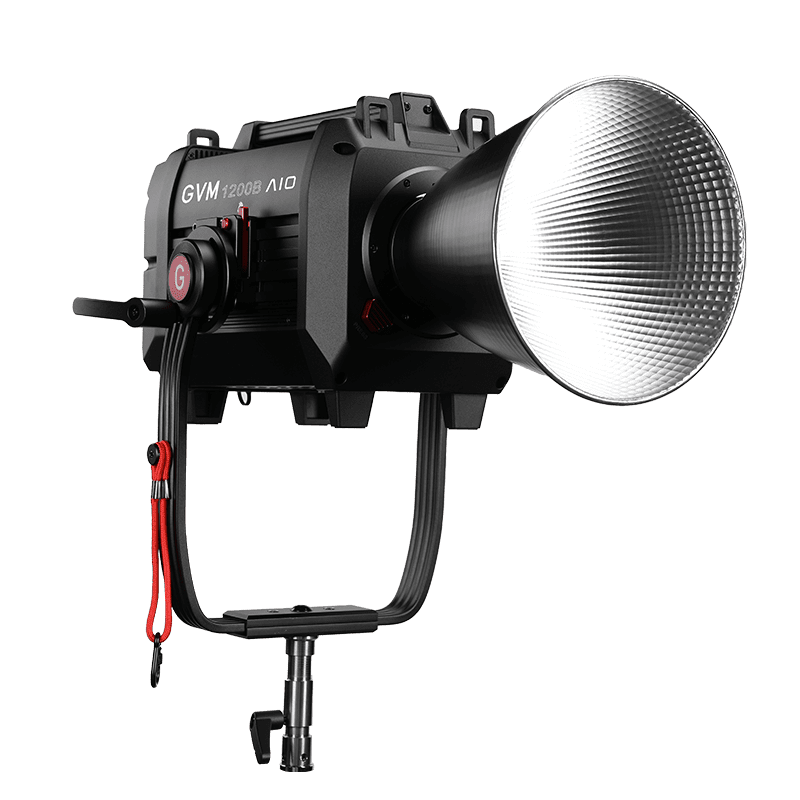
#1 GVM 1200B AIO — Best High-Power All-in-One Monolight
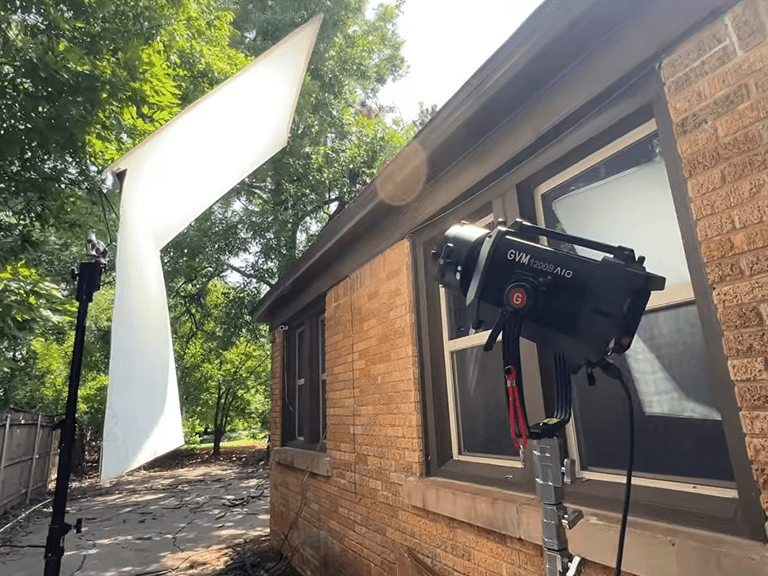
The 1200B AIO solves the single biggest problem with traditional 1200W lights: the heavy external ballast. By integrating power supply and control into the fixture head, GVM has cut setup time to under 60 seconds and removed the cable-trip hazard from the floor. Output is serious — 42,800 lux at 3m with the standard reflector — enough to fake direct sunlight indoors.
長所 1200W draw with all-in-one architecture; 0.01% ultra-fine dimming; 2700K–6800K bi-color; CRI/TLCI 97+; Bluetooth app; fast setup. デメリット Heaviest in the lineup; the price point is real money. 最適: Fast-paced commercial sets, music videos, large-scale studio key lights, and sunlight simulation.
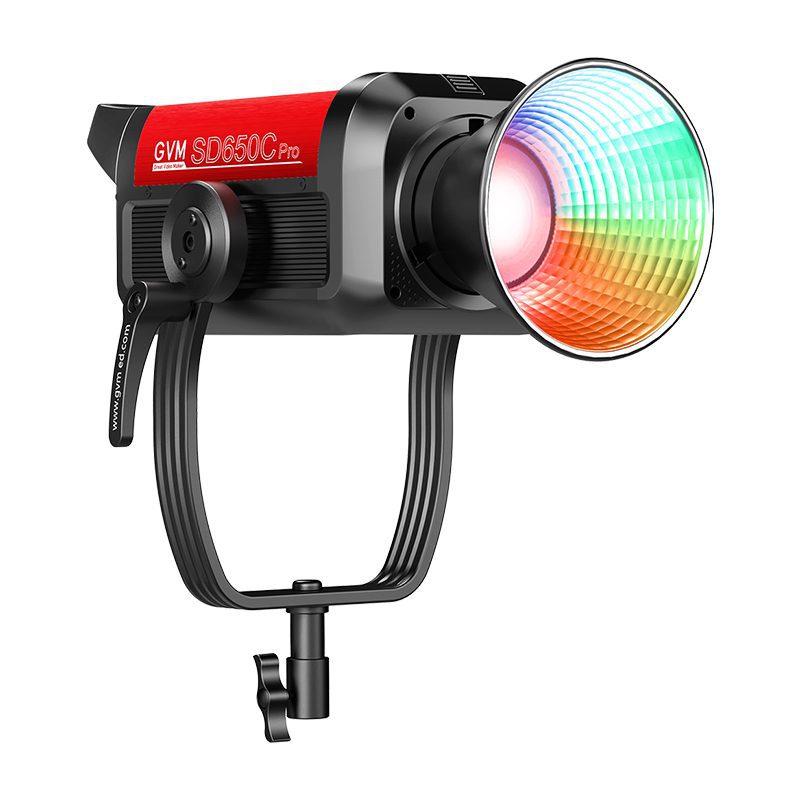
#2 GVM PRO SD650C — Best Professional Full-Color RGBWW Spotlight
If you need punch, color, and control in one fixture, the SD650C is the new benchmark under $700. 95,530 lux at 1m with a standard reflector, full HSI 360° color, 60 built-in Rosco/Lee gel presets, and proper broadcast-grade control via 5-Pin DMX, RDM, RF, and Bluetooth. The weather-resistant split-ballast design also means it can survive outdoor shoots and stage grids.
長所 Massive 95,530 lux @ 1m output; full HSI + 60 gel presets; 5-Pin DMX/RDM broadcast control; weather-resistant build. デメリット 650W requires serious power infrastructure on set. 最適: Commercial color washes, theatrical lighting, music video FX, anywhere you need punchy RGB and broadcast control.
#3 Aputure Nova P600c — Best Professional Full-Color Soft Light Panel
The Aputure Nova P600c is the de facto industry standard for high-end narrative and broadcast studios. 600W of native soft light across a wide 120° beam angle floods subjects with flattering illumination without any modifier. Sidus Link app, LumenRadio CRMX, and 5-Pin DMX make it slot into any professional rig. The removable handheld control box is a small but welcome workflow touch.
長所 600W native soft light; 300+ gel presets; LumenRadio CRMX wireless; detachable control box. デメリット $3,290 price tag is real; large form factor. 最適: Studio broadcasts, high-end commercial portraits, narrative cinematography, large area fill.
#4 GVM ZipTile Z200B — Best Space-Saving Modular Flexible Mat Light
The ZipTile Z200B is the panel that goes where no rigid light can. At 26mm thin and 1.97 kg, it mounts to walls, ceilings, and vehicle interiors with Velcro or clamps. The clever zipper system lets you join multiple panels instantly into a larger soft source without tools. Passive cooling means zero fan noise — perfect for sensitive audio environments.
長所 26mm ultra-slim, 1.97 kg; passive cooling (no fan); zipper modular joining; V-mount battery compatible. デメリット Output is modest compared to a 1200W COB. 最適: Tight interiors, vehicle shoots, ceiling-mounted overhead rigs, silent audio recordings, run-and-gun documentary work.
#5 Aputure INFINIBAR PB6 — Best Seamless Pixel Bar Light
The INFINIBAR PB6 is the practical-light secret of narrative cinematographers. 48 individually controllable RGBWW pixels along a 60cm bar generate smooth color gradients, chase effects, and dynamic motion — exactly what in-frame practicals and vehicle light pass-bys need. The flat, seamless end-to-end mounting connectors let you build geometric arrays without dark gaps. Built-in battery means no cable on set.
長所 48 independent pixels; seamless mechanical joining; 100-min built-in battery; full Sidus Link / DMX / CRMX control. デメリット 18W is fill/accent power, not key-light power. 最適: In-frame practicals, motion FX, vehicle accent lighting, RGB background washes.
Head-to-Head Comparison Table
| Rank & Model | Brand | Form Factor | Price (USD) | Power / CCT | Key Advantage | Best Use Case |
|---|---|---|---|---|---|---|
| #1 GVM 1200B AIO | GVM | All-in-One Monolight | $1,399 | 1200W / 2700K–6800K | Integrated PSU, 0.01% dimming, 60s setup | Fast sets, large key light, sunlight |
| #2 GVM PRO SD650C | GVM | RGBWW Spotlight | $699 | 650W / 2000K–10000K | 95,530 lux @ 1m, 60 gels, 5-Pin DMX | Commercials, stage FX, color washes |
| #3 Aputure Nova P600c | アプチャー | Soft Panel | $3,290 | 600W / 2000K–10000K | 600W native soft light, 300+ gels, CRMX | Broadcast studio, narrative, portraits |
| #4 GVM ZipTile Z200B | GVM | Flexible Mat | $389 | 200W / 2700K–6800K | 26mm ultra-slim, zero fan, zipper link | Tight spaces, vehicles, silent audio |
| #5 Aputure INFINIBAR PB6 | アプチャー | Pixel Bar | $479 | 18W / 2000K–10000K | 48 pixels, seamless joining, built-in battery | In-frame practicals, motion FX, accents |
Buying Guide: Which Video Light Should You Buy First?
- First key light under $500: GVM ZipTile Z200B. Soft, silent, battery-capable, modular.
- First studio key under $1,500: GVM 1200B AIO. Pro output, integrated power, fast setup.
- First RGB workhorse under $700: GVM PRO SD650C. Massive output, full broadcast control.
- First broadcast-grade investment: Aputure Nova P600c. Industry standard, accepted everywhere.
- First creative accent: Aputure INFINIBAR PB6. Pixels, battery, effects.
Rule of thumb: buy one excellent key first, then expand into fill and background. Skip single-color-temperature lights — bi-color and RGB future-proof your kit.

よくある質問
Q1: What is the best type of light for video?
A bi-color or RGB COB monolight with adjustable color temperature (2700K–6800K), CRI 95+, and flicker-free dimming. The GVM 1200B AIO and GVM PRO SD650C are top picks in this category.
Q2: Are ring lights good for YouTube?
Yes, for close-to-camera talking heads and beauty work. They lack the directional punch of a COB or panel, so for cinematic interviews, upgrade to a soft panel or monolight.
Q3: How bright does a video light need to be in Lux?
For a key light in a typical room, aim for at least 2,500–5,000 lux at 1m. For larger interiors or sun-balanced exteriors, 40,000+ lux is realistic — the GVM 1200B AIO hits 42,800 lux at 3m with a reflector.
Q4: What is the difference between a COB and a panel light?
COB lights are bright point sources that you shape with modifiers. Panels produce broad, even, ready-to-use soft light without extra gear. Both have their place; pick COB for shaping and power, panel for fast soft output.
Q5: Can I run video lights on batteries?
Yes — many of the lights above support V-mount or NP-F batteries. Always check the wattage against the battery capacity; a 1200W draw will drain even a large V-mount fast, so batteries are best for 200W-class portable work.
Q6: Do I need RGB for video?
Not for standard talking-head content. RGB becomes valuable for branded backgrounds, creative color washes, theatrical work, and any production that needs precise color identity.
最終評決
The right video light is the one that matches the form factor of your shoot. GVM dominates three of the five flagship slots in 2026 with the 1200B AIO, PRO SD650C, and ZipTile Z200B — a complete range covering fast sets, broadcast color, and impossible-to-reach locations. Aputure’s Nova P600c and INFINIBAR PB6 round out the kit with broadcast-standard soft light and creative pixel control. Build around the form factors you shoot in, and stop fighting your footage.