
A compact LED monolight has become one of the most practical upgrades for creators in 2026. Cameras got smaller, shooting locations got more flexible, and production teams got leaner. Lighting had to follow. The GVM FA500C 一体型 is built for that shift: a 500W full-color COB light in a flat all-in-one body, with Bowens mount support and professional color control.
This is for photographers, videographers, livestreamers, and small crews who want serious output without dragging a traditional long-head COB and separate ballast between rooms or locations.
目次
FA500C at a Glance
The FA500C AIO is a flat-profile compact COB monolight designed for studio and mobile production. Instead of a long tube-style head, it uses a space-saving form factor with integrated power and controls.
Product Spec Table
| 機能 | GVM FA500C 一体型 |
|---|---|
| 力 | 500W |
| ライトエンジン | Single COB LED |
| Output | 19,000 lux @ 1 m / 2,160 lux @ 3 m |
| CCT | 2000K–10,000K |
| 色の精度 | CRI ≥97 / TLCI 97+ |
| Modes | CCT, HSI, RGB, GEL, Source Matching, FX |
| 重さ | 3.7 kg |
| サイズ | 126 × 230 × 336 mm |
| 山 | Standard Bowens |
| 制御 | Onboard + Bluetooth Mesh App + NFC |
| 力 | AC 100–240V all-in-one |
| 冷却 | Heatsink + fan (Smart / High / Silent) |
| 最高 | Interviews, portraits, product work, studio and location video |
It supports full white-light work and creative color, with 12 source-matching presets and 16 FX effects through the app.

Why COB Matters for a Compact LED Monolight
COB (Chip-on-Board) lighting packs many LED chips into one dense source. Compared with panel lights, a COB monolight usually offers:
- stronger directional output
- better efficiency with reflectors and optical modifiers
- cleaner falloff for key light work
- more flexibility between hard and soft looks
Panels remain useful for soft fill. A compact LED monolight like the FA500C is better when you need a primary key light that can push through a softbox or optical accessory with real intensity.
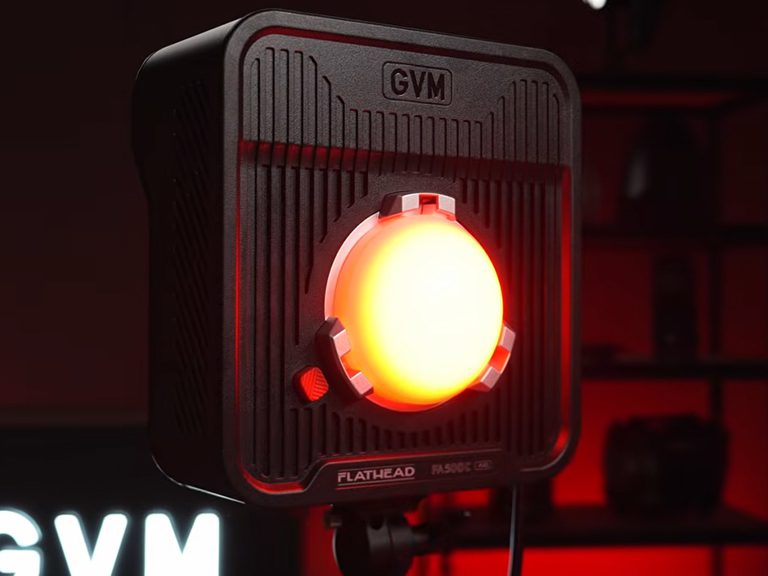
Monolight Design Advantages
Traditional COB systems often separate the lamp head and ballast. That increases cable clutter, packing volume, and setup time. The FA500C AIO keeps power and control in one body.
Practical benefits
- Faster setup in small studios
- Easier transport between locations
- Fewer failure points from external boxes and cables
- More stable mounting on compact stands
Heat management still matters at 500W. The FA500C uses aluminum construction plus active cooling, with Smart, High, and Silent fan modes. Silent mode reduces output to 50W to protect the fixture when absolute quiet is required, so it is best reserved for short, audio-critical moments.
Bowens Ecosystem Compatibility
A compact LED monolight becomes far more useful when it can grow with accessories. The FA500C uses a standard Bowens mount, which means one light can support:
- softboxes for flattering key light
- reflectors for more throw
- grids for spill control
- Fresnels or optical intensifiers for harder, more focused output
That modular path is one of the biggest reasons Bowens-mounted monolights remain a smart long-term buy. You are not locked into a single lighting quality.
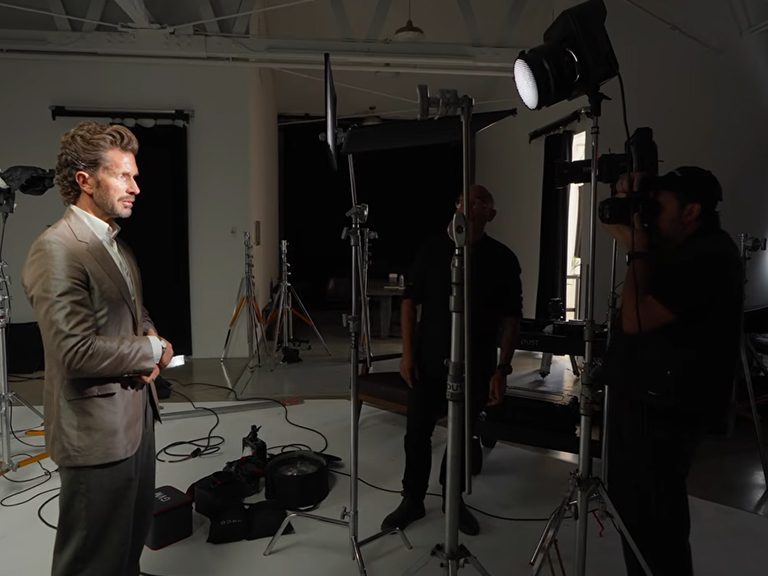
Interview Key Light: Getting the Most from the FA500C
For interview work, the FA500C is best used as a dedicated key light rather than a general fill fixture. Pair it with a Bowens softbox, place it about 45 degrees off-camera, and set the height slightly above the subject’s eye line so the light falls downward across the face. This angle creates natural facial shape without hard shadows under the eyes or nose.
Start by matching color temperature to the room. If the space is dominated by warm practical lamps, begin around 3200K–4000K. If there is strong window light, move closer to 5000K–5600K. The FA500C’s 2000K–10,000K range makes this adjustment straightforward, and its CRI/TLCI 97+ performance helps keep skin tones clean on camera with less corrective work in post.
Distance matters as much as power. Place the softbox close enough to soften transitions, then raise or lower intensity instead of pushing the fixture to full output immediately. At 500W, the FA500C has enough headroom to drive a medium or large softbox while still preserving highlight detail on the face. If one side of the face falls too dark, add a reflector opposite the key light before introducing a second fixture.
For multi-person interviews, keep the FA500C as the primary key on the main subject and use bounce or a lower-powered fill to maintain consistency across seats. App control is useful here: once the light is positioned, brightness and CCT can be refined from behind the camera without breaking the setup. The result is a clean, professional interview look built around one strong compact monolight rather than a complicated multi-light arrangement.
Best Modifier Pairings
- Softbox: best first accessory for interviews and portraits
- Optical intensifier: when you need more punch and a cleaner beam without buying a larger light
- Fresnel-style optic: when zoom control and harder projection matter
- Grid: when background spill needs tighter management
The fixture provides power and color. The modifier decides the final quality of light.
Pro Tips for Better Results
- Control distance before raising power. Moving the light closer changes softness and intensity faster than jumping straight to full output.
- Match color temperature carefully. Use the wide CCT range to align with ambient sources instead of fighting mixed light in post.
- Use app control when the light is hard to reach. Bluetooth Mesh is useful for overhead or multi-light setups.
- Do not rely on Silent mode for full-power scenes. It is a quiet mode, not a full-output mode.
- Build around one strong key light first. A single capable compact LED monolight plus a softbox often improves results more than several weak lights.
FA500C vs Typical COB Monolights
Many older COB lights are powerful but awkward: long bodies, separate controllers, and slower deployment. The FA500C competes by focusing on the combination creators actually feel on set:
- better compactness for a 500W-class light
- strong output-to-size ratio
- open Bowens flexibility
- full-color modes beyond basic bi-color
- all-in-one convenience for small crews
For value-driven professionals and advanced creators, that balance is the point. You get high output and modern control without defaulting to the bulkiest traditional workflow.
よくある質問
Is the FA500C a COB light?
Yes. It uses a single high-output COB LED engine.
Does the FA500C use a Bowens mount?
Yes. It supports standard Bowens modifiers such as softboxes, reflectors, and optical accessories.
Can I use softboxes and Fresnel lenses with it?
Yes, through the Bowens mount, depending on the specific accessory design.
Is it good for both photo and video?
Yes. Continuous output, high color accuracy, and flexible CCT/RGB modes make it suitable for hybrid workflows.
What is the best first modifier to buy?
A softbox is usually the best first purchase for portraits, interviews, and general creator work.
How portable is it for location shooting?
At 3.7 kg with an all-in-one body, it is practical for mobile studio work and indoor location shoots. It is AC-powered, so plan for available power on site.
最終評決
一番 compact LED monolight in 2026 is not only defined by peak brightness. It is defined by how efficiently that brightness can be used: COB output, monolight convenience, and Bowens expandability.
について GVM FA500C 一体型 brings those pieces together in one fixture. With 500W of power, 19,000 lux at 1 m, CRI/TLCI 97+, full-color control, and a flat all-in-one design, it is built for creators who need professional performance in tighter spaces and faster workflows.
If you want one key light that can handle interviews, portraits, product work, and studio video while staying modular for future modifiers, the FA500C is a strong compact monolight to choose.