見つける best lights for filmmaking usually comes down to a frustrating tradeoff. AC-powered lights are reliable but hard to move. Battery-powered lights go anywhere but rarely have the output a real shoot needs.
The GVM PRO SD650C is built to close that gap. This review uses the SD650C as the throughline while also covering the basics: what film lighting actually means, how to evaluate a light’s specs, and where different light types fit on set. By the end, you’ll know whether the SD650C is the right lighting investment for 2026.
目次
What Is Film Lighting? A Quick Definition
Film lighting definition: the use of continuous (non-flash) light sources to control exposure, contrast, color, and mood across every frame of a shot — not just a single still image.
Three variables drive every lighting decision:
- 強度 — how bright the light is at your working distance
- 色温度 — how warm or cool the light reads on camera
- 光質 — hard, directional light versus soft, wrapped light
Continuous light matters more in filmmaking than photography because there’s no flash to freeze per frame — what you see is what the camera records, with no flicker and no need for a second crew member to trigger a strobe. That makes it especially useful for solo creators and small crews.
Once you understand these three variables, choosing the right light becomes a matter of matching specs to your actual shooting needs — which is exactly what the next section covers.
How to Choose Film Lights: Key Specs Explained
This is your practical film light guide — the specs that actually matter when comparing lights.
Output (Lux @ 1m): Check both bare-bulb and reflector-equipped ratings. An interview setup might only need around 5,000 lux. Overpowering daylight through a window can require 50,000+ lux. The SD650C outputs 20,470 lux bare and 95,530 lux with its standard reflector — enough headroom for daylight-balanced exterior work.
Color Temperature Range: Bi-color (2700–6500K) covers most interior/exterior matching. Full-spectrum RGBWW (2000–10000K) is what you need for colored lighting effects, matching unusual practical sources, or virtual production backdrops.
CRI/TLCI A 97+ rating on both matters because skin tones that look off on camera are nearly impossible to fully correct in post. TLCI is worth knowing specifically — it’s the broadcast/TV industry’s stricter version of CRI, built to measure how a light performs specifically for cameras.
Power Options: AC-only lights are studio-bound. Dual power lights — like the SD650C’s 650W AC / 200–250W battery modes — give you one fixture that works as your studio key light and your location backup, instead of buying two separate units.
Control Protocol: DMX/RDM is the standard for professional multi-camera sets. App control is what solo creators actually use day to day. The SD650C supports both, so it scales from a one-person shoot to a full crew production.
シネマティックライティングとは何ですか?
Cinematic lighting isn’t about making a scene bright — it’s about building depth, guiding the viewer’s eye, and reinforcing the story with light.
Four core techniques show up in nearly every professional setup:
- キーライト — the primary light shaping the subject
- フィルライト — softens shadows cast by the key
- Back Light — separates subject from background
- Rim Light — adds a defining edge, often for mood or drama
Hard vs. Soft Light: Hard light creates crisp shadows and texture — good for drama and tension. Soft light flatters skin and smooths transitions — good for interviews and beauty work.
Color Contrast: Pairing warm and cool tones in the same frame is a classic way to create visual tension. This is where RGBWW lights like the SD650C have a real edge — you dial in color through the app instead of swapping physical gels mid-shoot.
Types of Film Lights
Five main categories dominate professional sets today:
- Tungsten/HMI: Traditional, color-accurate, high CRI — but heavy on power draw and heat output.
- LEDパネル Thin and even, great for fill light and interviews, but generally underpowered as a primary key.
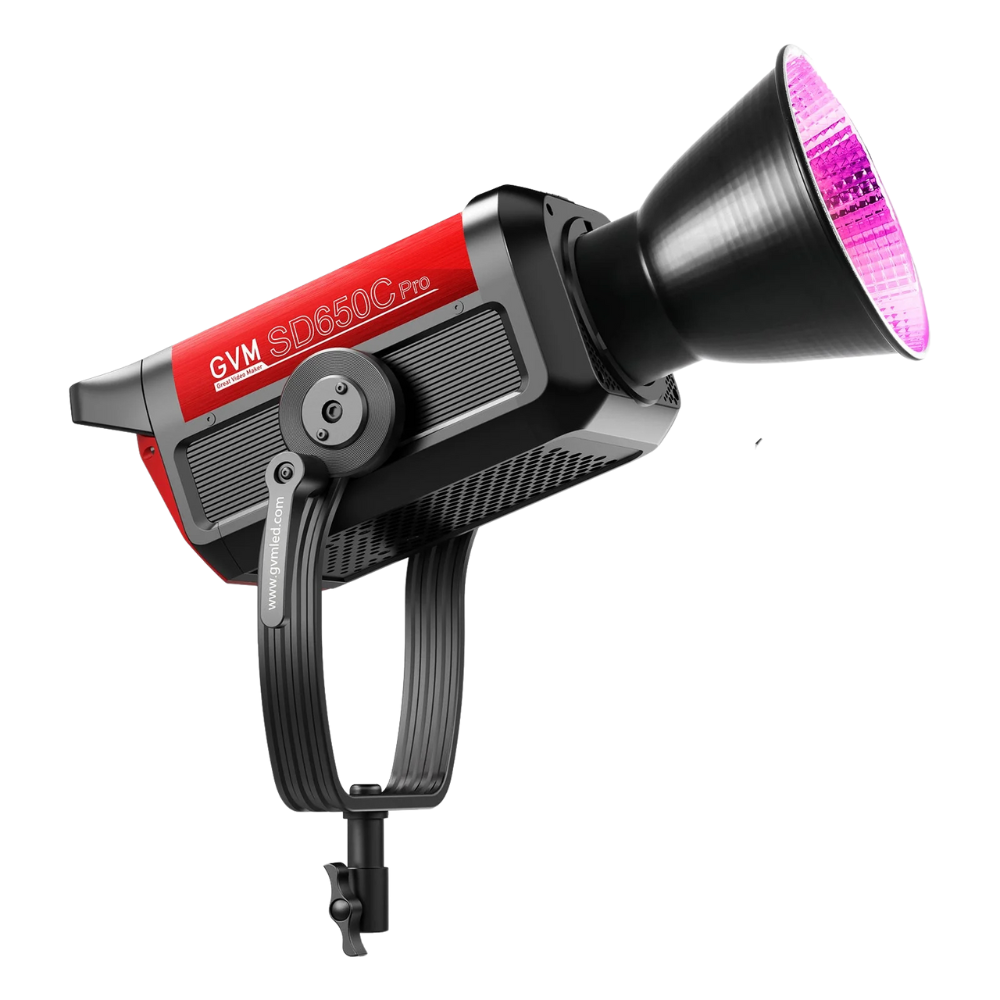
- COB Monolights: Point-source output with a Bowens mount for maximum modifier compatibility. This is where the SD650C lives, and it’s the current standard for cinematic key lighting.
- RGB Tubes/Strips: Great for ambient and background color accents, not suited as a main light.
- Portable Battery Lights: Compact units like GVM’s 800D-III, or the SD650C running on its dual V-mount battery ports — trading some output for mobility.
For most productions, a COB monolight anchors the setup as the key, with panels and tubes filling supporting roles.
Film Lighting Equipment List
A capable filmmaking kit is more than just a light. Here’s what typically rounds out a working setup:
- キーライト — a COB monolight like the SD650C for primary output
- Light modifiers — softboxes, Fresnel attachments, and barndoors to shape the beam
- Color gels — physical or digital, for matching or creative color effects
- C-stands or light stands — stable, adjustable mounting
- Diffusion and reflectors — to soften or bounce light naturally
- Battery power — V-mount batteries for location shoots without outlets
- Wireless/app control — for remote adjustment without touching the fixture
A light with a Bowens mount, dual power, and app/DMX control — like the SD650C — reduces how many separate accessories and adapters you need to buy.
GVM PRO SD650C: Full Review
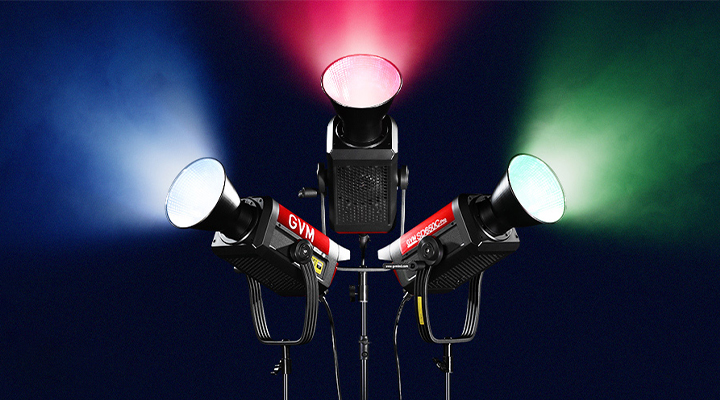
The SD650C is a 650W RGB & Bi-Color COB monolight built for productions that move between studio and location.
Overview: it outputs 95,530 lux at 1m with a 2000K–10000K range spanning full bi-color and RGB. A 97+ CRI/TLCI rating, 1/1000-step dimming, and silent cooling keep output smooth and flicker-free. Waterproofing plus APP, DMX, and mesh networking support lets multiple units sync for cinematic, studio, and livestream setups.
Standout strengths:
- 95,530 lux at 1m with reflector — enough to compete with daylight
- 2000K–10000K range with 360° hue control and 16M+ colors
- 97+ CRI/TLCI for accurate, editable skin tones
- 60 built-in industry-standard color gels for instant look matching
- Dual power (AC 650W / battery 200–250W) for studio-to-field flexibility
- DMX-512 (8/16-bit), RDM, and Bluetooth app control (up to 50m)
Where it’s not the fit: absolute beginners on a tight budget, or anyone shooting static product photos only, will find the output and control depth here more than they need.
| パラメーター | 価値 |
|---|---|
| 力 | 650W (AC) / 200–250W (Battery) |
| Light Output | 95,530 lux @ 1m (with reflector) |
| 色温度 | 2000K–10000K (RGBWW) |
| CRI / TLCI | 97+ / 97+ |
| 調光 | 1/1000-step, 4 dimming curves |
| RGB Colors | 16M+ (360° hue control) |
| Color Gels | 60 built-in industry-standard gels |
| 制御 | APP, DMX-512 (8/16-bit), RDM, Bluetooth Mesh (50m) |
| 山 | Bowens |
| Waterproof | はい |
Real-world case: on a run-and-gun interview shoot with no power outlets nearby, the crew ran the SD650C on its V-mount battery, pulling clean daylight-balanced output for the full setup. Back at the studio, the same fixture plugged into AC delivered the full 650W for a lit two-camera scene — no second light required.
最終評決
Who should buy the SD650C: independent filmmakers, commercial directors, and YouTube/podcast creators who need one COB fixture that performs in the studio and on location.
Who shouldn’t: absolute beginners on a limited budget (start with something like the 800D-III), or anyone shooting static product photography only, where a smaller panel is more cost-effective.
At around $699, the SD650C sits well below comparable-output alternatives like the Aputure 600x Pro (often $1,000+), making it less a budget pick and more a genuine performance-per-dollar anchor in the professional COB category. It’s not a cheap light, and it’s not an ultra-portable light — it’s the studio-to-location crossover for creators who don’t want to compromise on either.
よくある質問
Q: Can the GVM PRO SD650C run on battery power?
Yes. It supports dual power — 650W on AC and 200–250W on battery (dual V-mount), so it works as a studio key light and a location-ready fixture without swapping equipment.
Q: What’s the best continuous light for filmmaking?
A COB monolight with high CRI/TLCI, a wide color temperature range, and dual power capability — like the SD650C — is generally the strongest all-around choice, since it handles both studio and field work from a single fixture.
Q: What color light is best for skin tones?
Neutral to warm color temperatures (around 3200K–5600K) with a CRI/TLCI rating of 97 or higher produce the most accurate, flattering skin tones on camera.