Choosing the right Portable LED Video Light can make a significant difference in the quality of a video production. Good lighting helps preserve natural skin tones, define the subject, and create depth without requiring a large studio or a complicated equipment setup.
For years, professional lighting often meant heavy fixtures, multiple cables, and separate control units. Modern LED technology has changed that. Compact COB lights can now deliver substantial output, adjustable color temperature, and advanced control in a much smaller package.
Whether you shoot interviews, product videos, portraits, or commercial content, portability should not come at the expense of lighting quality. Understanding output, color accuracy, control options, and modifier compatibility will help you build a lighting setup that works in the studio and on location.
目次
What Is a Portable LED Video Light?
A portable LED video light is a compact lighting fixture designed to provide consistent illumination while remaining easy to transport and set up. These lights are commonly used by filmmakers, photographers, independent production teams, and content creators who work across different locations.
Not all portable lights serve the same purpose. Small LED panels are useful for close-range fill light, desk setups, and tight spaces. COB LED lights produce a more concentrated beam, making them suitable for key lighting, controlled highlights, and larger scenes when paired with appropriate modifiers.
The difference becomes clear during an actual shoot. A compact panel may be enough for a quick talking-head video, but a commercial interview with a softbox, background separation, and carefully controlled shadows may require a more powerful point-source light.
Portability is therefore not simply about size. A practical lighting system should balance output, weight, setup time, and the flexibility to adapt to different shooting conditions.
Why Does Portable Lighting Matter for Video Production?
Studio lighting provides control, but production rarely happens in a perfectly equipped studio. You may need to film in a small office, a client’s workspace, a hotel room, or a location where equipment must be packed away quickly.
A portable lighting setup makes these situations easier to manage. Instead of relying on available light, you can establish a consistent key light and adjust the scene to suit your subject.
Compact equipment also reduces the burden on small production teams. When one person handles the camera, lighting, and audio, fewer components and faster adjustments can make a noticeable difference.
Modern LED fixtures offer another advantage: many provide adjustable brightness and color temperature, allowing creators to match existing light sources or establish a particular mood without changing lamps.
The goal is not to carry less equipment at any cost. It is to carry equipment that gives you more control over the final image.
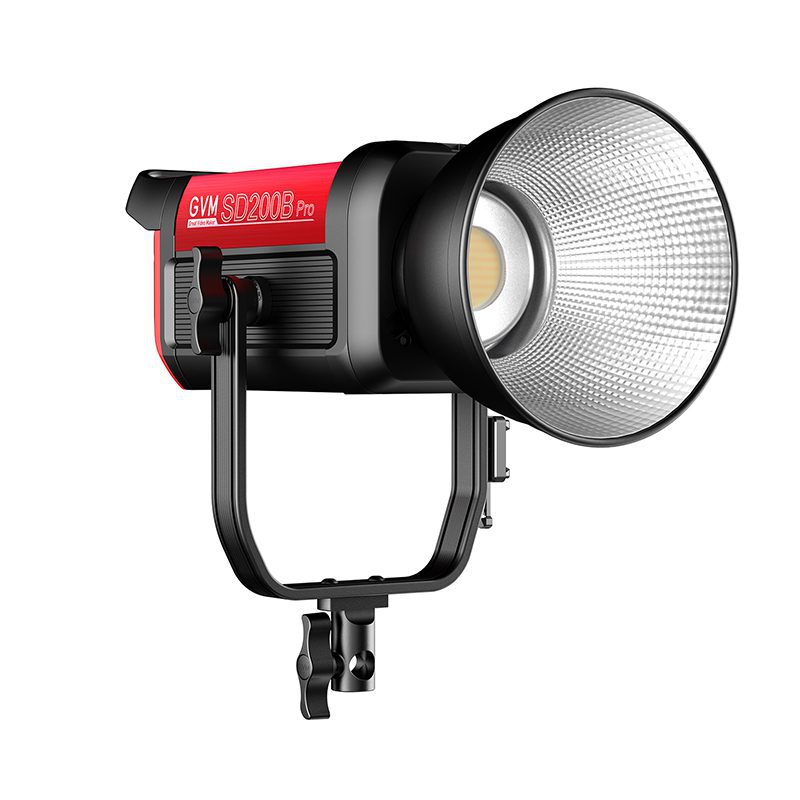
GVM PRO SD200B: A Portable LED Video Light for Professional Work
The GVM PRO SD200B is a 200W bi-color COB fixture designed for portable production and studio use. Its compact body integrates the controller and power circuitry into the light head, reducing the need for a separate control box.
The design addresses a common challenge for independent filmmakers: how to maintain professional lighting control without transporting a large, complicated rig.
With a 2700K–6800K color temperature range, CRI/TLCI ratings of 97+, and compatibility with Bowens-mount modifiers, the SD200B can be used for interviews, portraits, product videos, and a range of controlled lighting setups.
Professional Output in a Compact Design
A portable fixture needs enough output to remain useful after the light has been shaped. The SD200B is rated at up to 45,400 lux at 1 meter with its standard reflector, giving creators a useful starting point for directional key lighting.
Its integrated design and approximately 2.7 kg listed weight make it easier to transport than many larger professional lighting systems. That matters when moving between locations, working in confined rooms, or setting up without a dedicated lighting crew.
The 200W output also provides room to experiment with modifiers. A reflector can establish a defined key light, while a compatible softbox can create a broader, softer source for interviews and portraits.
Portability is most valuable when it preserves creative options. A compact fixture that can function as a key light, a controlled accent, or part of a multi-light arrangement is more useful than one designed for only a single setup.
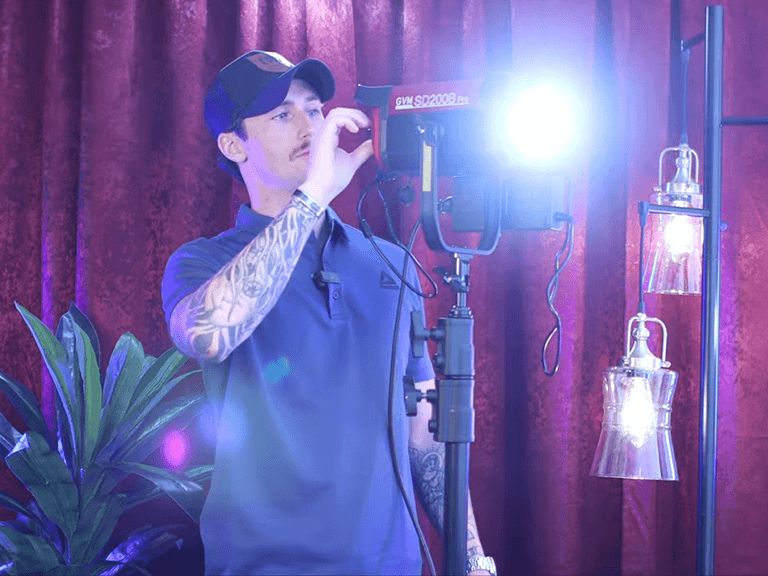
Flexible Lighting Control for Different Workflows
The SD200B supports several control methods, allowing it to fit different production environments.
The GVM app provides remote adjustments from compatible iOS and Android devices. Bluetooth mesh networking supports group control with compatible GVM fixtures, which can simplify changes when multiple lights need to work together.
For more structured productions, the fixture also supports DMX control, including 8-bit and 16-bit modes, as well as RDM. Onboard controls remain available for direct adjustments.
These options serve different needs. App control is convenient for small crews, while DMX becomes more valuable when lighting cues and multiple fixtures need to be managed from a central console.
Bi-Color Output and Broad Modifier Compatibility
The SD200B’s 2700K–6800K range allows it to move between warm interior tones and cooler daylight conditions without requiring a separate light source for each color temperature.
Its CRI/TLCI ratings of 97+ support accurate color reproduction for people and products. Brightness can be adjusted from 0% to 100% in 0.1% increments, allowing fine control over light levels. The fixture also includes built-in lighting effects and source-matching options for specific creative situations.
The standard Bowens mount expands its practical range. Depending on the shot, creators can use compatible softboxes, Fresnel attachments, or projection accessories to change the spread and character of the light.
This combination makes the SD200B more than a compact travel fixture. It can serve as a core light in a small studio and remain useful when the same production moves on location.
| 機能 | Specification / Benefit |
| Power consumption | 200W |
| Light source | Bi-color COB LED |
| 色温度 | 2700K–6800K |
| Maximum illuminance | 45,400 lux at 1m with standard reflector |
| Color accuracy | CRI 97+, TLCI 97 |
| 調光 | 0%–100%, adjustable in 0.1% increments |
| 制御 | Onboard controls, app, Bluetooth mesh, DMX IN/OUT, RDM |
| 山 | Bowens |
| Listed weight | Approximately 2.7 kg |
| Best suited for | Interviews, portraits, product videos, studio and location shoots |
Specifications are based on GVM’s published product information. Output measurements depend on the reflector or modifier used.
How to Use a Portable LED Video Light Effectively
Even a capable fixture will produce disappointing results if it is placed without considering the subject and environment. A few basic techniques can help you get more from a compact lighting setup.
1. Establish the Key Light First
Start by deciding where the main light should come from. For an interview, position the key light slightly to one side of the camera and above the subject’s eye level. This creates natural facial dimension without making the shadows excessively harsh.
Adjust the distance and angle before increasing brightness. Moving the light closer can make the source appear larger relative to the subject, which generally produces softer shadows. A softbox can further broaden the illumination.
2. Match the Color Temperature to the Environment
If daylight enters through a window, begin by considering a daylight-balanced setting. In a room dominated by warm practical lamps, a warmer setting may blend more naturally with the surroundings.
Mixed lighting is not always a problem. However, uncontrolled differences between sources can make skin tones inconsistent across the frame. Check the image on your camera rather than relying entirely on the numerical color temperature.
3. Shape the Beam Instead of Increasing Power
When a background is too bright or light spills onto unwanted areas, adding more power is rarely the best first move.
Try changing the fixture’s angle, moving it closer to the subject, or selecting a more suitable modifier. A Fresnel attachment can help control the beam, while a softbox is often better for creating flattering illumination over a wider area.
Light placement usually has a greater effect on the final look than small changes in brightness alone.
4. Coordinate Multiple Lights When Needed
A simple two- or three-light setup can create more depth than a single fixture used at high output.
Use the key light to establish the main direction, a fill source to manage shadow contrast, and a separate background or rim light when the scene needs more separation. Keep the purpose of each fixture clear.
When compatible lights support app-based group control or DMX, coordinating brightness and color becomes easier. This is especially useful when repeating a setup across multiple takes or shooting several scenes in the same space.
結論
Choosing a Portable LED Video Light means finding a balance between output, color accuracy, control, and practical transport. The right fixture should work with your shooting environment rather than forcing you to build every production around the limitations of your equipment.
について GVM PRO SD200B brings these considerations together in a compact 200W bi-color COB design. Its integrated construction suits mobile work, its control options support both simple and more advanced setups, and its Bowens mount provides flexibility for shaping the light.
For creators who move between studio sessions and location shoots, that combination offers a practical approach to professional lighting: carry a manageable setup, keep control over the image, and let the lighting serve the story.