Cinematic lighting is the art and science of using light to tell stories visually — creating mood, directing attention, establishing time and place, and communicating emotion before a single word of dialogue is spoken. It is what separates footage that feels like a film from footage that merely documents what happened. Whether you are producing a feature film, a branded commercial, a YouTube series, or a short-form social content campaign, understanding and applying cinematic lighting principles is the most transformative technical investment you can make in your production quality. This complete guide covers everything from foundational concepts to the best cinematic lighting equipment available in 2026.
What Is Cinematic Lighting?
Cinematic lighting is the deliberate, purposeful use of light and shadow as a narrative and visual tool. Unlike functional lighting — which aims simply to make subjects visible — cinematic lighting treats every light source as an expressive element that contributes to the meaning and emotional register of the image.
The vocabulary of cinematic lighting draws on a century of filmmaking tradition. From the deep chiaroscuro shadows of film noir to the soft, overexposed naturalism of contemporary romantic drama, from the hard tungsten warmth of a period Western to the cool, desaturated tones of a clinical thriller — every distinct visual language in cinema is fundamentally a lighting language.
At the technical level, cinematic lighting operates through three core variables. Contrast ratio — the relationship between the brightest and darkest areas of the frame — determines the emotional intensity of a scene. High contrast reads as dramatic, tense, and psychologically loaded. Low contrast reads as open, approachable, and emotionally safe. Colour temperature — the warmth or coolness of the light — establishes time of day, interior versus exterior, and contributes to the overall colour grade of the production. Light quality — hard versus soft, determined by source size relative to subject — shapes how dimensionally and texturally the subjects and environments are rendered on screen.
Professional cinematic lighting does not require Hollywood budgets. It requires understanding these three variables and having equipment precise enough to control them intentionally. The gap between cinematic-looking independent production and technically functional but visually flat content is almost entirely a lighting gap — not a camera gap.
Types of Film Lights: Understanding Your Tools
Professional film lighting draws from several distinct fixture categories, each with specific optical characteristics and production applications.
HMI (Hydrargyrum Medium-arc Iodide) lights were the dominant outdoor and large-studio fixture in professional cinema for decades. They produce daylight-balanced output (approximately 5600K) at extremely high efficiency, making them the preferred choice for daylight exterior work where the light needs to compete with or supplement natural sunlight. HMI fixtures require ballasts, warm-up time, and careful handling — factors that have made modern LED alternatives increasingly attractive for independent productions.
Tungsten lights produce warm, orange-toned light in the 3200K range and were the standard of studio filmmaking for most of the twentieth century. They are valued for their continuous, smooth spectral output and their characteristic warmth — a quality many cinematographers deliberately recreate with modern LED fixtures using warm colour temperature settings and gel simulation. Tungsten lights generate significant heat, which limits their use with living subjects and heat-sensitive materials.
Fresnel fixtures use a stepped lens to focus and project a COB light source into a beam of variable angle — from a narrow spot to a wide flood — via a simple focus adjustment. Fresnels are among the most controlled and precisely directable light sources in professional cinema, producing the hard, defined shadows that characterise theatrical and dramatic lighting styles. Modern LED Fresnels have largely replaced tungsten equivalents on contemporary sets.
LED COB (Chip on Board) lights are the dominant technology in contemporary professional film lighting. They combine the high output and modifier compatibility of traditional film fixtures with the energy efficiency, low heat output, bi-color capability, and digital control integration that modern production workflows demand. High-end LED COB fixtures now match or exceed the colour quality and output intensity of HMI and tungsten alternatives at a fraction of the operational cost and with significantly greater versatility.
Painéis de LED distribute output across a broad surface, producing inherently soft light suitable for interview, portrait, and fill positions. They are lighter and less expensive than equivalent COB fixtures but lack the modifier flexibility and raw lux output that demanding cinematic production requires at key light positions.
For independent filmmakers and professional production companies building a cinematic lighting kit in 2026, LED COB fixtures with Bowens mount compatibility represent the optimal balance of output power, colour accuracy, modifier versatility, and practical portability.
Cheap Film Lights: Building Cinematic Quality on a Budget
Cheap film lights that deliver genuinely cinematic results exist across every budget tier — the key is understanding which specifications to prioritise and which to compromise on without sacrificing the visual quality that makes footage look intentional rather than accidental.
CRI (Colour Rendering Index) is non-negotiable. At any price point, prioritise lights with CRI 95 or above. Below this threshold, skin tones shift, fabric colours distort, and the subtle colour information that makes an image feel rich and filmic is lost. Budget LED panels with CRI below 90 introduce colour cast problems that compound across a multi-light setup and cannot be fully recovered in colour grading. This single specification separates cheap lights that work from cheap lights that don’t.
Bi-color capability matters more than raw wattage. A 100W bi-color LED with precise colour temperature control is more cinematically useful than a 200W daylight-only fixture, because it allows you to match and blend with any ambient light source on any location — the core challenge of practical filmmaking outside a controlled studio.
Modifier compatibility multiplies value. A modest COB fixture with a standard Bowens mount is worth significantly more than an equivalent-powered panel light without modifier options, because a single fixture with a softbox, a grid, a beauty dish, and a Fresnel lens is effectively four different lights. Invest in Bowens-mount compatible fixtures and spend the modifier budget on quality softboxes and a grid.
Budget tier guide for cinematic lighting:
Entry level (under $200): Small LED COB fixtures in the 60–100W range with Bowens mount. Suitable for close-up interview and portrait work, product video, and YouTube content. Pair with a quality 90cm softbox for a flattering key light.
Mid range ($200–$600): 300–500W bi-color COB fixtures with app control and flicker-free output. Capable of serving as key light on small studio productions and location shoots. Sufficient output to work through diffusion modifiers without significant exposure sacrifice.
Professional ($600–$1,500+): 700W–1200W all-in-one COB fixtures with full protocol support (DMX, CRMX, Art-Net), ultra-quiet cooling, and the lux output needed to compete with daylight on exterior locations.
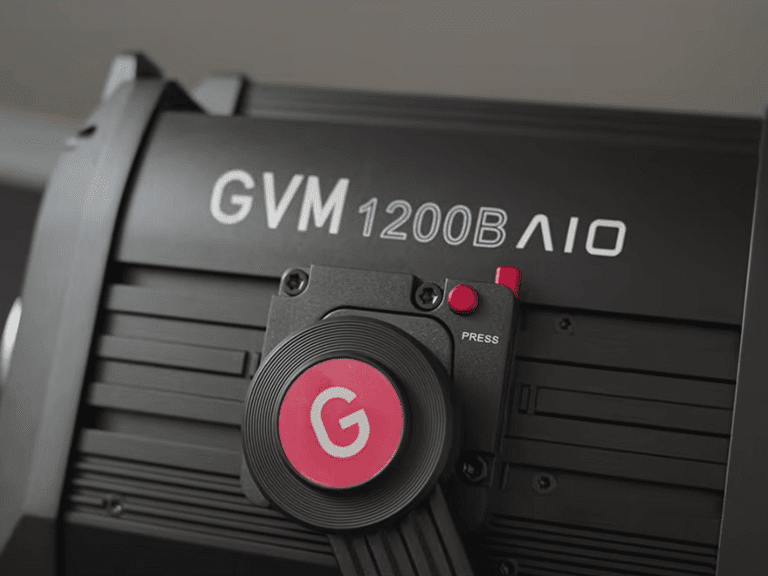
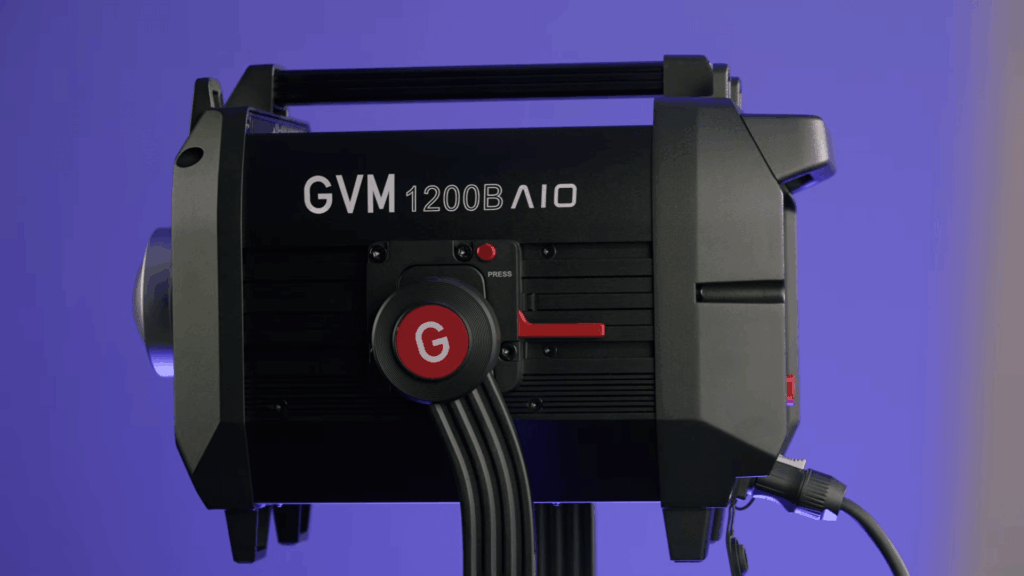
Portable Film Lights: Professional Cinematic Lighting Anywhere — Product Spotlight: GVM 1200B AIO
For filmmakers who need maximum cinematic lighting performance in a portable, location-ready package, the GVM 1200B AIO sets the standard for what a professional portable film light can deliver in 2026.
GVM 1200B AIO Full Specification Table
| Parâmetro | Especificação | Cinematic Lighting Application |
|---|---|---|
| Potência de Saída | 1200W | Primary key light for large sets and exterior locations |
| Iluminância | 42,800 lux @ 3m | Competes with and supplements direct sunlight outdoors |
| Temperatura de Cor | 2700K–6800K Bi-Color | Match tungsten, HMI, daylight, and golden hour precisely |
| Precisão de Cor | CRI/TLCI ≥97+ | Cinema-grade skin tone and colour reproduction |
| Escurecimento | 0.3%–100% Stepless (PWM flicker-free) | Precise exposure and ratio control at any intensity level |
| Cinematic Effects | 12 Built-in FX | Lightning, TV, Fire, Paparazzi, Candle, Explosion + more |
| Light Source Modes | 12 Simulation Presets | Candlelight, Daylight, HMI, Tungsten, and more |
| Controle | App / DMX 5-pin / CRMX / RDM / Art-Net | Full integration into professional wired and wireless systems |
| Suporte Modificador | Bowens Mount with safety lock | Softboxes, reflectors, Fresnel, grids, parabolic modifiers |
| Sistema de Arrefecimento | 3-mode intelligent fan (Auto/Low/Off) | Silent mode for critical audio environments |
| Projeto | All-in-one, no external ballast required | Plug and play setup anywhere |
| Peso | 10 kg / 22 lbs | Portable enough for solo operator location work |
| Yoke | Detachable U-shaped | Quick setup and repositioning in any scenario |
| Melhor para | Film, TV, Commercial, Studio, Location | Universal cinematic key light for professional production |
The GVM 1200B AIO’s 42,800 lux at 3 metres output is the specification that defines its cinematic utility. At this intensity level, the 1200B AIO can serve as a dominant key light on large interior sets, overpower mixed ambient light on practical locations, and supplement natural daylight on exterior shoots without being visually overwhelmed — capabilities that previously required HMI fixtures at significantly greater cost, weight, and operational complexity.
A 2700K to 6800K bi-color range covers every colour temperature encountered in professional filmmaking — from the warm tungsten quality of period interior scenes to the cool, clinical daylight of contemporary commercial production. Critically, the 1200B AIO maintains colour temperature consistency across its entire dimming range — a specification that budget fixtures consistently fail to deliver. When dimming from 100% to 30% output, the colour temperature remains stable, ensuring your carefully established colour balance survives intensity changes between setups.
Flicker-free PWM dimming from 0.3% to 100% means the 1200B AIO captures cleanly at any shutter speed and frame rate — including the high-speed slow-motion frame rates increasingly common in commercial and narrative production. At low dimming levels where budget LED fixtures typically introduce visible flicker, the 1200B AIO maintains clean, artefact-free output.
A 12 built-in cinematic effects — Lightning, TV Flicker, Fire, Paparazzi, Candle, Explosion, and more — and 12 light source simulation modes replicate practical light sources and environmental conditions without physical gels, additional fixtures, or post-production compositing. For a cinematographer recreating a candlelit interior, a thunderstorm exterior, or a television-lit bedroom, these one-click presets eliminate the need for multiple specialist fixtures and their associated setup time.
Three-fan-mode intelligent cooling with an Off option for complete silence makes the 1200B AIO usable in critical audio environments — dialogue scenes, voice-over sessions, and any production where cooling fan noise would contaminate the audio track. The ability to run a 1200W fixture in complete silence on a live set is a practical capability that significantly expands the scenarios in which the light can be deployed.
Full professional protocol support — CRMX wireless, 5-pin DMX, RDM, and Art-Net via the GVM BOX accessory — integrates the 1200B AIO into broadcast and film production lighting control systems of any scale. For productions using a lighting board or wireless DMX controller, the 1200B AIO functions as a first-class node within a fully integrated system, with remote control of intensity, colour temperature, effects, and fan mode from a central console.
At 10kg with a detachable U-shaped yoke and no external ballast required, the 1200B AIO achieves a portability level that traditional 1200W HMI fixtures cannot approach. A single operator can transport, position, and operate the light on location without crew support — a genuine practical advantage for independent filmmakers and commercial production companies running lean teams.
Building Your Cinematic Lighting Kit: Recommended Configurations
Solo filmmaker / YouTube cinema: One GVM 1200B AIO as key light with 90cm softbox, one smaller bi-color LED panel as fill, one compact LED fixture for back light or background. This three-fixture configuration covers the complete three-point setup with a cinematic-quality key light anchor.
Small production company: Two GVM 1200B AIO units as key and back lights, one or two LED panels as fill and background, a Fresnel modifier for the key light position when hard, directional light is required. CRMX or DMX integration for multi-light control from a single wireless console.
Location documentary and commercial: One GVM 1200B AIO as the primary HMI-replacement daylight key light, portable battery-powered LED panels as supplementary fill and practicals. The 1200B AIO’s ability to match daylight at 5600K or 6800K makes it a direct functional substitute for HMI fixtures in most location documentary scenarios at a fraction of the HMI’s logistical complexity.
Considerações Finais
Cinematic lighting in 2026 has never been more accessible. The convergence of high-CRI LED technology, intelligent dimming, professional control protocols, and genuine portability in fixtures like the GVM 1200B AIO means that independent filmmakers and small production companies can now achieve lighting quality that was previously the exclusive domain of major studio productions. Understand your contrast ratios, control your colour temperatures, invest in modifier flexibility, and anchor your kit with a fixture powerful and precise enough to serve as a true cinematic key light — and the visual gap between your work and professional cinema will narrow with every production.