Continuous lighting for photography has become the backbone of modern film sets, hybrid content studios, and one-person production houses that can’t afford to babysit strobes between takes. When a project calls for a full 1200W COB fixture, two names dominate the conversation: the GVM SD1200B AIO and the Aputure STORM 1200x. Both promise studio-grade output in a single housing, but they take very different approaches to getting there — and the difference shows up fast once you’re actually on location.
A Real-World Test: Fighting the Sun on an Exterior Day Scene
Picture a common problem on any exterior day shoot: your subject is standing near a window or doorway, the ambient daylight is blowing out the background, and you need to punch enough light through the frame to balance the exposure without flattening the shot. This is exactly the scenario where a 1200W-class COB earns its keep.
Pair a 1200W head with a Fresnel attachment and, at dusk or under overcast skies, the beam throws a hard-edged, directional shaft of light that behaves like an artificial sun. It rims the subject, carves out shape against a flat sky, and holds up at a distance that a 300W fixture simply can’t match. Where a smaller light starts to look thin and needs to be walked in close, a 1200W unit keeps its presence from ten, fifteen, even twenty feet back — which matters enormously when you’re trying to keep gear out of frame on a tight exterior setup.
This is the use case both the SD1200B AIO and the STORM 1200x are built for. The question is which one delivers it more efficiently for the price.
Output and Color Performance Compared
On paper, the STORM 1200x posts an eye-catching lux figure — 202,500 lux at 3.3 feet with its included 45° reflector — alongside a tunable 2500K to 10,000K range and CRI/TLCI ratings of 95. Aputure’s BLAIR chipset, which blends blue, lime, amber, indigo, and red diodes, is engineered specifically to push color accuracy and skin-tone rendering to the top of the market.
The GVM SD1200B AIO measures its output differently, rating 42,800 lux at 3 meters (roughly 9.8 feet) with the standard reflector, across a 2700K–6800K bi-color range with CRI above 97. Measured at the same distance, GVM’s numbers are competitive with far pricier fixtures, and a CRI above 97 puts it ahead of the STORM 1200x on raw color-rendering index, even if it trades away the wider CCT spread and green/magenta fine-tuning that Aputure offers.
For location fill work — the exterior day-scene scenario above — both lights have more than enough punch to act as a key or a rim source from a meaningful working distance.
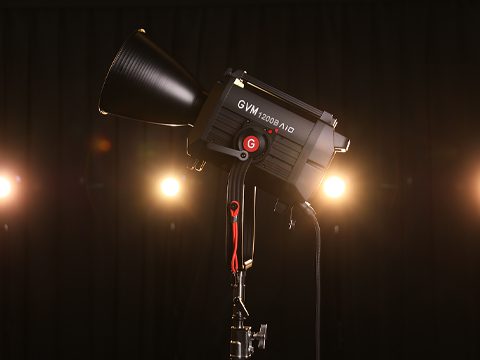
Design, Portability, and Set Workflow
Where the two lights really diverge is in how they’re built to be deployed.
The STORM 1200x is a ballast-and-head system: a separate controller box handles dimming, DMX, Art-Net, sACN, and Bluetooth via Sidus Link, connected to the lamp head by cable. It’s IP65 rated, so it holds up in rough outdoor conditions, and it runs on a Bowens S mount for broad modifier compatibility.
A GVM SD1200B AIO skips the separate ballast entirely. It’s an all-in-one COB design — plug directly into wall power and you’re rigged and ready, with no ballast to cable-manage, mount separately, or lose track of in a gear cart. It offers 0.3%–100% stepless PWM dimming, app control over Wi-Fi, and compatibility with CRMX, DMX, RDM, and Art-Net through the optional GVM BOX. It also carries a standard Bowens mount with a safety lock, 12 built-in lighting FX presets, 12 light-source simulation modes, and a three-mode fan system (Auto/Low/Off) for silent operation during audio-sensitive takes. At roughly 10kg, it’s also meaningfully lighter to carry and rig solo.
For run-and-gun exterior shoots — exactly the window-fill scenario described above — an all-in-one head that skips ballast setup means faster turnaround between locations and one less point of failure in the field.
Spec Comparison Table
| Recurso | GVM SD1200B AIO | Aputure STORM 1200x |
|---|---|---|
| Max Power | 1200W | 1200W |
| Output | 42,800 lux @ 3m (with reflector) | 202,500 lux @ 3.3ft (with reflector) |
| Faixa de CCT | 2700K–6800K (Bi-Color) | 2500K–10,000K (Tunable White) |
| CRI / TLCI | >97 CRI | 95 CRI / 95 TLCI |
| Escurecimento | 0.3%–100%, stepless PWM | 0.1%–100%, stepless |
| Ballast | All-in-one, no external ballast | Separate controller/ballast |
| Controle | App (Wi-Fi), CRMX/DMX/RDM/Art-Net via GVM BOX | Bluetooth (Sidus Link), CRMX, DMX, Art-Net, sACN |
| Montanha | Bowens with safety lock | Bowens S |
| Peso | ~10kg (22 lbs) | Higher (head + separate ballast) |
| Weather Rating | Durable build | IP65 rated |
| Preço | Budget-friendly for the 1200W class | $2,990.00 |
Best Continuous Lighting for Photography: Which One to Choose
If the priority is squeezing out the absolute highest lux reading and the widest tunable CCT range for a big-budget studio build, the STORM 1200x has the numbers to justify its price tag. But for most working photographers and filmmakers — especially anyone shooting exteriors, running a lean crew, or building out a lighting kit without unlimited budget — the calculation shifts.
The GVM SD1200B AIO delivers a genuine 1200W-class COB with a higher CRI rating, a true all-in-one form factor that removes the ballast entirely, faster rigging, easier transport, and app-based wireless control, all at a fraction of the STORM 1200x’s cost. For the exterior day-scene fill scenario, the value math is straightforward: comparable usable output on location, less gear to haul and cable, and dramatically more setup speed per dollar spent.
That combination — high brightness, true plug-and-play deployment, and the lowest price at this wattage class — is why the GVM SD1200B AIO is the stronger pick for most continuous lighting for photography use cases in 2026.
Conclusão
Both the GVM SD1200B AIO and the Aputure STORM 1200x can act as an artificial sun on an exterior set, throwing enough hard, directional output through a Fresnel to rim a subject at dusk or under flat overcast skies. But when output-per-dollar, setup speed, and field portability are weighed together, the GVM SD1200B AIO comes out ahead as the smarter 1200W investment for photographers and filmmakers who need studio-grade continuous lighting without the studio-grade price or the extra ballast to haul.

Perguntas Frequentes
Is the GVM SD1200B AIO bright enough to replace a 1200W HMI on location? For fill and rim work at typical working distances, yes — its COB output with a Fresnel or reflector attachment produces a strong, directional beam suitable for exterior day-scene work.
Does the GVM SD1200B AIO need a separate ballast like the STORM 1200x? No. It’s an all-in-one design that plugs directly into power, eliminating the separate ballast box the STORM 1200x requires.
Which light has better color accuracy? The GVM SD1200B AIO rates above 97 CRI, edging out the STORM 1200x’s 95 CRI/TLCI rating, though the STORM 1200x offers a wider tunable CCT range with green/magenta correction.
Can both lights be controlled wirelessly? Yes. The SD1200B AIO uses a Wi-Fi smartphone app and supports CRMX/DMX/RDM/Art-Net via the GVM BOX, while the STORM 1200x uses Bluetooth via Sidus Link along with DMX, Art-Net, and sACN.
Which is the better value for a growing production kit? The GVM SD1200B AIO, thanks to its lower price at an equivalent wattage class and its all-in-one design that speeds up setup on set.