More creators are turning to a led panel light for photography and video work than ever, and the reason comes down to how the light behaves once it hits your subject. Unlike a COB spotlight that concentrates output into a single point, a panel spreads LEDs across a flat surface, producing soft, even illumination with none of the harsh falloff or hotspots that a bare point source creates.
That makes panels easier to work with for beginners, faster to set up for solo creators, and more forgiving across a wide shooting area — which is exactly why panel lights have become the default starting point for portraits, interviews, and studio product work.
LED Photography Panel: Two Popular Options
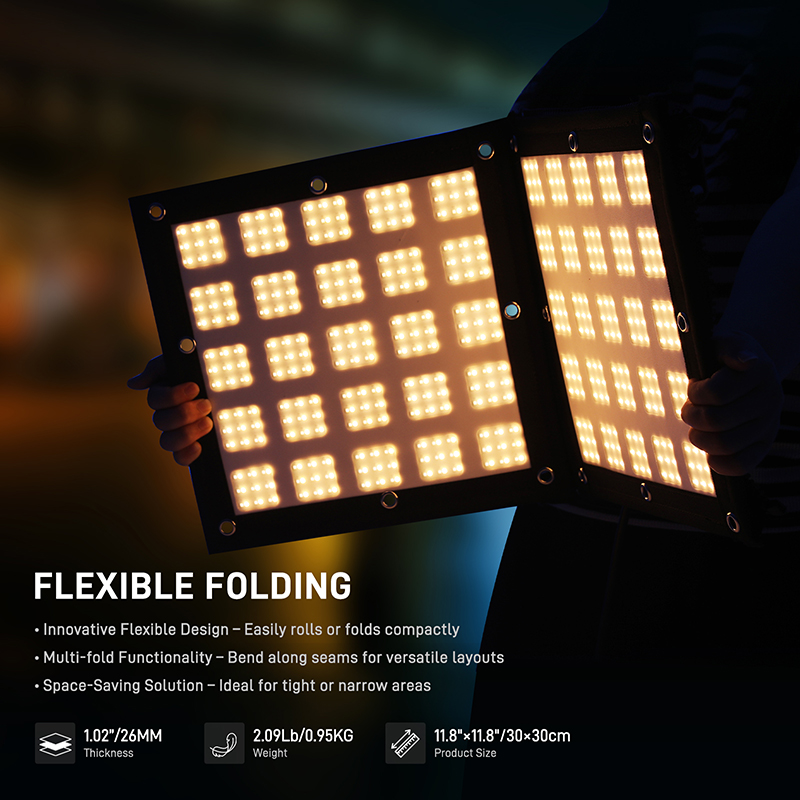
Among the panel lights creators reach for most often, the GVM YU150R and the GVM Z100B consistently come up — and for good reason, since they approach the same category from different angles. The YU150R is a 150W RGB soft panel built for creators who want maximum creative range: full RGB color, six lighting modes, and DMX support for professional integration. The Z100B takes a different approach, prioritizing portability and scalability with a tool-free zipper connection system that lets multiple panels join together into one larger light source. Both are strong picks, but which one fits depends heavily on how you actually shoot.
Light Panel Photography: Full Comparison
Side by side, the differences between these two panels become clear. The YU150R is the more feature-dense fixture — its 2000K–10,000K range is significantly wider than the Z100B’s 2,700K–6,800K, and it adds full RGB color control, sound-synchronized lighting, and DMX input that the Z100B doesn’t offer. The Z100B counters with something the YU150R can’t match: physical scalability. Its zipper system lets creators combine multiple units into a larger panel on demand, which is genuinely useful for covering bigger sets without buying a single oversized fixture.
| Recurso | GVM YU150R | GVM Z100B |
|---|---|---|
| Poder | 150W | 100W |
| Temperatura de Cor | 2000K–10,000K | 2,700K–6,800K |
| CRI | ≥97 | High CRI (bi-color) |
| Modos de Cor | CCT, HSI, RGB, GEL, Scene Effects, Source Matching | CCT with 12 light source presets |
| Controle | APP, Bluetooth Mesh, DMX | Integrated onboard control box |
| Scalability | Single fixture | Zipper-connect, modular expansion |
| Melhor para | RGB creative work, DMX studio integration, live streaming | Portable setups, expandable coverage, minimal cabling |
In practical terms, the YU150R earns its place in setups where color accuracy and creative flexibility matter most — live streaming with sound-reactive effects, multi-camera studio work synced over DMX, or any shoot where RGB accents are part of the look. The Z100B is the better fit when the priority is a clean, fast setup that can grow: its integrated control box means no extra cables, and its zipper connection means the same light that works for a single portrait can scale up for a wider commercial set without a different fixture.
Best LED Panel Light for Photography
There’s no single universal answer here — the best led panel light for photography depends on whether creative color range or physical scalability matters more to your workflow. For photographers and videographers who lean into RGB effects, need DMX for studio integration, or want the widest possible color temperature range, the YU150R is the stronger technical pick. For creators who prioritize fast, clutter-free setup and the option to expand coverage without buying a second fixture from scratch, the Z100B’s modular design is hard to beat. Many working studios end up owning both — the YU150R as a primary creative light, the Z100B as a flexible, scalable fill or expansion panel.

Perguntas Frequentes
What is a led panel light for photography used for?
A led panel light for photography is typically used as a key or fill light, producing soft, even illumination across a wide area — ideal for portraits, interviews, product shots, and studio video work where harsh shadows need to be avoided.
Is the GVM YU150R or Z100B better for beginners?
The Z100B is generally easier for beginners thanks to its simpler integrated control box and straightforward CCT mode, while the YU150R’s RGB and DMX features suit creators who already understand more advanced lighting control.
Can LED panel lights be used outdoors?
Yes, both panels can be used outdoors, though panel lights generally perform best at closer working distances than COB spotlights, since their output spreads more widely rather than concentrating into a single beam.
Do these panels support app control?
Yes. Both the YU150R and Z100B support smartphone app control, with the YU150R also offering Bluetooth Mesh networking and DMX for multi-fixture professional setups.
Which panel light has a wider color temperature range?
The GVM YU150R has the wider range at 2000K–10,000K, compared to the Z100B’s 2,700K–6,800K, making the YU150R better suited to extreme warm or cool color matching.