Escolhendo o caminho certo outdoor video light can be the difference between footage that looks professionally lit and footage that looks like it was shot with whatever daylight happened to be available. Natural light outdoors is beautiful, but it’s also unpredictable — clouds roll in, the sun moves, and golden hour lasts only a few minutes. For filmmakers, YouTubers, and content creators who shoot on location, a dedicated outdoor video light provides the consistency that natural light alone can’t guarantee.
Unlike studio lighting, outdoor video lights face a different set of demands: they need to run without a nearby power outlet, hold up to changing weather and terrain, and still be bright enough to compete with or shape sunlight. This guide covers what makes a light suitable for outdoor use, how outdoor and indoor lighting needs differ, practical techniques for shooting outdoors, and which portable, battery-powered lights are worth adding to a filmmaker’s kit in 2026.
What Is an Outdoor Video Light?
An outdoor video light is a continuous LED light source designed to supplement or shape natural light during on-location filming, rather than relying on wall power in a controlled studio environment. Unlike indoor fixtures that assume a stable power source and a fixed shooting position, outdoor video lights are built around portability, battery flexibility, and enough output to remain visible even in bright daylight conditions.
Key qualities that define a genuinely outdoor-ready video light include:
- Battery or multi-source power options, since AC outlets are rarely available on location
- Sufficient brightness to act as fill light against strong sunlight, not just in dim indoor rooms
- Compact, rugged design that can be transported easily and withstand handheld or on-the-move use
- Accurate color temperature control, allowing the light to blend naturally with daylight rather than clashing with it
A light that performs well on a desk under controlled indoor conditions doesn’t automatically translate to outdoor use — outdoor shooting introduces variables that make portability and power flexibility just as important as raw brightness.
Outdoor vs. Indoor Video Lighting
Indoor and outdoor lighting solve fundamentally different problems, even when using similar equipment.
Indoor video lighting typically works within a controlled environment. The light source stays constant, power is always available nearby, and the main challenge is arranging fixtures to create flattering key, fill, and background light. Indoor setups can prioritize precision — softboxes, multiple fixtures, and careful positioning — since none of those elements need to move quickly or survive changing conditions.
Outdoor video lighting has to work in cooperation with an uncontrollable variable: the sun. Instead of being the only light source, an outdoor video light typically acts as a fill or accent light, balancing shadows created by direct sunlight or adding a catchlight to a subject’s eyes on an overcast day. Because natural light shifts constantly — from harsh midday sun to soft, warm golden hour — outdoor lighting setups need to adapt quickly, which is much harder to do with heavy, power-hungry indoor fixtures.
The practical result is that outdoor lighting favors speed and portability over the level of fine control available in a studio, while still needing enough brightness and color accuracy to hold up against natural daylight.
How to Use Video Lights Outdoors
Successfully using a video light outdoors comes down to working with natural light rather than trying to overpower it.
Use your light as fill, not the key. On most outdoor shoots, the sun remains your primary light source. Position your video light to soften harsh shadows cast by direct sunlight — typically on the shadow side of a subject’s face — rather than trying to replace sunlight entirely.
Match color temperature to the time of day. Midday sun sits close to 5600K, while golden hour light warms significantly, often dropping toward 3200–4000K. A bi-color light lets you match your fill light to the ambient color temperature so it blends naturally instead of looking artificially blue or orange against the sun.
Watch your background exposure. Outdoor scenes often have far more dynamic range than indoor ones — a bright sky and a shaded subject can be several stops apart. Using a video light to bring up your subject’s exposure without blowing out the background is one of the most common and useful applications outdoors.
Account for wind and instability. Lightweight stands and clamps can be knocked over easily outdoors. Sandbags, weighted stands, or handheld operation are often more practical than a full studio stand setup when shooting in open or windy locations.
Plan around your battery life. Unlike an indoor shoot where you can simply stay plugged in, outdoor shoots are limited by however much battery power you’re carrying. Knowing your light’s runtime in advance prevents losing your light source mid-shoot.
Portable Outdoor Video Light for Filmmakers
Portability is the defining requirement for outdoor filmmaking, and it’s where many otherwise powerful studio lights fall short. A large panel or COB light might offer excellent output, but if it requires a bulky stand, external ballast, and constant AC power, it becomes impractical for run-and-gun outdoor shoots, travel vlogging, or documentary-style filmmaking.
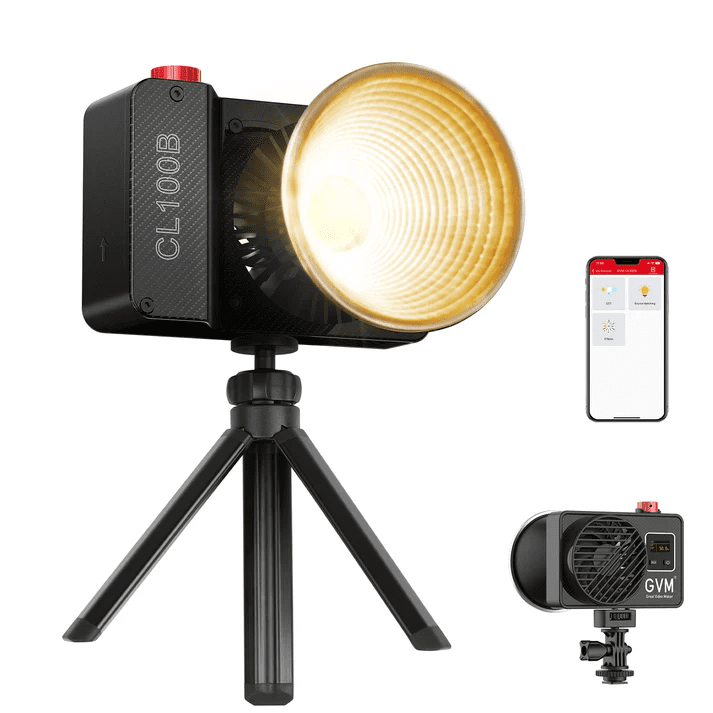
This is the exact gap the GVM-CL100B Portable Bi-Color LED Monolight is designed to fill. At just 357g — roughly the size and weight of a mirrorless camera body — it’s compact enough to fit in a jacket pocket or camera bag, yet still delivers 100W of output and 18,500 lux at 1 meter, enough to act as effective fill light even in fairly bright outdoor conditions.
For filmmakers who need to move quickly between locations or shoot handheld, the CL100B’s small footprint means it can be mounted on a compact stand, clamped to a rig, or even handheld without adding significant weight to a kit that already includes a camera, lenses, and audio gear.
Best Battery Powered Video Light for Outdoor Shoots
Battery flexibility is often the single most important factor for outdoor video lighting, since power availability on location is never guaranteed. The GVM-CL100B addresses this with a sistema de fonte de alimentação tripla: an AC adapter for controlled setups near a power source, NP-F batteries for fully wireless, extended outdoor use, and USB-C PD charging that allows the light to run from the same portable power bank many filmmakers already carry for their camera or phone.
This flexibility means a single light can serve both as a quick-grab solution for a short outdoor interview and as a longer-running fill light for a full day of location shooting, without needing separate gear for each scenario. Combined with CRI and TLCI ratings of 97+, the CL100B maintains accurate color reproduction even when adjusted to match shifting outdoor light throughout the day.
| Recurso | Specification / Benefit |
|---|---|
| Peso | 357g — pocket-sized, ideal for travel and location work |
| Output | 100W, 18,500 lux @ 1m |
| Precisão de Cor | CRI ≥ 97, TLCI ≥ 97 for natural outdoor color matching |
| Opções de Energia | AC adapter, NP-F battery, or USB-C PD power bank |
| Controle | Onboard LCD/knobs plus Bluetooth app (50m mesh range) |
| Included Kit | Silicone light dome, small reflector, tabletop tripod, 1/4″-20 mount |
| Melhor para | Outdoor interviews, travel vlogging, run-and-gun filmmaking, documentary work |
Conclusão
The best outdoor video light isn’t necessarily the brightest one on paper — it’s the one that can keep up with the unpredictability of shooting outside. Battery flexibility, compact size, and accurate color reproduction matter more outdoors than the raw output specs that dominate studio lighting comparisons. For filmmakers who need a light that travels light, runs on multiple power sources, and still holds up against natural daylight, the GVM-CL100B offers a practical, professional-grade solution built specifically for the demands of location shooting.
Ready to light your next outdoor shoot? Explore the GVM-CL100B and its full accessory kit to build a portable lighting setup that goes wherever your production takes you.

Perguntas frequentes
Do I need a video light if I’m already shooting in natural sunlight?
Yes, in most cases. Direct sunlight creates strong, often harsh shadows, especially around midday. A video light used as fill helps soften those shadows and balance exposure between a subject and a bright background, even on a sunny day.
What color temperature should an outdoor video light be set to?
It depends on the time of day. Midday sun is close to 5600K, while golden hour light is much warmer, often 3200–4000K. A bi-color light lets you adjust to match the current ambient light so your fill blends naturally rather than looking artificially cool or warm.
How long does a battery-powered video light typically last outdoors?
Battery life varies by brightness setting and battery type, but most creators can expect a portable light like the CL100B to run for a full outdoor session on a single NP-F battery or USB-C power bank at moderate brightness, with AC power available as a backup for longer, stationary shoots.
Can a small, portable light like the CL100B really compete with sunlight?
At close range, yes — especially as fill light rather than a primary source. A light with high lux output at 1 meter, like the CL100B’s 18,500 lux rating, is effective for softening shadows on a subject’s face even in bright outdoor conditions, though it isn’t intended to overpower the sun entirely.
Is a bi-color light necessary for outdoor shooting, or is daylight-only enough?
A bi-color light is generally more versatile. While daylight-balanced lights work well at midday, outdoor shoots often extend into golden hour or overcast conditions where color temperature shifts significantly, and a bi-color light lets you adapt without needing a second fixture.