A photography focusing flood light is the tool I wish existed twenty years ago, back when I was hauling three different fixtures to a shoot just to cover the range that one modern light now handles on its own. In 2026, focusing LED lights have gone from a niche gaffer’s toy to something every working photographer and content creator should at least understand, because the ability to zoom a beam from a tight spot to a soft flood — without swapping a single piece of gear — genuinely changes how fast and how well you can light a scene.
I’m luuka a working gaffer and cinematographer, and I’ve spent more shoots than I can count fighting the exact problem this category of light solves. Here’s what I’ve learned about focusing flood lights, what separates a good one from a marketing gimmick, and how one specific fixture performed the last time I put it to work.
Continuous Lighting for Photography Has Changed
For most of my career, continuous lighting for photography meant picking your beam angle before you ever left the truck. Flood lights were flood lights. Spotlights were spotlights. If a shoot needed both — a tight accent on one subject and a soft wash across a background — you brought two fixtures, ran two power cables, and hoped you had the stands to support both.
That’s not really true anymore. The rise of the focusing LED light for photography has quietly solved a problem gaffers have been managing around for decades. A single COB fixture with a proper zoom lens can now shift from a narrow, punchy spot to a wide, even flood with a twist of a knob, mid-shoot, without touching the power or repositioning the stand. On a set with a tight schedule and a smaller crew — which, let’s be honest, describes most shoots I work now, from indie sets to solo content creators — that flexibility isn’t a luxury. It’s what keeps a session on schedule.
What the Best Lights for Photography Actually Need
I get asked constantly what separates a genuinely useful focusing light from one that just has “zoom” printed on the box. After enough shoots where a cheap zoom light let me down, here’s what I actually check for now.
A real optical zoom, not a diffusion trick. Some lights fake a “focus” adjustment with interchangeable caps or sliding diffusers. A proper focusing light uses an actual lens system — usually a TIR optic — that physically reshapes the beam. You can feel the difference the moment you use one.
A zoom range wide enough to matter. A light that only shifts ten degrees isn’t giving you two tools, it’s giving you one tool with a slightly blurry edge. I look for at least a 15° to 45° range, which is wide enough to go from a genuine accent spot to a usable flood.
Color that doesn’t drift as you zoom. This one’s easy to overlook until you’re mid-shoot and notice your subject’s skin tone shifted slightly as you widened the beam. A well-engineered light holds its CRI and color temperature steady across the entire zoom range.
Dimming that actually feels smooth. Stepped or jumpy dimming ruins slow fades and careful exposure work. I want stepless control, and ideally more than one dimming curve, so I can match how brightness falls off to the mood of the shot.
A body that doesn’t need a separate ballast box. Anything that adds a second cable and a second box to carry defeats half the point of a compact, focusing fixture in the first place.
Why Older Video Lights Needed a Whole Bag of Accessories
Before this category existed, getting any real creative range out of a light meant packing a small bag of accessories just to compensate. A flat panel gave you one fixed spread — to soften it, you clipped on a diffusion dome or a small softbox. To narrow it, you dug out barn doors or a snoot. To change the entire character of the light, you often had no choice but to grab a completely different fixture.
I’ve physically felt the weight of that bag on my shoulder more times than I want to admit. What a focusing flood light does is fold most of that kit into the light head itself. It doesn’t replace every modifier — a proper softbox still gives you the softest, most even wrap you can get for a portrait — but it collapses the everyday range of looks you’d normally need three or four accessories to achieve down into a single knob.
Focus Lights for Photography: The GVM PF100B
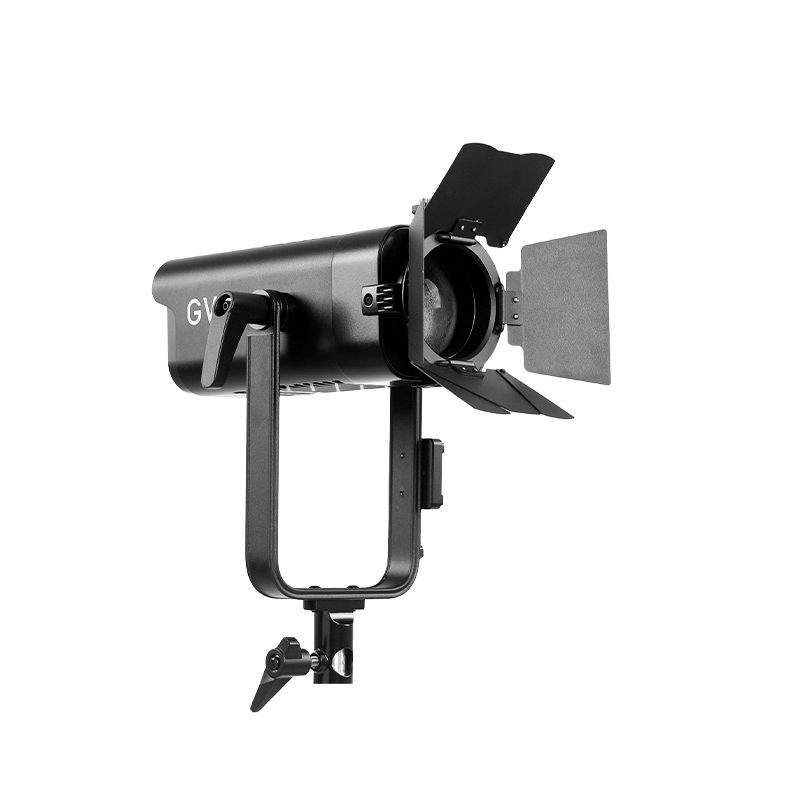
The last fixture I ran through a real shoot in this category was the GVM PF100B, a 100W bi-color COB light built specifically around genuine spot-to-flood focusing rather than treating it as a footnote feature.
It uses a custom TIR optical lens to deliver an actual 15°–45° zoom, and the range is wide enough to be genuinely useful on both ends — 30,200 lux at 1 meter in tight spot mode, which is plenty of punch for a dramatic accent or reaching a distant subject, opening up to a soft, even 45° flood when the scene calls for broader coverage. What I appreciated most on set was that the color held steady across that entire range — CRI and TLCI both sit at 97+, and I didn’t notice the drift I’ve caught on cheaper zoom fixtures in the past.
It also carries four separate dimming curves — Linear, Log, Exponential, and S-Curve — which sounds like a spec-sheet detail until you’re trying to match a specific fall-off style and realize how much control that actually gives you. Beyond the core focusing function, it includes a CCT mode, a Source Matching mode that simulates twelve real-world light sources through the GVM app, and an Effects mode with twelve built-in cinematic presets. The cooling system offers four fan modes, including a Silent mode that kills the fan entirely for audio-sensitive work, and the whole controller lives in the light head — no separate ballast box to carry or cable to route.
| Recurso | Specification / Benefit |
|---|---|
| Modelo | GVM PF100B |
| Poder | 100W bi-color COB |
| Ângulo do Feixe | 15°–45° zoomable (TIR optical lens) |
| Illuminance (Spot 15°) | 30,200 lux @ 1m |
| Illuminance (Flood 45°) | 3,460 lux @ 1m |
| Temperatura de Cor | 2700K–6800K |
| CRI/TLCI | 97+ held consistent across the full zoom range |
| Escurecimento | 0–100% stepless, 4 dimming curves |
| Lighting Modes | CCT, Source Matching (12 sources), Effects (12 FX) |
| Arrefecimento | 4 modes including Silent (fan off) |
| Opções de Energia | AC 100–240V or optional V-mount battery |
| Projeto | Integrated controller, Mini Bowens mount |
| Melhor para | Portrait accents, interviews, product photography, on-location video |
On Set: How I Actually Used It
I ran the PF100B on a single-subject portrait session where the plan changed halfway through, which is exactly the kind of shoot that shows you what a light can actually do versus what the spec sheet promises.
I started in tight spot mode at 15°, about 60% brightness, positioned at a 45-degree angle to build a strong, dramatic key with a defined shadow across one side of the subject’s face — the kind of hard, sculpted look I’d normally need a grid or a snoot to pull off on a flatter fixture. Color temperature was set to 3200K to keep the mood warm and a little moody.
Then the client asked for something softer for a second set of frames, wanted within the same session. Normally that means stopping to swap a modifier or bring in a second light. Instead, I just turned the focus ring toward 45°, and the shadow edges softened out and the coverage widened across the subject’s face and shoulders almost immediately. I dropped brightness slightly and switched to the S-Curve dimming setting to keep the fall-off smooth as the beam opened up.
Two completely different looks, one light, no gear swap, no lost time. That’s not a small thing on a real shoot with a real clock running.
Conclusão
Focusing LED lights are one of the more genuinely useful shifts I’ve seen in continuous lighting for photography, and they’re not hype — they collapse what used to take multiple fixtures and a bag of accessories into a single, adjustable tool. A light in this category earns its place by holding true color across its zoom range, offering a wide enough beam spread to matter, and giving you dimming control precise enough to trust. The GVM PF100B checked every one of those boxes the day I used it, and it’s stayed in my kit since.
Ready to add real focusing control to your kit? Check out the GVM PF100B and see what spot-to-flood precision does for your next shoot.

Perguntas frequentes
What actually makes a light “focusing” instead of just having a wide beam angle?
A true focusing light uses an internal lens system, usually a TIR optic, to physically reshape the beam as you adjust it — not just a fixed wide spread or a swap-on diffuser. That’s what lets a single fixture move between a tight spot and a soft flood.
Does zooming the beam change the color of the light?
On a well-built fixture like the PF100B, no. CRI and TLCI stay at 97+ across the full 15°–45° range, so you’re not chasing a color shift every time you adjust the focus.
Can this replace a softbox entirely?
Not quite — a softbox still gives you the softest, most even wrap for portrait work. What a focusing light does is cut down how often you actually need one, since the flood setting already covers a lot of the range a softbox is usually reached for.
Is a light like this suited for video, or just stills?
Both. Between the stepless dimming, multiple dimming curves, Silent cooling mode, and built-in Source Matching and Effects modes, it works just as well on interviews and run-and-gun video as it does on a portrait session.
What if I’m shooting somewhere without reliable AC power?
The PF100B runs on an optional V-mount battery in addition to standard AC power, so on-location work without a wall outlet isn’t a problem.