In 2026, mastering Photography Lighting Basics is the definitive skill that separates amateur creators from professionals. As AI beautification becomes ubiquitous, authentic and high-quality lighting is more critical than ever. This complete guide rebuilds lighting knowledge from the ground up, focusing on continuous lights. It covers the four core concepts every creator must know—quality of light, color temperature, Lux (illuminance), and CRI/TLCI—followed by practical setups for talking heads, vlogs, and product photography, plus advanced multi-light control techniques. The article also features an in-depth review of the GVM PRO SD200B, a 200W bi-color COB light that meets 2026 professional standards, along with a tiered budget planning framework. Whether you are a videographer, photographer, or streamer, this guide will help you build a pro-grade lighting system on a sensible budget and unlock your gear’s full potential.
Introduction: Why You Must Relearn Photography Lighting Basics in 2026
Photography lighting basics 2026 is no longer optional knowledge — it is the skill that separates amateur work from professional work. In an era where AI beautification is everywhere, viewers have developed an instinct for what looks real. Flat, dim, and color-shifted footage gives you away instantly. Here is the uncomfortable truth: when your photos or videos look wrong, the problem is rarely your camera — it is your light.
This guide rebuilds lighting from the ground up using the latest 2026 gear and workflows. You will learn the four core concepts every creator must master, how to apply them in real shooting scenarios, how professional control takes footage from good to cinematic, and how to build a professional-grade lighting system on a sensible budget. From continuous (constant) lighting selection to advanced multi-light control, photography lighting basics 2026 is your annual must-learn discipline.
Photography Lighting Basics 2026 — The 4 Core Concepts Beginners Must Master
These four concepts are the foundation of everything else. Get them right and every lighting decision afterward becomes easier.
1. Quality of Light: Hard vs Soft
Luz dura produces sharp, defined shadows and high contrast — perfect for sculpting depth, texture, and dramatic mood (bare bulbs, spot reflectors). Luz suave creates smooth gradients and shallow shadows — the go-to for portraits, beauty, and flattering skin (softboxes, octaboxes). In 2026, collapsible deep-parabolic softboxes have become mainstream, letting one light serve both purposes: pop the diffusion on for soft, remove it for punch.
2. Color Temperature and Why Bi-Color Is Essential
Color temperature is measured in Kelvin (K). The two foundation points are 5600K (daylight) e 3200K (tungsten). Matching your light to the ambient environment prevents that ugly orange-or-blue color cast. The 2026 standard is stepless bi-color tuning across 2700K–6800K, letting you match window light, indoor warm bulbs, or overcast skies in seconds — no gels, no guesswork.
3. Brightness and Metering: Stop Looking at “Watts” — Look at Lux
Wattage (W) measures power consumption, not how bright a light actually appears. What determines your exposure is illuminance (Lux) at a given distance. As a rule of thumb: around 5,000–8,000 Lux at 1 meter handles most talking-head and interview setups, while product and still-life work benefits from higher, tightly controlled output. Always compare lights by Lux at a stated distance, not by their wattage label.
4. Color Rendering Index (CRI & TLCI): The Baseline of Color Fidelity
CRI measures color accuracy as the human eye sees it; TLCI measures the same for camera sensors. CRI ≥ 97 and TLCI ≥ 97 are the professional baseline. Low-CRI lights cause subtle color shifts that no amount of grading fully fixes — I have personally lost hours in color correction because of a cheap light with a sub-95 rating. Do not make that mistake.
2026 Video & Photography Lighting in Practice (Best Light for Videography)
Theory only matters when it survives contact with a real shoot. Here are three reusable setups.
Scenario 1: YouTube Talking Head / Interview — Upgraded Three-Point Lighting
- Luz principal: 45° to the side and slightly above eye level.
- Luz de preenchimento: at roughly half the key’s brightness to hold a 1:2 lighting ratio.
- Rim light: behind the subject to light the hair and separate them from the background.
Advanced tip: save your best settings as an app preset and recall them in one tap — consistency across episodes is a signature of professional channels.
Scenario 2: Vlog / Run-and-Gun — Lightweight Quick-Deploy
A portable LED paired with a small diffusion dome is all you need on the move. Use fast bi-color adjustment to match shifting environments — warm indoor light one minute, overcast daylight the next — without slowing your shoot.
Scenario 3: Product Reviews / Still Life — Even, Shadowless Lighting
Place a main light to the upper side and add a reflector below to lift shadows. Use a separate background light to control the brightness gradient behind the product, giving it dimension instead of a flat cutout look.
Advanced Light Control: From One Light to a Multi-Light System
Once the basics are solid, control is what separates competent work from cinematic work.
- Beam control: honeycomb grids and barn doors prevent spill and shape where light lands.
- Creative effects: built-in lightning, candle, and TV effects cut post-production time dramatically.
- Multi-light sync: Bluetooth Mesh or DMX networks let you control brightness and color temperature across an entire rig at once.
- Silent cooling: for long recordings, fan noise will ruin your audio — prioritize quiet-cooling designs.
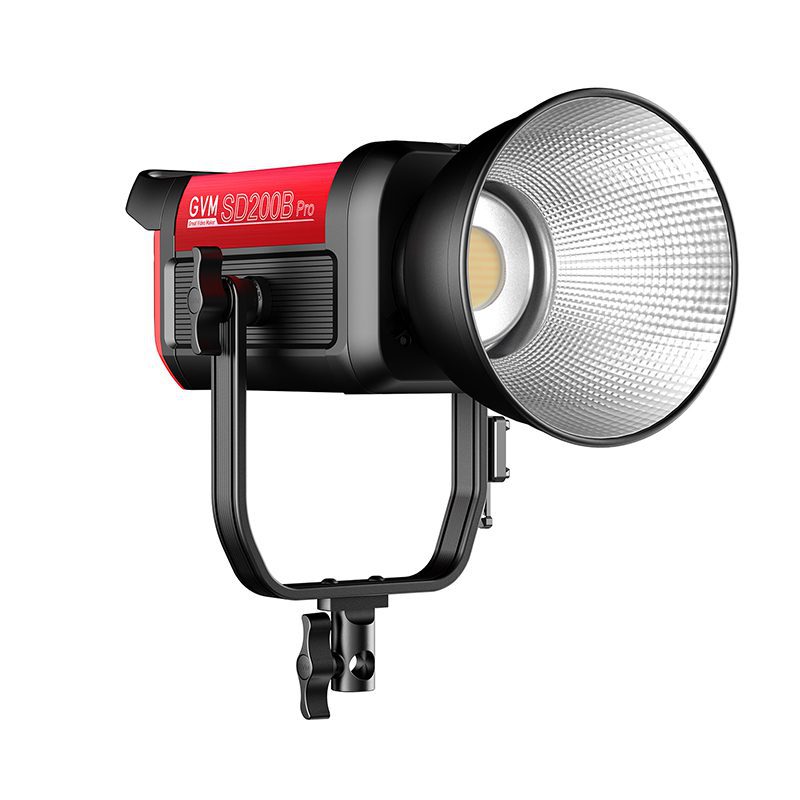
Product Deep Dive: How the GVM PRO SD200B Redefines 2026 Professional Lighting
The GVM PRO SD200B is a 200W bi-color COB light built for creators who want studio performance without a studio budget. Here is why it meets the 2026 professional standard.
Core Specs at a Glance
| Parâmetro | GVM PRO SD200B | Industry Comparison |
|---|---|---|
| Brightness | 45,400 Lux @ 1m | Far exceeds same-price 200W rivals |
| Color Rendering | CRI / TLCI ≥ 97 | Professional-grade baseline |
| Temperatura de Cor | 2700K–6800K | Full-scenario coverage |
| Escurecimento | 0–100%, 1/1000 step | Cinema-level smoothness |
| Controle | App + DMX + knob | Triple redundancy |
| Montanha | Bowens mount | Broad modifier compatibility |
4 Core Advantages That Solve Real Pain Points
- High color fidelity — stays true over long shoots, ideal for livestreaming and feature work.
- Flexible control — Bluetooth Mesh networking syncs multiple lights, while 5-Pin DMX integrates into studio systems.
- Creative presets — 12 lighting effects and 12 source simulations boost on-set efficiency.
- Powerful output — a single unit covers most medium and large scenes.
Who It Is For
Professional video production, livestreaming, and interviews; wedding, portrait, and product photography; both studio and on-location shooting.
2026 Continuous Light Buying Checklist & Budget Planning
Use this tiered framework to avoid overspending and future-proof your kit.
| Stage | Orçamento | Recommended Setup | Core Goal |
|---|---|---|---|
| Beginner | 150–250 | 1× 200W bi-color + softbox | Master basic three-point lighting |
| Intermediate | 300–500 | 2× 200W + 1× 80W + modifiers | Multi-light coordination, precise dimming |
| Profissional | $600+ | 3–4 light DMX system + full accessories | Studio-grade workflow |
Avoid these traps:
- Do not buy single-color-temperature lights — retrofitting color later costs more.
- Do not ignore cooling noise — a loud fan destroys your audio.
- Prioritize lights that support App/DMX to leave room for expansion.
FAQ — Photography Lighting Basics 2026
Q1: What are the basic photography lighting setups for beginners in 2026? Start with a single light plus a reflector, then learn the position and ratio of key, fill, and rim lights. Master three-point lighting first — everything else builds on it.
Q2: Continuous light vs strobe — which is better for video? Video requires continuous light, because strobes cannot provide sustained illumination. In 2026, continuous lights are bright enough and offer real-time preview, making them the standard for motion work.
Q3: How many watts do I need for a YouTube talking-head setup? A 150–200W bi-color light (like the GVM SD200B) with a softbox delivers ample exposure at 1.5 meters. Wattage is a guide — check Lux at your working distance.
Q4: Is a bi-color adjustable light worth the extra cost? Absolutely. 2700K–6800K tuning lets you match any environment quickly and avoid color cast — it is the 2026 professional standard, not a luxury.
Q5: What does CRI ≥ 97 and TLCI ≥ 97 mean for my videos? It ensures true color reproduction, natural skin tones, and greater grading latitude. Lights below 95 often cause color shift and are not recommended for commercial projects.
Q6: Do I need DMX control for a home studio? Not at first — but App control is essential. DMX suits future multi-light setups or integration into broadcast systems.
Q7: How do I choose my first light modifier? Go with a 90–120cm deep-parabolic softbox. It is soft yet directional and is the most versatile accessory in photography lighting basics.
Q8: Can I use photography lights for live streaming? Yes, and it is recommended. Continuous lights are flicker-free and high-CRI, making them ideal for streaming. Just choose a model with quiet cooling.
Considerações Finais
Domínio photography lighting basics 2026 is the fastest shortcut to better-looking work. The camera you already own is capable of stunning images — it has simply been waiting for the right light. Start with one professional light, learn to shape it, then expand into a system as your skills grow. That is how amateurs become professionals.