Effective Iluminação de vídeo goes beyond illumination; it’s the visual language that shapes how viewers perceive, emotionally connect with, and ultimately understand your story.
A well-lit frame often works because the light feels natural and controlled. Shadows fall where they should, colors remain consistent, and the subject stands out without the lighting becoming the focus itself.
This is the foundation of effective videography light—creating a visual balance between creativity and control.
For filmmakers, creators, and studio professionals, choosing the right lighting equipment is not only about output power or features. It is about finding a tool that fits the story being told and supports the creative process.
Modern lighting solutions are designed precisely around this concept: delivering reliable performance while enabling creators to focus more on the image itself.
Índice
Light First, Camera Second
In many setups, lighting is still treated as the final layer. Something adjusted after framing, after exposure, after composition decisions are already made.
But experienced crews rarely work that way.
Light comes first because it defines what the camera is even allowed to see. A videography light is not decoration. It is structure. It draws invisible boundaries in the frame—where attention settles, where it fades, where it refuses to go.
Once you start thinking in that direction, gear stops being the focus. Behavior of light becomes the subject.
What a Videography Light Is Really Solving
Strip away brand language, and the problem becomes simple:
How do you keep lighting stable when everything around it is not?
Shooting environments change constantly. Walls shift color perception. Distance alters softness. Even a slight repositioning of a subject can change the entire tone of a frame.
A reliable videography light is expected to hold its ground in that instability. Not by overpowering it, but by staying consistent inside it.
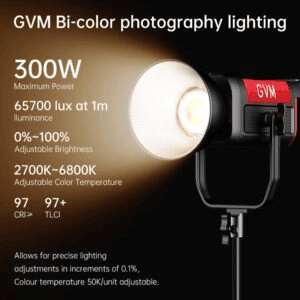
That is where fixtures like the GVM PRO SD300B are typically introduced—not as experimental tools, but as anchors.
GVM PRO SD300B in Practical Use
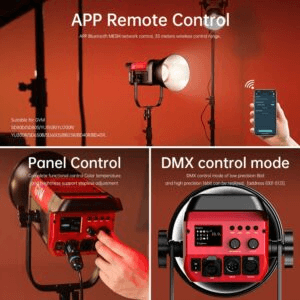
A GVM PRO SD300B is part of GVM’s professional LED lighting line, designed for controlled video production environments where repeatability matters more than dramatic effect.
In real-world workflows, it tends to appear in three kinds of situations:
Interview and Dialogue Work
Human presence is fragile on camera. Too harsh, and expression collapses into contrast. Too soft, and structure disappears.
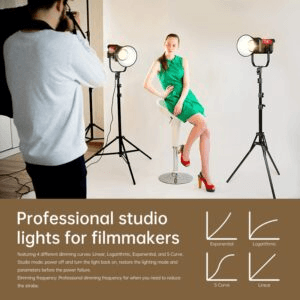
A videography light in this space is used with restraint. The goal is not transformation. It is clarity. Skin tones remain readable. Shadows stay intentional, not accidental.
The SD300B is often positioned in this middle ground—where light supports speech rather than competing with it.
Product and Detail Shooting
When photographing products, lighting plays a major role in how details are perceived. The shape, texture, and material of an object can change dramatically depending on how light falls on its surface.
A good lighting setup helps maintain consistency from one shot to the next. It allows photographers to control reflections, preserve accurate colors, and highlight important details without distracting glare or uneven exposure.
For commercial shoots and product videos, reliable lighting is especially important. A fixture like the GVM PRO SD300B can help creators build a more stable setup, making it easier to achieve consistent results across different scenes and shooting sessions.
Compact Studio Environments
Modern creators often work in spaces that shift roles quickly. One corner becomes an interview setup. Later, it turns into a product table. Sometimes both exist within the same hour.
In these environments, lighting cannot be rebuilt from zero every time. It needs to carry memory.
A structured videography light system allows that memory to persist. Once a look is established, it can be recalled without rebuilding the entire scene logic.
The SD300B fits into this rhythm quietly. It does not demand attention. It waits for configuration.
| Recurso | GVM PRO SD300B |
| Melhor para | Film Production, Studio Lighting & Video Creation |
| Potência de Saída | 300W COB LED / Up to 65,700 Lux at 1m (with reflector) |
| Temperatura de Cor | 2,700K – 6,800K |
| Modos de Cor | Bi-Color / CCT Mode / Source Matching / Lighting Effects |
| CRI / TLCI | 97+ CRI / 97+ TLCI |
| Efeitos Especiais | Multiple Built-in Lighting Effects for Creative Shooting |
| Escurecimento | Flicker-Free 0% – 100% Stepless Dimming |
| Tipo de Montagem | Encaixe Bowens |
| Sistema de Arrefecimento | Intelligent Active Cooling / Silent Cooling / Passive Cooling Modes |
| Control Type | Built-in Controller / Bluetooth / RF / DMX IN & OUT / RDM |
| Projeto | Compact Monolight Design with Integrated Controller & Ballast |
| Portabilidade | 2.7kg Lightweight Body / Easy Studio & Location Setup |
| Fonte de Energia | AC Power (100–240V) / DC Input Support |
The Discipline Behind Stable Light
Good lighting is often misunderstood as “good output.” In practice, output is the least interesting part.
What matters is behavior over time.
Does the light hold its character when the subject moves slightly?
Does it remain consistent when the environment changes?
Can the same setup be recreated without visual drift?
A videography light earns its place not in the first frame, but in the tenth repeat of the same frame.
The SD300B belongs to that philosophy. It is not about spectacle. It is about repeatability that feels almost invisible once achieved.
A Subtle Shift in How We Build Images
There is a quiet change happening in video production. Tools are no longer chosen only for capability, but for how easily they integrate into rhythm.
Cameras have become faster. Editing has become lighter. Distribution has become immediate.
Lighting remains the part that resists shortcuts.
Which is why videography light systems like the GVM PRO SD300B matter—they do not simplify the craft, but they reduce unnecessary friction inside it.
The result is not louder images. It is steadier ones.
Closing Thought: Light That Stays in the Room
At some point, good lighting stops announcing itself. It stops feeling like equipment in the space.
It becomes part of how the room behaves.
A subject sits down. The frame settles. Nothing calls attention to itself, yet nothing feels uncertain either.
That is usually where the work begins to feel finished—not because everything is perfect, but because nothing is fighting to be noticed.
And in that quiet balance, videography light does its most honest work.
Explore the full range of GVM professional lighting solutions(https://gvmled.com/)today.