Macro photography lighting is the single most critical variable separating sharp, vibrant close-up images from flat, detail-crushing failures. At macro distances — where your subject fills the entire frame at 1:1 magnification or greater — the camera lens itself blocks most ambient light, depth of field collapses to millimeters, and even the smallest inconsistency in illumination becomes immediately visible in the final image. Getting macro lighting right requires understanding not just how much light you need, but the quality, direction, colour accuracy, and controllability of every source in your setup. This guide covers everything you need to know about LED macro photography lighting in 2026.
LED Macro Photography Lighting: Why LED Is the Right Choice
LED has become the dominant technology for macro photography lighting, and for good reason. Traditional macro lighting solutions — ring flashes, fiber optic systems, and halogen macro lights — all carry significant limitations: ring flash produces flat, shadowless light that eliminates the texture detail that makes macro images compelling; halogen lights generate heat that wilts flowers, stresses insects, and melts delicate subjects; and fiber optic systems are expensive, fragile, and difficult to position precisely.
Modern LED macro lighting solves all three problems simultaneously. LEDs produce negligible heat at close distances, allowing you to work with living subjects — insects, flowers, food — without disturbance or damage. LED output is continuous, giving you a live preview of exactly how the light falls on your subject before you trigger the shutter. And high-CRI LED fixtures reproduce colour with the accuracy that macro photography demands — when you’re filling the frame with the texture of a butterfly wing or the surface of a strawberry, colour fidelity is not optional.
The key specifications to evaluate in any LED light for macro work are CRI (Colour Rendering Index) — look for 95 or above, with 97+ being the professional standard — output consistency, colour temperature flexibility, and physical size, since compact units can be positioned closer to the subject and from more angles than large panel lights.
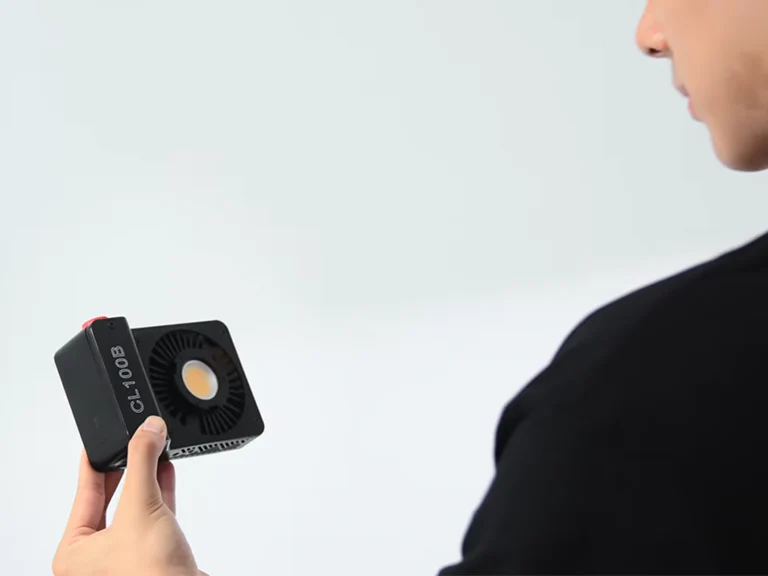
Why Is Lighting Important in Macro Photography?
Lighting is important in every genre of photography, but in macro photography it is uniquely decisive for three reasons that don’t apply at normal shooting distances.
Depth of field and exposure. Macro lenses at 1:1 magnification produce extremely shallow depth of field — sometimes just a few millimeters at working apertures. To extend the plane of focus, macro photographers stop down to f/11, f/16, or even f/22. At these apertures, available light is almost never sufficient for a clean exposure at a shutter speed fast enough to freeze subject movement. Powerful, controllable artificial light is the only reliable solution.
Subject texture and dimension. Macro photography reveals surface detail invisible to the naked eye — the facets of a compound eye, the grain of a wood surface, the crystalline structure of a salt granule. This texture is only visible when light strikes the subject from an angle that creates micro-shadows across the surface. Flat, frontal lighting eliminates texture. Angled, directional LED lighting reveals it. The ability to precisely position your light source — and adjust its intensity in real time — directly determines how much of this textural information appears in the final image.
Colour accuracy. At macro scale, colour rendering errors that would go unnoticed in a portrait become clearly visible. A CRI of 97+ ensures that the colours of your subject — the exact shade of a flower petal, the precise hue of a gemstone, the true colour of food — are reproduced faithfully without post-production correction.
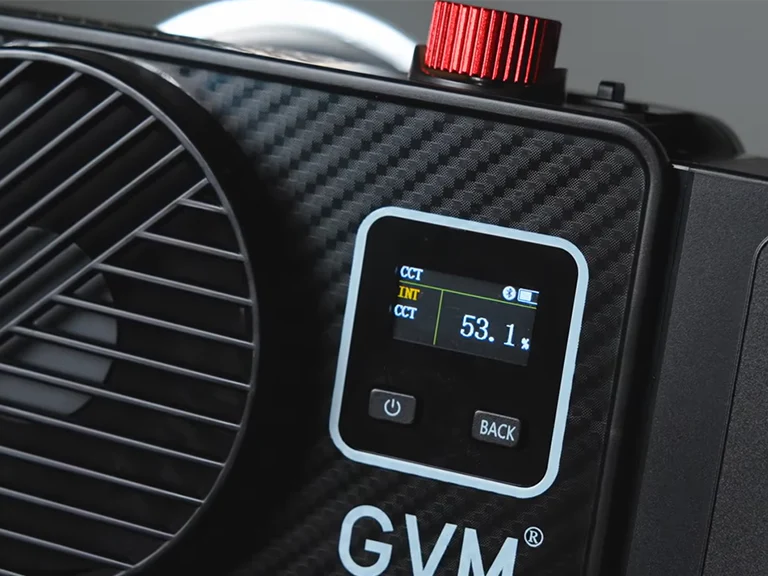
Product Spotlight: GVM-CL100B Portable Bi-Color LED Monolight
For macro photographers who need professional-grade lighting performance in a compact, portable form factor, the GVM-CL100B represents a genuine breakthrough in the category. At just 357g — lighter than most mirrorless camera bodies — it delivers 100W of bi-color LED output with CRI 97+ accuracy, making it equally capable as a dedicated macro light and a versatile everyday shooting companion.
GVM-CL100B Full Specification Table
| Parameter | Specification | Macro Photography Relevance |
|---|---|---|
| Model | GVM-CL100B | — |
| Power Output | 100W | Sufficient output at f/16–f/22 macro apertures |
| Illuminance | 18,500 Lux @ 1m | High intensity for close-focus distances |
| Color Accuracy | CRI ≥97, TLCI ≥97 | True-to-life colour reproduction for product & nature macro |
| Color Temperature | Bi-Color (adjustable) | Match ambient light or creative intent precisely |
| Dimming | 0–100% stepless | Fine exposure control without changing aperture |
| Weight | 357g / 0.78 lbs | Positions easily at any angle without stand stress |
| Mount | Mini GVM Mount + 1/4″-20 Thread | Universal compatibility with stands, arms, and rigs |
| Power Supply | AC / NP-F Battery / USB-C PD | Studio and outdoor location macro shooting |
| Control | Onboard LCD/Knobs + Bluetooth App | Remote adjustment without disturbing the subject |
| Bluetooth Range | 50m (164 ft) | Control from camera position without moving the light |
| Cooling | 3-mode fan (Smart/High/Silent) | Silent mode protects audio; minimal heat output for live subjects |
| Included Accessories | Silicone Dome, Small Reflector, Tabletop Tripod | Complete macro lighting kit out of the box |
The GVM-CL100B’s silicone light dome diffuses output into soft, wrapping illumination ideal for product macro and food photography where harsh shadows are undesirable. The small reflector attachment narrows and focuses the beam for directional, texture-revealing light — the configuration that brings insect, mineral, and botanical macro images to life. The included tabletop tripod positions the light independently of your camera stand, giving you the freedom to angle illumination from any direction relative to the subject without a second operator.
The triple power supply system — AC adapter, NP-F series batteries, and USB-C PD power bank — means the CL100B transitions without friction between a controlled studio macro setup and an outdoor field session photographing insects or wildflowers. For location macro work, NP-F battery operation provides completely wire-free positioning freedom that no mains-powered light can match.
Bluetooth Mesh networking allows multiple CL100B units to be controlled simultaneously from a smartphone at up to 50 metres — a significant advantage for macro photographers building multi-light setups to control shadow direction and ratio without physically touching each fixture between shots.
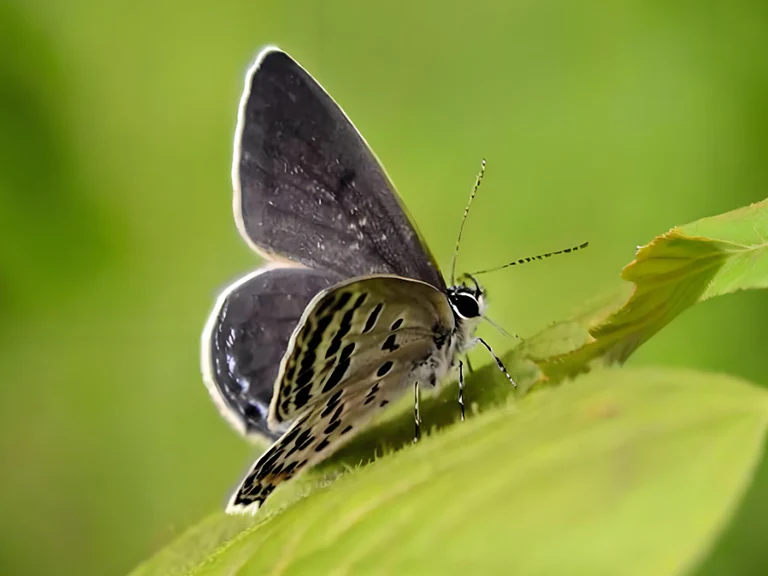
Mobile Macro Photography Lighting Setup
Smartphone macro photography has exploded with the introduction of dedicated macro lenses on flagship phones, and the lighting demands are identical to those of dedicated camera macro work — the subjects are just as small, the depth of field just as shallow, and the colour accuracy just as important.
The ideal mobile macro photography lighting setup consists of two elements: a compact, high-CRI continuous LED source and a reliable positioning system. The GVM-CL100B addresses both — its 1/4″-20 thread mount connects directly to a smartphone rig, cage, or desktop tripod arm, and its Bluetooth app control allows you to adjust brightness and colour temperature from your phone while simultaneously shooting, without a second hand free to operate the light.
For outdoor mobile macro work — shooting insects, plants, or street-level details — the USB-C PD power option allows the CL100B to run from the same power bank that charges your phone, eliminating the need for a separate battery system. The 357g weight means it can be handheld and angled freely with one hand while the other operates the phone camera — a genuinely practical setup for run-and-gun mobile macro work that larger LED panels cannot replicate.
Key tips for mobile macro lighting: use the silicone dome for diffused product-style shots, switch to the small reflector for directional insect and botanical work, and always set the CL100B to Silent fan mode when shooting video macro to protect audio from cooling fan noise.
Best Lighting Setup for Macro Photography
The best lighting setup for macro photography depends on your primary subjects and shooting environment, but the following configurations cover the most common scenarios.
Single-light product and food macro: Position the GVM-CL100B with the silicone dome attached at approximately 45 degrees above and to one side of the subject, close enough to create soft directional light that reveals texture without harsh shadows. Add a small white reflector card on the opposite side to lift shadow detail. This setup works for jewellery, food close-ups, cosmetics, and any subject where colour accuracy and surface texture are the primary goals.
Two-light insect and botanical macro: Use two GVM-CL100B units — one as a key light with the reflector attachment for directional texture light, one as a fill with the dome for shadow control. Bluetooth Mesh synchronisation allows both units to be adjusted simultaneously from one app. The low heat output of LED ensures you can work close to living subjects without wilting flowers or disturbing insects.
Outdoor location macro: Run the CL100B from an NP-F battery for complete freedom from power sources. Position the light using a small articulating arm or flexible clamp attached to your tripod — this allows precise angle adjustment without a second stand. In bright sunlight, use the CL100B to fill in harsh shadow areas that would otherwise crush detail on the shadow side of your subject.
Studio tabletop macro: Mount the CL100B on the included tabletop tripod and position it independently of your camera. The 18,500 lux output at 1m allows you to stop down to f/16 or beyond for maximum depth of field while maintaining a shutter speed fast enough to eliminate vibration without flash.
Final Thoughts
Macro photography lighting demands precision, colour accuracy, low heat, and physical flexibility that general-purpose studio lights cannot consistently deliver. A compact, high-CRI, bi-color LED monolight like the GVM-CL100B — with its 357g portability, 100W output, triple power supply, and complete accessory kit — is purpose-built for the specific demands of close-up work across every macro shooting scenario. Invest in lighting that matches your subject scale, and the detail, colour, and dimension in your macro images will reflect the difference immediately.