Spotlight cinematography is the art and science of using directional, focused light sources to create depth, drama, and focus within a frame. In the modern era of digital filmmaking, the ability to control light with precision is what separates amateur content from high-end cinematic productions. Whether you are lighting a moody noir scene or a high-key commercial, understanding how to harness the power of a professional spotlight is essential for every director of photography.
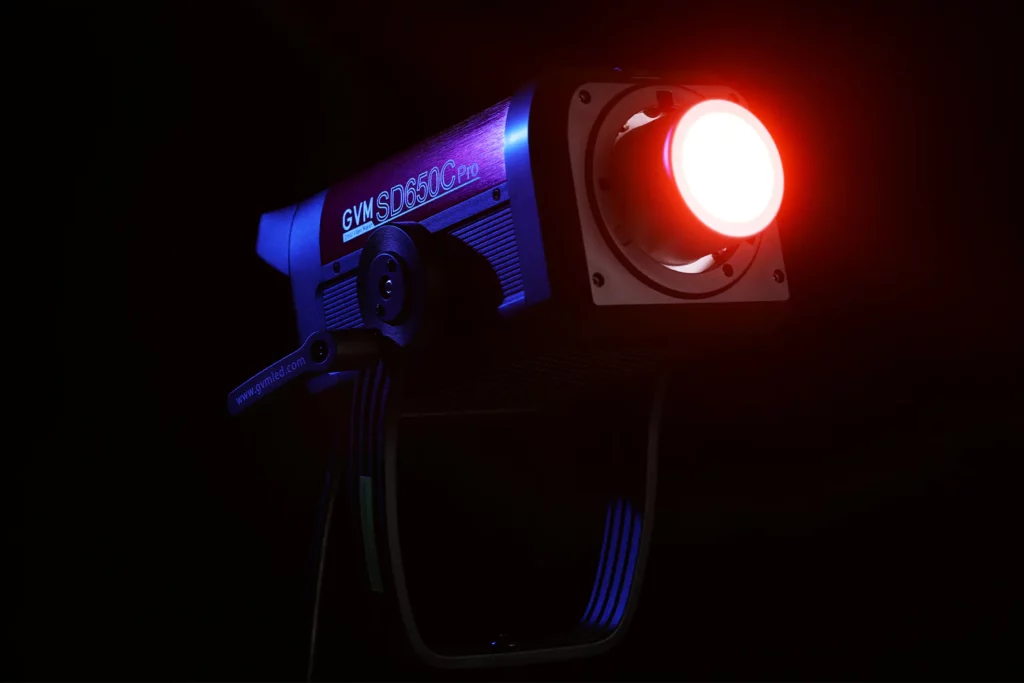
This piece walks you through the nitty-gritty of spotlighting, compares the most popular fixtures out there, and dives into the new technology shaping film lighting in 2026.
Table of Contents
Spotlight Cinematography: Crafting the Visual Narrative
The primary goal of spotlight cinematography is to direct the viewer’s eye. Unlike soft, ambient lighting that fills a room, a spotlight provides a “hard” light source that can be shaped using barn doors, fresnel lenses, or projection attachments.
In professional sets, spotlights are used for several key purposes:
- Key Lighting: Establishing the primary light source on a subject to define their shape and features.
- Backlighting/Rim Lighting: Creating a “halo” effect to separate the subject from the background, adding a three-dimensional feel.
- Hard Shadow Play: Using the sharp fall-off of a spotlight to create “Chiaroscuro” effects, which are vital for thrillers and dramatic narratives.
- Special Effects: Simulating light coming through a window (gobos) or mimicking streetlights.
Aputure STORM 1200x: A Benchmark in High-Output Lighting
When discussing the current landscape of professional lighting, the Aputure STORM 1200x often comes up as a benchmark for high-output LED fixtures. Known for its immense brightness and reliability, it has become a staple on large-scale film sets. The STORM 1200x represents the “Point Source” revolution, proving that LEDs can now compete with traditional HMI lights in terms of raw power and throw distance.
However, as the industry evolves into 2026, filmmakers are looking for more than just raw power. The demand for full-spectrum color control (RGBWW) and ultra-precise dimming has led to the rise of versatile alternatives that offer more creative flexibility without the massive footprint of a 1200W unit.
The GVM PRO SD650C: The New Standard for Versatile Spotlights
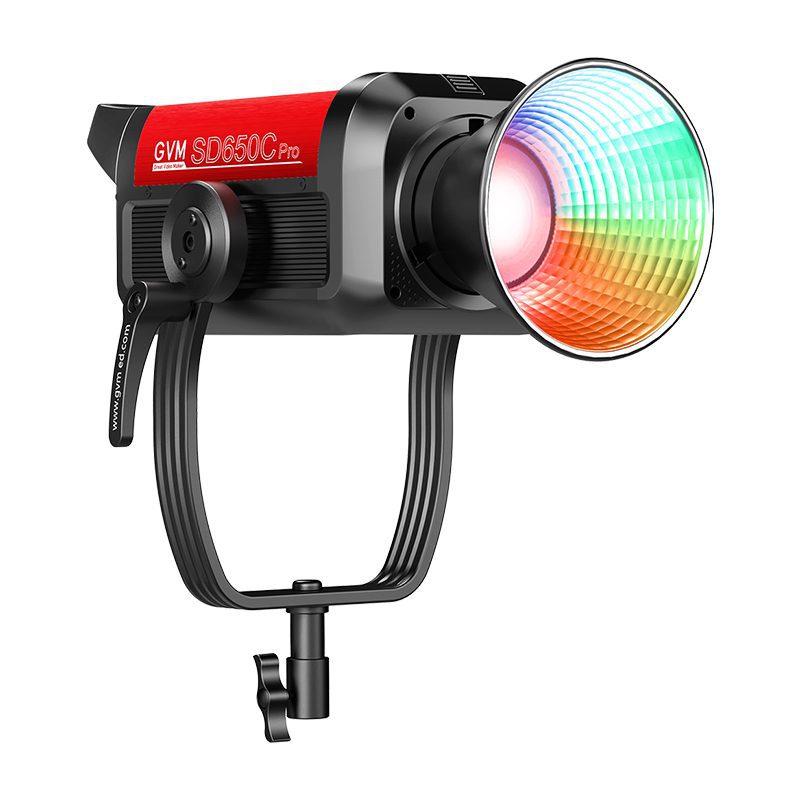
For cinematographers who require a balance between extreme power and total color creative control, the GVM PRO SD650C has emerged as a top-tier choice. While the Aputure STORM focuses on bi-color intensity, the SD650C offers a 650W RGBWW light engine that allows for 16 million colors and 360° hue control.
The GVM PRO SD650C is designed for high-end studio and on-location productions where color accuracy is non-negotiable. With a massive output of 95,530 lux at 1 meter, it provides the punch needed for spotlight cinematography while maintaining a high CRI/TLCI of 97+.
Technical Specifications: GVM PRO SD650C
| Parameter | Value |
| Power | 650W |
| Light Output | 95,530 lux at 1m (with standard reflector) |
| Color Temperature | 2000K–10000K |
| Light Type | RGBWW (Bi-Color + Full RGB) |
| CRI / TLCI | 97+ / 97+ |
| Dimming | 1/1000-step precision |
| Dimming Curves | 4 types (Exponential, Logarithmic, S-Curve, Linear) |
| Color Control | 360° Full Color Spectrum |
| Gel Library | 60 Industry-standard gels built-in |
| Control Protocols | APP, DMX-512 (8/16-bit), RDM, Bluetooth Mesh |
| Mount | Bowens Mount |
| Cooling | Intelligent, Whisper-quiet system |
Why Professionals are Choosing the SD650C
The SD650C solves the common “flicker” and “stepping” issues found in lower-end lights. Its 1/1000-step precision dimming allows for incredibly smooth transitions during slow fades, which is critical for high-frame-rate cinematography. Furthermore, the built-in library of 60 industry-standard gels allows lighting technicians to match traditional tungsten or daylight sources with gelled filters instantly, saving hours of physical gel swapping on set.
Best Lights for Filmmakers: What to Look For in 2026
Choosing the best lights for filmmakers depends on the specific needs of the production. However, certain “must-have” features have become the standard for professional-grade gear:
- Color Accuracy: Look for CRI and TLCI ratings above 95. This ensures that skin tones look natural and post-production color grading is seamless.
- Weatherproofing: On-location shoots are unpredictable. Lights like the SD650C that offer waterproof capabilities are essential for outdoor sets.
- Connectivity: In 2026, manual control is no longer enough. DMX-512 and RDM protocols are required for lighting consoles, while Bluetooth Mesh apps allow solo creators to manage multiple units from a tablet.
- Modifier Compatibility: A spotlight is only as good as its accessories. Standard Bowens Mount compatibility is vital so you can use fresnels, softboxes, and projection attachments.
Film Lighting Brands: The Industry Leaders
The market for professional lighting has matured, with several key film lighting brands leading the way:
- GVM (Great Video Maker): With their “PRO” series, GVM has transitioned from a consumer-friendly brand to a professional powerhouse, offering high-wattage RGBWW solutions like the SD650C and SD1200C.
- Aputure: The brand that popularized the LED COB light. They continue to innovate with the STORM and Light Storm series.
- Arri: The gold standard for cinema. Their Orbiter and SkyPanel series are found on almost every Hollywood set, though they come at a significant price premium.
- Nanlite: Known for their Forza series, offering great performance-to-size ratios for independent filmmakers.
Types of Cinematic Lighting
To truly master spotlight cinematography, one must understand the various types of cinematic lighting techniques used to build a scene:
1. Hard Lighting vs. Soft Lighting
Spotlights are naturally hard light sources. By using a GVM Fresnel F60 on the SD650C, you can intensify that hardness for dramatic shadows. To soften it, filmmakers use large softboxes or “Latern” modifiers to spread the light evenly across a subject’s face.
2. Motivated Lighting
This technique involves positioning your spotlight to mimic a natural light source within the scene, such as a lamp, a window, or the moon. The wide color temperature range (2000K–10000K) of modern lights allows you to perfectly match the “warmth” of a candle or the “coolness” of a night sky.
3. Practical Lighting
While practicals are lights that appear in the frame (like a desk lamp), a spotlight is often hidden just off-camera to “augment” the practical light, making it appear brighter and more directional than it actually is.
4. Background and Accent Lighting
Using the RGB capabilities of a light like the SD650C, filmmakers can add a splash of color to a background wall or a specific prop. This adds visual interest and helps establish the color palette of the film.
Conclusion
Mastering spotlight cinematography requires both an artistic eye and the right technical tools. While the industry continues to be pushed forward by brands like Aputure and Arri, the GVM PRO SD650C represents the cutting edge of what is possible for modern filmmakers—combining 650W of raw power with the infinite creative possibilities of RGBWW color.
Whether you are building a professional studio or heading out for an on-location shoot, investing in high-quality, high-CRI lighting is the most effective way to elevate your production value in 2026 and beyond.