A portable monolight used to mean one thing: a long cylindrical head with a fan on one end and a Bowens mount on the other. That shape has defined studio lighting for decades, and it still works well for many setups. GVM’s newest COB monolight breaks from that tradition entirely, using a flat, panel-style flathead design that trims the bulk without cutting output. For creators who move between locations, carry gear on foot, or set up in tight spaces, that shift in form factor changes what “portable” actually means.
Monolight Photography
Monolight photography relies on a single self-contained fixture that houses its own power supply, control panel, and often a cooling fan, all built into the light body itself. This differs from a two-piece system where a separate power pack feeds a lighter head. The tradeoff has always been portability versus simplicity — a monolight is heavier at the head but far easier to set up, since there’s no separate cable run to a pack on the floor.
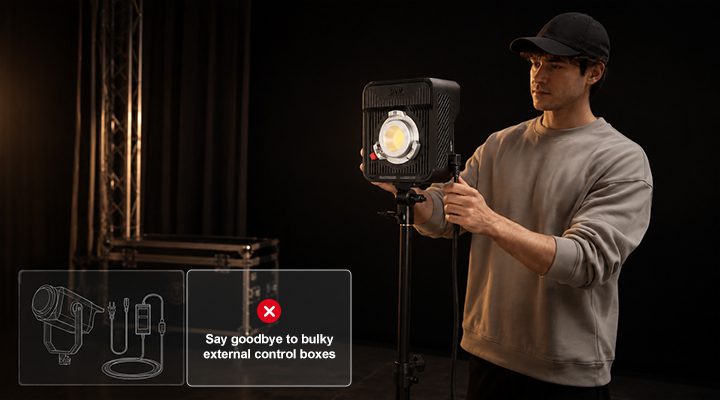
For product photography, portrait work, and small studio setups, monolights remain the standard because they deliver consistent color output and fast recycle times. The newer panel-style monolights push this further by keeping the compact, all-in-one convenience while reducing the physical footprint, which matters when a shoot involves multiple lights crammed into a small room or a mobile studio packed into a car.
Godox Monolight
The cylindrical shape most people picture when they hear “monolight” traces back to studio flash design. Early strobes were built around a round flash tube and a coiled reflector housing, so the long tubular body became the default form factor — and decades later, most manufacturers still follow that same blueprint, Godox included.
Godox has built a large following among photographers for its monolight lineup, particularly with battery-powered and TTL-compatible models aimed at location shooters. These lights are widely available, have a mature accessory ecosystem, and cover a broad price range from entry-level to professional.
Where Godox monolights tend to fall short is video-specific features. Many models are optimized around flash photography — high-speed sync, TTL metering, and short flash duration — rather than continuous output for filmmaking. Colour temperature control on some units is also fixed or limited to daylight-balanced output, which means video shooters working across mixed lighting conditions often need additional gels or a second fixture. The tubular body inherited from flash design also does the fixture no favors on cramped sets, where every extra inch of depth eats into already limited space.
GVM took a different approach by rethinking the shape itself rather than just shrinking it. Its panel-style flathead monolights drop the long flash-derived body in favor of a flat, compact housing that’s built for how creators actually shoot today — in small rooms, tight studio corners, and mobile setups where a deep cylindrical head simply doesn’t fit as easily.
Bowens Monolight
The Bowens mount itself has become the de facto standard for lighting modifiers, and most monolights on the market, GVM included, build around it for exactly that reason. A Bowens-mount monolight can accept softboxes, beauty dishes, reflectors, and grids from dozens of manufacturers without an adapter, which is one of the biggest practical advantages of sticking with this mount type.
Bowens-branded monolights specifically tend to sit at a higher price point and are positioned more toward established studio photographers than mobile content creators. Availability and support outside larger markets can also be inconsistent, which pushes many creators toward Bowens-mount-compatible alternatives that offer the same modifier flexibility at a lower cost of entry.
Best Monolight for Video
Video work places different demands on a monolight than stills photography. Continuous output, flicker-free dimming, and a wide adjustable colour temperature range matter more than flash duration or sync speed. Bi-color LED monolights that can shift smoothly between roughly 2700K and 6800K let a videographer match warm interior lighting or cooler daylight without swapping gels mid-shoot.
App and Bluetooth control also carries more weight for video than for stills, since a run-and-gun shoot often means adjusting brightness or color from across the room without walking back to the fixture. A monolight with mesh Bluetooth networking lets several units on set be controlled from one phone, which speeds up multi-camera or multi-light video setups considerably.
COB Monolight
COB (chip-on-board) monolights concentrate LED output onto a single dense array rather than spreading it across dozens of individual bulbs, which produces a more even, controllable beam of light — closer to a traditional tungsten or HMI fixture than to a panel light. This is part of why COB monolights pair so naturally with Bowens-mount modifiers: the concentrated light source throws shadows and highlights through a softbox or reflector more predictably.
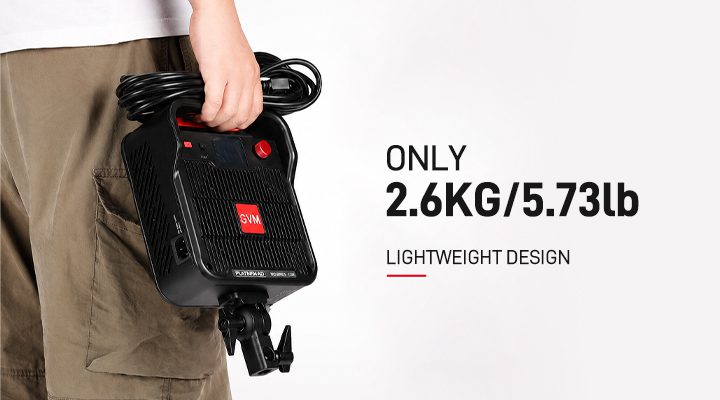
GVM’s FA300B AIO is a good example of where COB monolight design is headed. Instead of the long cylindrical body typical of older COB fixtures, it uses a flat panel-style flathead housing that’s easier to pack into a case and quicker to mount on location.
| Feature | Specification / Benefit |
|---|---|
| Design | All-in-one panel-style flathead, compact and lightweight |
| Illuminance | 71,400 lux at 1m with optional reflector |
| Color Temperature | 2700K–6800K adjustable, stepless |
| Dimming | 0%–100% stepless, flicker-free |
| Lighting Effects | 12 built-in scene simulation effects |
| Preset Light Sources | 12 modes for common lighting environments |
| Wireless Control | Mesh Bluetooth, app-controlled multi-light setups |
| Mount | Bowens mount (modifiers sold separately) |
| Cooling | Active cooling, quiet operation |
| Price | $299.00 USD |
Compared with Godox monolights, which lean toward flash-first features, and Bowens-branded units, which come at a premium price with less consistent availability, the FA300B lands in a different spot entirely. It matches Bowens-mount versatility, adds video-friendly continuous output with a wide CCT range, and includes app-based multi-light control that many competitors reserve for higher-tier models. At $299, it delivers a level of output and control per dollar that’s difficult to match in this category, making it one of the strongest value picks for anyone building a portable lighting kit in 2026.
Conclusion
Portability in monolight design has moved past simply making a fixture smaller — it’s about rethinking the shape entirely, as GVM’s flathead COB design shows. Whether the priority is studio-style modifier compatibility, video-ready color control, or a light that survives being packed and unpacked on every shoot, the FA300B checks each box while staying well under what comparable Godox or Bowens-branded lights typically cost. For creators weighing brightness, features, and price side by side, GVM currently offers the most cost-effective way into portable monolight lighting.