RGB Lighting — it’s the term every content creator inevitably runs into when searching for video lights on Amazon in 2026. But when RGB Lighting shows up alongside bi-color options in the search results, most people get stuck: What’s the real difference? Which one should I pick?
Is RGB Lighting actually worth the extra cost? To clear up the confusion once and for all, we’ve invited a veteran lighting expert to give you a straightforward breakdown of everything you need to know about choosing and using RGB Lighting.
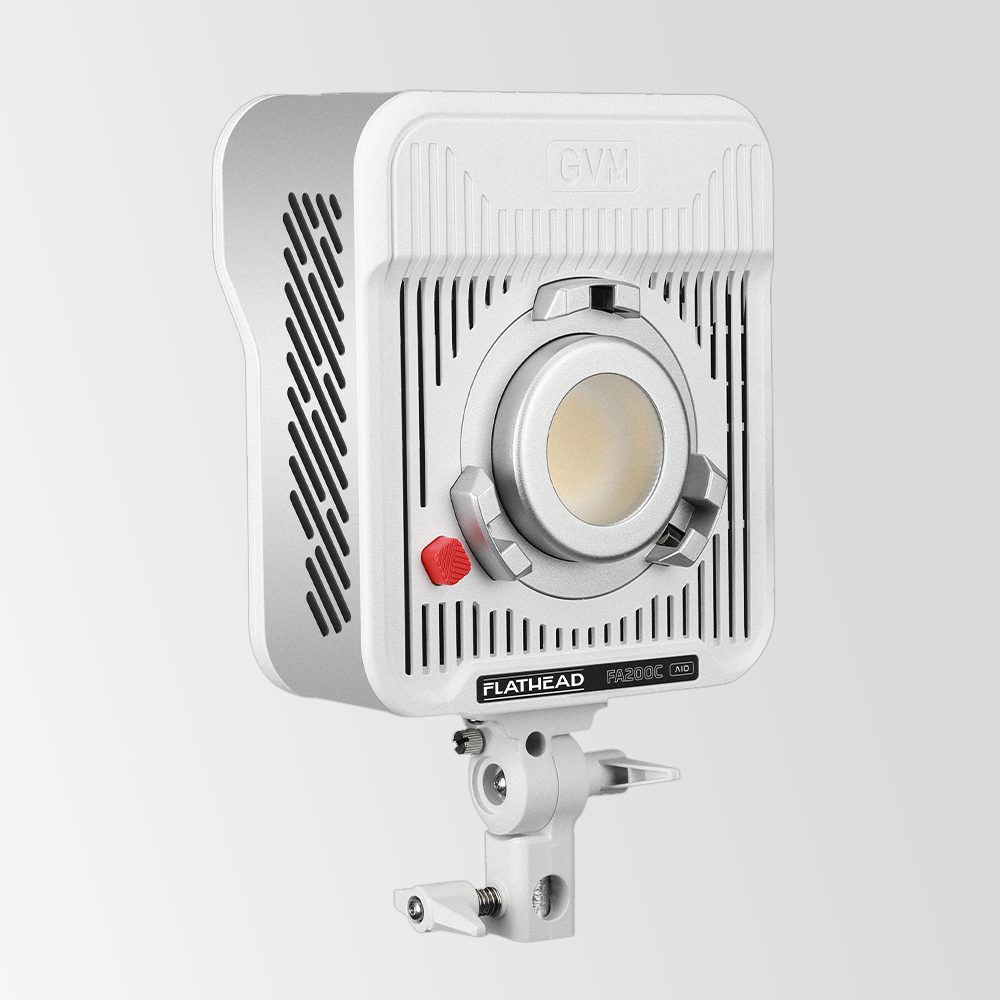
If you’re shopping for photo equipment lighting with true RGB capability, let’s start with three of our most popular GVM models: the GVM FA200C AIO RGB COB monolight, the GVM 800D III RGB+Bi-Color panel, and the GVM BD100 RGB bi-color light stick. Each one serves a different role on set with its own unique positioning. Read on to find out which one to choose, which one to skip, and how the GVM Lantern Globe Softbox fits in when you want to soften that COB punch into a wraparound key light.
Table of Contents
What Is RGB Lighting — and Where It Fits in a Video Setup
RGB lighting combines red, green, and blue LED channels to produce any color the eye can see. In modern creator lights, the spec sheet usually lists three terms that matter:
- RGBWW — RGB plus warm white plus cool white. Better whites, wider CCT range, higher CRI.
- HSI — Hue, Saturation, Intensity. The intuitive way to dial any color.
- GEL — pre-programmed gel filter simulations (Rosco / Lee style), so you skip physical gel sheets on set.
In real shooting, RGB lights come in four shapes:
- RGB panels — broad, even, ready to soften a face or flood a wall with brand color.
- RGB COB monolights — point sources that take Bowens-mount modifiers (softboxes, lanterns) for shaped key lights.
- RGB tube / wand lights — handheld, battery-powered, perfect for accents and motion.
- Pocket RGB lights — on-camera, magnetic, ultra-portable, for travel.
For livestreaming, the standard pattern is straightforward: bi-color high-CRI light on the face (your main key), RGB light behind or beside the subject (background and rim), and a small RGB element on the desk if you want brand color.
5 Things to Check Before Buying an RGB Video Light
- Color Rendering Index — CRI/TLCI 95+ is the floor. For on-camera faces, push for 97+; otherwise skin tones drift and grading eats hours.
- Color Temperature Range — 2700K–6800K bi-color plus full HSI RGB is the 2026 sweet spot.
- Brightness Reality — RGB mixed colors are dimmer than pure white. Always check the Lux @ 1m at full white, not just the wattage.
- Control Options — onboard dial, 2.4G, Bluetooth app, or DMX. The deeper the control stack, the easier multi-light setups become.
- Mount and Power Ecosystem — Bowens mount for modifier flexibility, NP-F or V-Mount batteries for on-location runs, plus 1/4″ or cold shoe for accessories.
Skip single-color-temperature lights. They look cheap at the register and cost hours in post later.
RGB Lighting TOP 3 Picks — In-Depth Reviews
#1 GVM FA200C AIO — Best Professional RGB COB Monolight
The FA200C AIO is the heavy lifter in the lineup. A 200W-class all-in-one panel-style monolight that integrates the lamp head, control system, and power supply into one compact body — no external ballast, no cable spaghetti. With 41,300 lux at 1m using the optional reflector, full CCT / HSI / RGB / GEL control, 2000K–10000K bi-color range, and a universal Bowens mount, it replaces what used to require two separate fixtures.
The 16 built-in FX (lightning, TV, fireworks, candle, paparazzi, emergency) cover most creative scenes without a post-production pass. Mesh Bluetooth app control lets you sync multiple FA200Cs across a set, and the active cooling system stays quiet enough for interviews.
Pros: Massive 41,300 lux @ 1m output; 2000K–10000K + full HSI/RGB/GEL; Bowens mount for softboxes/lanterns; 16 FX; mesh Bluetooth; integrated PSU.
Best for: Professional video studios, YouTube channels, commercial shoots, large livestream sets. Pair it with the GVM 26″ Lantern Globe Softbox for a wraparound, omnidirectional key that flatters every face and floods a whole room with soft RGB.
#2 GVM 800D III — Best RGB Panel for Streaming and Desks
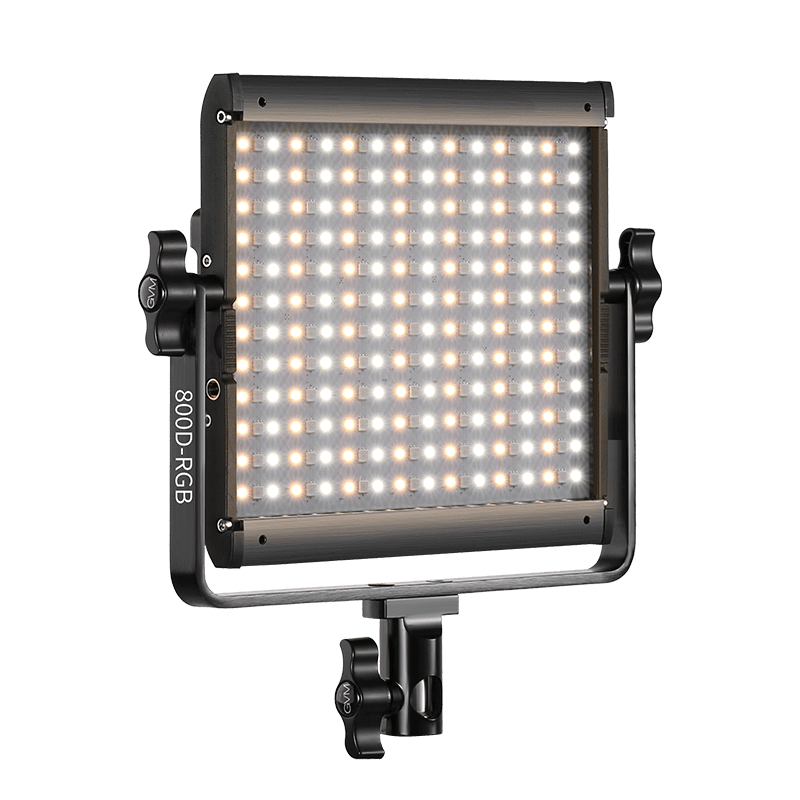
The 800D III is the everyday workhorse for creators shooting in tighter spaces. A 40W panel that fits on a desk arm, a small stand, or the top of a camera, packing CRI/TLCI 97+, 360° HSI color control, 3200K–5600K bi-color, and 20 built-in scene effects in a 10.6 × 10.3 × 1.5-inch body. Output reaches 2900 Lux at 1m — plenty for talking heads, podcast cameras, and small livestream desks.
The GVMLED app supports master-slave sync, so you can run a 3-light panel setup from one phone. Third-generation LED technology gives the 800D III noticeably better brightness than the previous generation while keeping the same compact footprint.
Pros: CRI/TLCI 97+; 360° HSI + bi-color; compact 10.6″ panel; 20 scene effects; app + master-slave control; travel-friendly.
Best for: Twitch and YouTube streamers, podcasters, makeup tutorials, product close-ups, webcam upgrades, and any small-room content creator.
#3 GVM BD100 — Best Creative RGB Light Stick for Accents and Motion
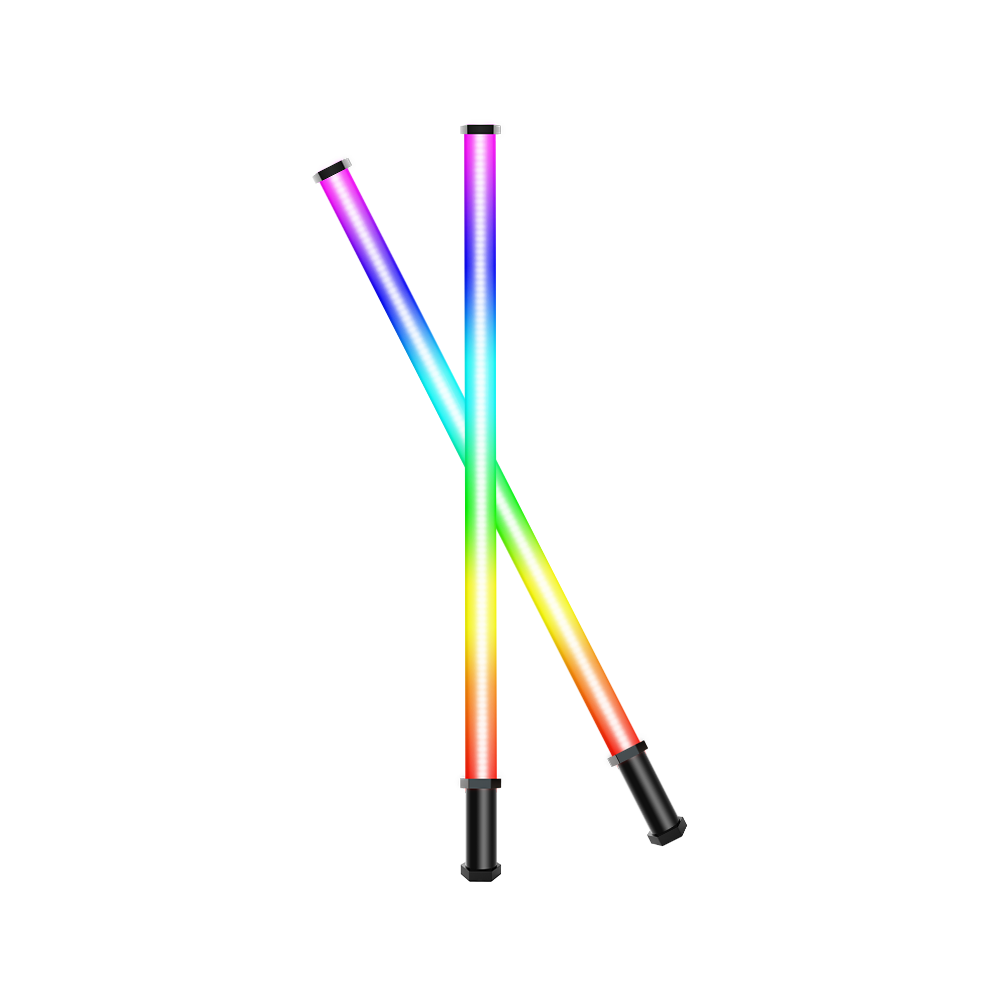
The BD100 is the one you keep in your bag for the moments bi-color panels cannot cover. A handheld, battery-powered RGB bi-color light stick with CRI ≥97, 3200K–5600K bi-color, full HSI color, 8 dynamic scene effects (lightning, cop car, paparazzi), and intuitive OLED onboard controls.
The GVM LED app handles brightness, CCT, HSI, and FX from your phone, plus wireless master-slave sync for multi-light setups. The built-in battery plus DC input gives you both untethered freedom and unlimited runtime on long shoots. The stick form factor makes it perfect as a hand-painted practical, an edge light, a quick product accent, or a chase effect for music video and gaming content.
Pros: CRI ≥97; RGB + 3200K–5600K; 8 FX; built-in battery; app + master-slave; handheld/lightweight form.
Best for: Music videos, gaming setups, product hero shots, Reels/shorts, atmospheric backgrounds, run-and-gun event lighting.
TOP 3 Comparison Table
| Spec | GVM FA200C AIO | GVM 800D III | GVM BD100 |
|---|---|---|---|
| Type | RGB COB Monolight | RGB+Bi-Color Panel | RGB Light Stick |
| Power | 200W | 40W | Lower (battery-fed) |
| Color Modes | CCT / HSI / RGB / GEL | CCT / 360° HSI / RGB | CCT / HSI / RGB |
| CCT Range | 2000K–10000K | 3200K–5600K | 3200K–5600K |
| CRI / TLCI | Professional broadcast-grade | 97+ / 97+ | ≥97 |
| Brightness (max) | 41,300 lux @ 1m (reflector) | ~2900 lux @ 1m | Lower |
| FX | 16 built-in | 20 scene modes | 8 dynamic effects |
| Mount | Bowens | 1/4″ / cold shoe | 1/4″ / handheld |
| Power | AC, integrated PSU | AC / NP-F | DC + built-in battery |
| Best For | Pro studio, YouTube, large livestream | Streaming desk, podcast, interviews | Accents, motion, products, gaming |
Buying Guide — Match the Light to Your Setup
- First-time streamer → 1× GVM 800D III (face key) + 1× BD100 behind (RGB brand color). Cheapest, fastest, professional.
- Game streamer → 1× 800D III on the face + 1× BD100 as background chase light. Tight footprint, big vibe.
- Short-video / on-location → 1× BD100 handheld + 1× pocket RGB. One operator, one bag.
- Commercial shoot → 2× FA200C AIO + GVM Lantern Globe Softbox (Bowens mount) + 1× BD100 as accent. Bowens mount unlocks soft boxes, lanterns, and projection modifiers.
- Music video / narrative → 1× FA200C AIO with lantern softbox as key + 3–4× BD100 for set dressing and practicals.
Pitfall to avoid: RGB is not “more powerful white.” Pure white skin tones are still best done with bi-color or daylight-balanced COB/panels. RGB is for color, mood, and brand — not face key.

FAQ
Q1: Can RGB lighting be used as a main key light?
Technically yes, but bi-color or daylight-balanced fixtures deliver cleaner white and more consistent brightness. Use RGB for color work and accents, bi-color for skin.
Q2: For livestreaming, should I pick an RGB panel or an RGB COB?
RGB panels (like the 800D III) are friendlier for desks and small spaces. RGB COB monolights (like the FA200C) win on output and modifier flexibility, but need a real stand and Bowens-mount accessories.
Q3: Is the difference between CRI 95 and CRI 97 noticeable?
For most viewers, no. For faces, products, and broadcast work, yes — the 2-point jump reduces color drift and skin tone correction in post. Pick 97+ if faces are on camera.
Q4: Are RGB lights loud?
It depends on wattage. The FA200C uses intelligent active cooling that stays near-silent even on extended shoots; the 800D III is panel-thin with minimal fan; the BD100 is fan-free on battery.
Q5: How do GVM, Neewer, SmallRig, and Ulanzi compare? GVM leans toward professional specs at mid-market prices with deep Bowens and app ecosystems. Neewer and SmallRig compete on portability and ecosystem accessories. Ulanzi targets budget creators. For the same brightness class, GVM is generally the most cost-effective in the RGB category.
Q6: Do I need gels if the light has a GEL mode? No. GEL mode simulates 60+ Rosco/Lee gel colors digitally. Skip the physical gel sheets unless you need exact spectral fidelity for legacy film or theater.
Final Verdict
There is no single “best” RGB light — there are three form factors for three jobs. The GVM FA200C AIO is the professional RGB COB that turns into a soft key with the GVM Lantern Globe Softbox. The GVM 800D III is the desk-friendly RGB panel that makes any livestream look like a studio. The GVM BD100 is the handheld light stick that adds color, motion, and brand identity to anything you shoot. Pick the one that matches the way you actually create, and the rest of the setup clicks into place.