Filming light equipment is one of the most important investments a new filmmaker can make. Good lighting does far more than simply make the image visible—it shapes mood, creates depth, guides the viewer’s eye, and gives a film its professional, cinematic quality.
Poor lighting can make even an expensive camera look amateur, while thoughtful lighting can elevate simple footage into something that feels intentional and polished. For beginners, choosing the right filming light equipment is often the fastest way to improve overall production value.
Table of Contents
What Is the Best Type of Light for Video?
The best light for video should deliver several key qualities:
- High color accuracy (CRI 97+ / TLCI 97+) so skin tones look natural
- Continuous output so you can see the exact result before recording
- Precise, flicker-free dimming
- Flexible color temperature or full RGB control
- Quiet or silent operation for dialogue scenes
- Enough output for your typical working distance and modifiers
- Practical mounting options (especially Bowens) and modern control (app, DMX, etc.)
Continuous LED lights currently meet these needs better than traditional tungsten or pure strobe systems for most modern productions because they offer real-time feedback, lower heat, and excellent color performance.
Types of Cinematic Lighting
Common types of cinematic lighting include:
- COB Monolights – High-output point sources ideal as key lights with softboxes or optical modifiers
- LED Panels – Soft, even light for fill or key in smaller setups
- RGB / Full-color lights – Creative color and atmospheric effects
- Fresnel and optical attachments – Beam control and intensity boost
- Softboxes, grids, and intensifiers – Shape and quality of light
Each type serves different roles in a lighting plan. For a detailed breakdown of every major category, see our full guide: Studio Lighting Types 2026 [blocked].
Best Filming Light Equipment Top 3 in 2026
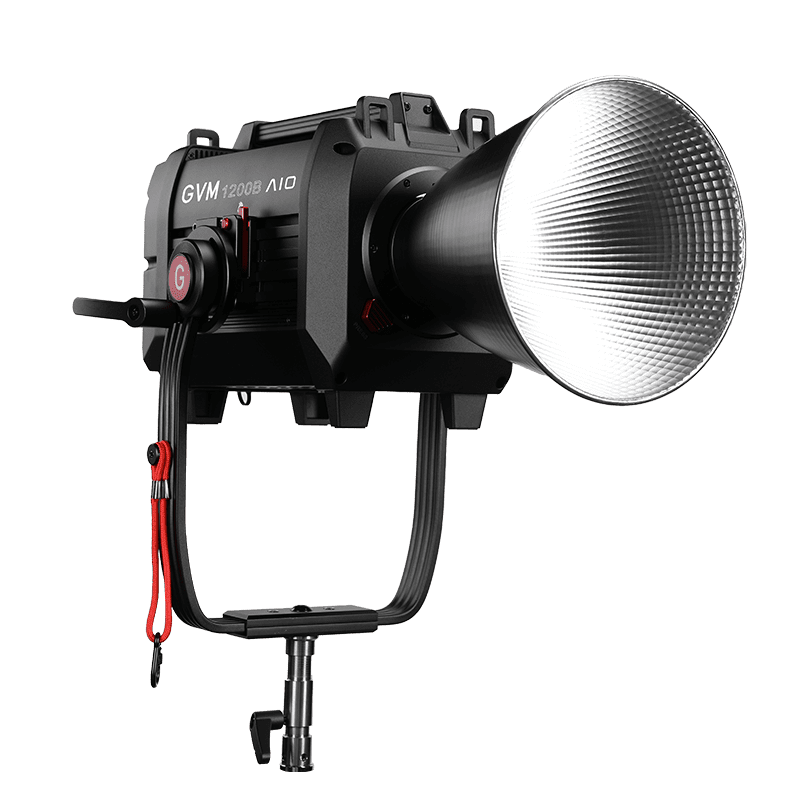
1. GVM 1200B AIO – Best High-Power Filming Light
The GVM 1200B AIO is a 1200W all-in-one bi-color COB spotlight designed for professional filmmaking. It delivers up to 42,800 lux at 3 meters with a standard reflector, offers a 2700K–6800K range, and maintains CRI/TLCI 97+. The true all-in-one design integrates the power supply into the head—no external ballast required. Features include ultra-precise 0.01% stepless dimming, 12 lighting effects, app control, and support for CRMX, DMX, RDM, and Art-Net. Intelligent cooling provides Auto, Low, and complete Off modes. The Bowens mount makes it highly compatible with professional modifiers.
Pros: Extremely high output, excellent color, true all-in-one convenience, professional control protocols, silent modes.
Cons: Heavier than smaller lights; best for studio or controlled location work.
Best for: Primary key light on film sets and any production that needs serious power.
2. GVM FA200C AIO – Best Compact RGB Filming Light
The GVM FA200C AIO is a compact all-in-one RGB LED monolight with a panel-style design. It supports full RGB, HSI, CCT (2000K–10,000K), and GEL modes, delivers up to 41,300 lux at 1 m with a reflector, and includes 16 built-in FX effects. Mesh Bluetooth control and a Bowens mount add flexibility. Quiet active cooling supports longer shoots.
Pros: Wide creative color range, true all-in-one design, strong output for its size, useful effects library.
Cons: Slightly more complex than pure bi-color lights.
Best for: Filmmakers who need both natural-looking light and creative colored lighting in one portable fixture.
3. GVM PRO SD650B – Best Versatile Mid-High Power Light
The GVM PRO SD650B is a 650W bi-color COB light that delivers up to 81,300 lux at 1 meter with the standard reflector. It offers a 2700K–6800K range, CRI/TLCI 97+, 1/1000-step precision dimming, 12 light-source presets, and flexible control via app, onboard, and DMX. It features intelligent quiet cooling and a durable, water-resistant design suitable for demanding environments.
Pros: Strong output, excellent color accuracy, precise dimming, versatile control, robust build.
Cons: Not a full RGB fixture.
Best for: Professional film, studio, and location work that needs reliable power and control.
Product Comparison Table
| Model | Power | Color Range | Key Strength | Best For | Portability |
|---|---|---|---|---|---|
| GVM 1200B AIO | 1200W | 2700–6800K | Extreme output + all-in-one | Main high-power key light | Good |
| GVM FA200C AIO | Compact | 2000–10,000K + Full RGB | Creative color + strong output | Interviews + creative looks | Very good |
| GVM PRO SD650B | 650W | 2700–6800K | High output + precise control | Versatile pro film work | Good |
Video Lighting Accessories – The GVM F60 Fresnel
Even the best filming light equipment performs better with the right modifiers. The GVM F60 Fresnel is a Bowens-mount attachment designed for lights such as the PRO SD650B (and compatible models). It features a rotating barrel design that adjusts the beam from a tight 15° spotlight to a 45° flood and can increase brightness by approximately 450%–960% depending on the setting.
A good Fresnel gives filmmakers classic beam control, longer throw, and the ability to create more dramatic, focused light without changing the fixture itself. Pairing a strong COB light with a quality Fresnel is one of the most effective ways to expand the creative range of your filming light equipment.

Detailed Real-World Case Study: PRO SD650B + F60 Fresnel
Project type: Short documentary-style interview + product insert for a lifestyle brand, shot partly in a small studio and partly on location near large windows.
Challenge:
The team needed one flexible key light that could deliver soft, flattering interview lighting and, minutes later, a harder, more directional beam for product details and window-light simulation—without bringing multiple heavy fixtures.
Solution & Setup:
- Interview Segment (Soft Key)
- GVM PRO SD650B fitted with a medium softbox
- Placed at 45° to the subject, slightly above eye level
- Color temperature set to 5600K to match window light
- Dimmed with 1/1000-step precision until the face was cleanly exposed and the background sat slightly darker
- Result: Natural, professional skin tones and soft shadows with minimal setup time
- Product & Accent Segment (Hard Directional Light)
- Softbox removed and GVM F60 Fresnel attached
- Beam tightened to approximately 15°–20°
- Light repositioned as a strong edge/rim light and for selective product highlights
- Intensity increased (the Fresnel’s optical gain provided a clear jump in brightness and throw)
- Fine dimming used to balance the accent against the ambient window light
- Result: Crisp separation on the subject and clean, controlled highlights on the product without flooding the entire set
- Location Window Simulation
- Same SD650B + F60 combination placed outside a window, pushing light inward
- Fresnel zoomed to control spill and create the feeling of strong late-afternoon sun
- Quick adjustments on the light’s dimming and CCT kept continuity with interior shots
Key Takeaway:
With only one powerful fixture (PRO SD650B) and one optical accessory (F60 Fresnel), the team covered soft interview lighting, hard accent lighting, and motivated window-light effects. The combination proved that the right filming light equipment plus a simple, high-quality modifier can replace a much larger lighting package on many real productions.
Best Filming Light Equipment – Final Recommendation
The best filming light equipment depends on your typical shooting scenarios:
- Choose the GVM 1200B AIO when you need maximum power and a true high-output key light.
- Choose the GVM FA200C AIO when creative RGB color and compact all-in-one design are priorities.
- Choose the GVM PRO SD650B when you want strong, precise, professional performance in a versatile mid-high power package.
Adding a modifier such as the GVM F60 Fresnel further expands what any of these lights can do. Start with the light that matches your most common work, master basic placement and exposure, and build your filming light equipment kit as your projects grow. In 2026, well-chosen continuous LED lights remain one of the highest-leverage investments a filmmaker can make.