As a professional cinematographer who has spent countless hours on sets ranging from high-end commercial studios to run-and-gun documentary shoots, I’ve seen the lighting industry evolve at breakneck speed. If you’re a photographer or videographer currently staring at your shopping cart, torn between the GVM AIO 300B and the PRO 300B, I know exactly what you’re feeling.
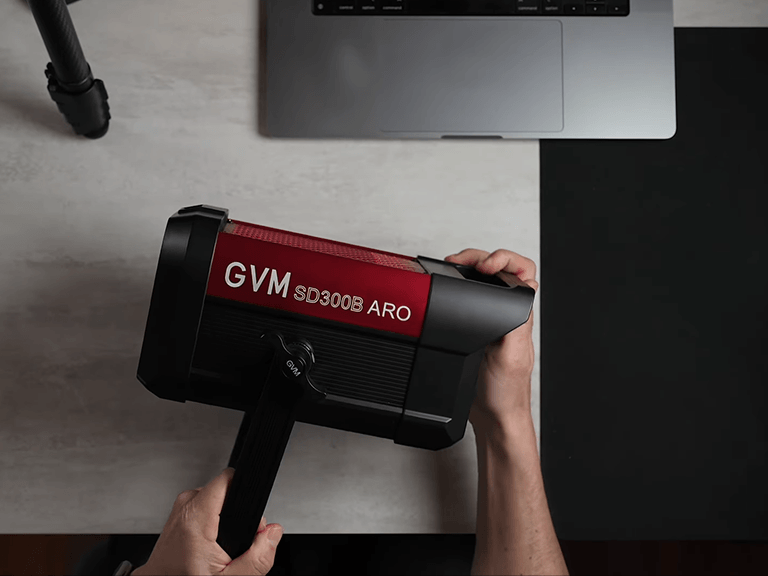
You’re hesitant. You want that “cinematic look,” but you don’t want to overspend on features you’ll never use, nor do you want to buy a “budget” light that fails you on its first professional gig.
In 2026, the 300W category has become the true “sweet spot” for creators. But which of these two GVM heavyweights is the best budget light for video for your specific workflow? Let’s break it down from a pro’s perspective.
Is Inexpensive Lighting for Video Worth Buying in 2026?
The Myth of “Cheap” Lights
There was a time, not too long ago, when “budget-friendly” was code for “low quality.” You’d expect green color shifts, plastic builds that crack under heat, and fans that sound like jet engines—ruining your interview audio.
However, the myth of the “cheap” light has been debunked. In 2026, the democratization of LED technology means that a mid-range investment now buys you the same light quality that used to cost thousands. Budget-friendly no longer means low quality; it means you are paying for efficient engineering rather than a legacy brand name.
The 300W Benchmark: The Creator’s “Sweet Spot”
Why 300W? If you’re doing professional work, 100W or 200W lights often fall short when you start adding modifiers. Once you put a heavy 36-inch softbox or a lantern on your light, you lose significant output. A 300W light provides the “punch” needed to maintain professional exposure even with heavy diffusion, allowing for that creamy, soft light depth that separates amateurs from pros.
Color Accuracy First: CRI/TLCI 97+
As a pro, I don’t care how bright a light is if it makes my subject look sickly. GVM has managed to achieve a CRI/TLCI of 97+ in both the AIO and PRO models. This means skin tones remain faithful and vibrant. Whether you are filming a high-stakes interview or a product commercial, you won’t be fighting magenta or green tints in post-production.
Best Affordable Video Lighting Recommendations for 2026
Current Market Trends: The COB Revolution
The shift toward high-output COB (Chip on Board) LEDs has changed the game. These single-point light sources mimic the behavior of traditional tungsten bulbs but with a fraction of the heat and power consumption.
Value Proposition: Why GVM Dominates
In the “Price-to-Performance” category, the GVM 300W series is currently hard to beat. You are getting a rugged build, Bowens mount compatibility, and professional-grade color accuracy for a price that allows you to buy two lights for the cost of one from other major brands.
Future-Proofing your Studio
Investing in 300W today is a hedge against tomorrow. As camera sensors become more sophisticated, the demand for high-quality, controllable light doesn’t decrease—it becomes more specific. A 300W bi-color light gives you the flexibility to grow your channel or business without needing an upgrade next year.
How to Choose Video Lighting on a Budget
When you’re on a budget, every dollar counts. Here is what I look at before I sign off on a purchase:
1. Luminous Flux: Raw Power
Don’t just look at the wattage; look at the Lux.
- The AIO 300B delivers a solid 11,800 Lux at 1 meter (with standard reflector).
- The PRO 300B, however, jumps to a staggering 51,100 Lux at 1 meter (with its 45° standard reflector). If you need to compete with sunlight coming through a window, that extra punch of the PRO model is a deciding factor.
2. Dimming Precision
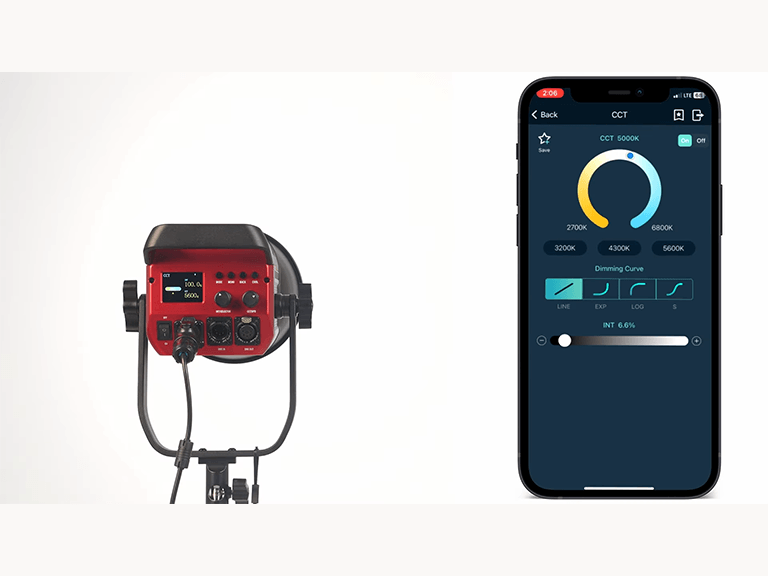
Most budget lights jump from 1% to 5%. For professional work, that’s too much. The PRO 300B offers 0.1% “Thousand-Step” accuracy. When you’re doing a delicate macro shot or an intimate low-light scene, that micro-adjustment is a lifesaver.
3. Cooling Systems: The Audio Killer
Nothing kills a video like bad audio. GVM’s active cooling systems are remarkably quiet. With four modes—including Silent and Intelligent—you can trust that these lights won’t ruin your audio during a 2-hour interview.
300W Video Light vs. 500W Spotlight: Which One Should You Choose?
The Portability vs. Power Debate
I’ve seen many creators buy a 500W light thinking “more is better,” only to realize it weighs 15 pounds and requires a massive C-stand.
- The AIO 300B weighs only 2.8KG (approx. 6 lbs) and has everything integrated.
- It’s easier to transport, easier to rig, and doesn’t require a specialized heavy-duty stand.
Electricity and Heat
500W spotlights generate massive amounts of heat, often turning small studios into saunas. In a small home setup, two 300W lights are much more manageable and versatile than one 500W monster.
Why AIO 300B is the Ideal Choice for Cheap Lighting for YouTube Videos
The “All-In-One” Advantage
This is the AIO’s greatest strength. There is no external ballast. You don’t have a heavy “power brick” dangling from your stand or cluttering your floor. For a YouTuber working in a bedroom or small office, this “plug-and-play” simplicity is the ultimate luxury.
User Experience and FX
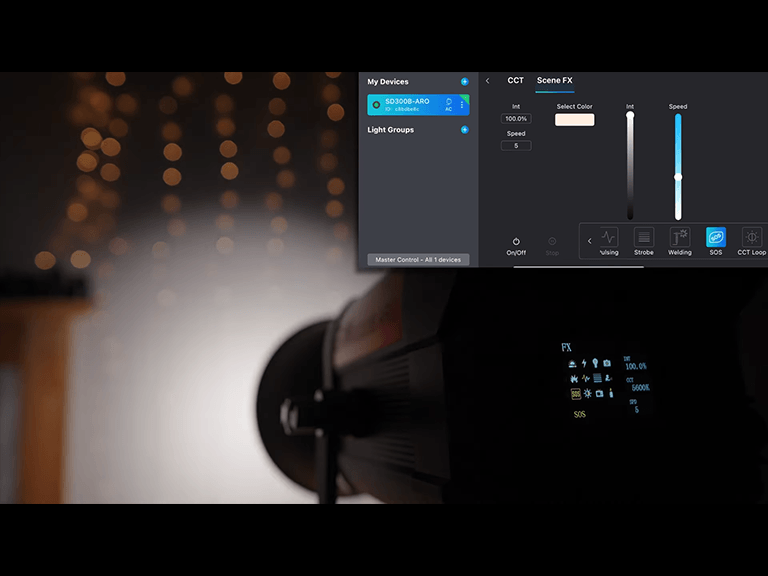
The 12 built-in cinematic FX (Lightning, TV, Paparazzi, etc.) allow you to add high-production value to your videos instantly. It’s “cheap” in price, but the results look expensive.
The Modern Workflow
With the Smart APP Control, you can adjust your light from your phone while sitting at your desk. No more getting up and down to tweak brightness between takes.
AIO 300B vs. PRO SD300B: Finding Your Perfect Match
Design: Integrated vs. Matrix
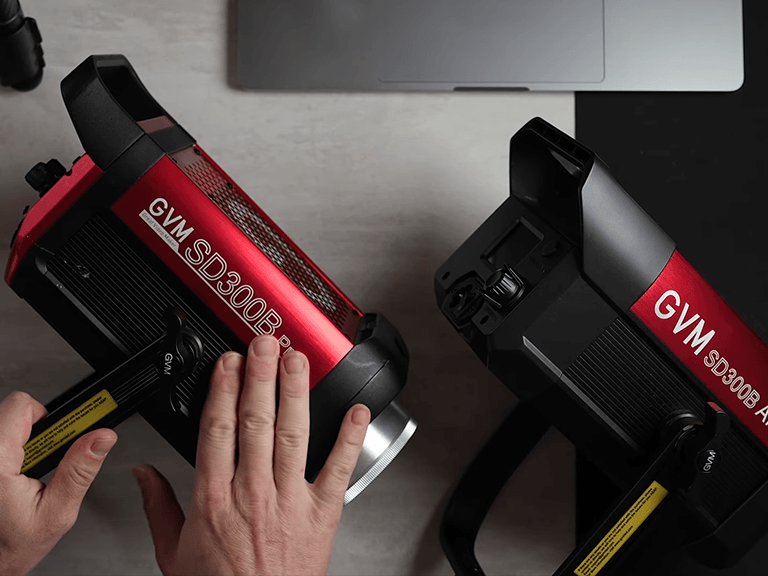
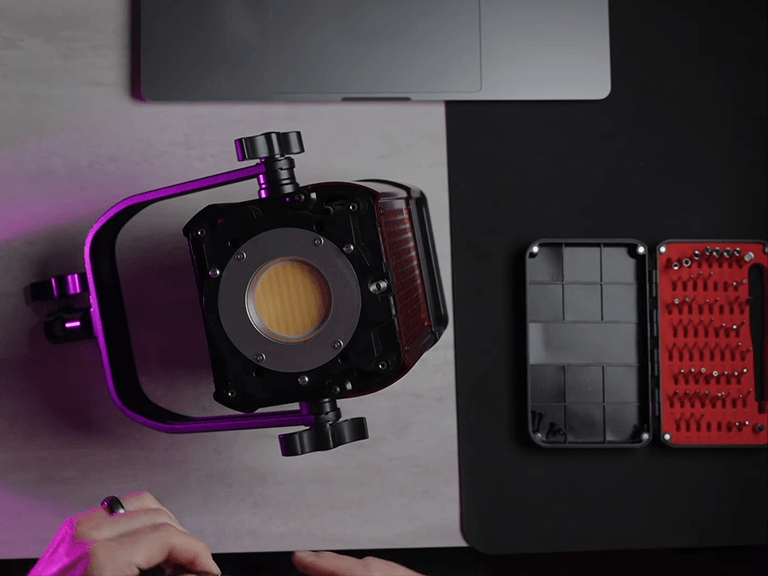
The AIO is a single unit—clean and fast. The PRO uses a Professional Matrix System with a separate controller. The PRO is built for a “set” environment where the light might be high up on a stand, and you need the controls at waist level.
Control Depth: DMX
If you ever plan on working in larger productions, the PRO’s 8-bit/16-bit DMX control is essential. It allows you to control the light through a professional lighting console. The AIO is strictly App/Manual.
Consistency: The “10-Hour” Rule
The PRO SD300B is rated for 10 hours of stable data. Many budget lights drift in color temperature as they get hot. The PRO stays locked. If your shoot lasts all day, your first shot will match your last shot perfectly.
Final Verdict: Which 300W Light Wins in 2026?
The Budget Champion: AIO 300B
If you are a solo creator, YouTuber, or streamer who values a clean setup and fast workflow, the GVM AIO 300B is the best budget light for video. It’s the most “frictionless” light I’ve ever used.
The Professional Choice: PRO SD300B
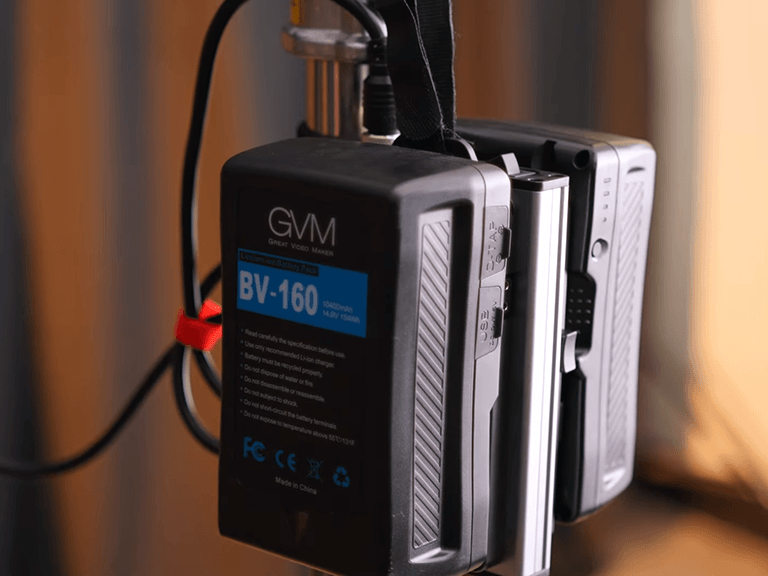
If you are an aspiring filmmaker, do client work, or need the absolute maximum brightness (51,100 Lux), the PRO SD300B is your tool. It offers the battery flexibility (V-Mount) and DMX control that professional sets demand.
📊 GVM SD300B AIO vs. PRO SD300B: Head-to-Head Comparison
| Feature | GVM SD300B AIO (Integrated) | GVM PRO-SD300B (Professional) |
| Design Philosophy | All-In-One (Integrated Head) | Professional Matrix (Modular) |
| Power Solution | Built-in Power (No external brick) | Separate Control Box + Ballast |
| Max Output (1m) | 11,800 Lux (with Standard Reflector) | 51,100 Lux (with 45° Reflector) |
| Dimming Precision | 0% – 100% Stepless | 0.1% – 100% “Thousand-Step” |
| Dimming Curves | Standard Linear | 4 Pro Curves (Linear/Exp/Log/S) |
| Color Temp (CCT) | 2700K – 6800K (Bi-color) | 2700K – 7500K (Bi-color) |
| Color Accuracy | CRI 97+ / TLCI 97+ | CRI 97+ / TLCI 97+ |
| Lighting Effects | 12 Built-in Scenarios | 12 Effects + 12 Source Matching |
| Power Options | AC Only (100V-240V) | AC + V-Mount Battery (Portable) |
| Control Interface | On-board / Bluetooth App | On-board / App / 8 & 16-bit DMX |
| Data Stability | Standard Performance | 10-Hour Color/CCT Consistency |
| Weight (incl. yoke) | 2.8 KG (Ultra-Lightweight) | Heavier (due to external controller) |
| Ideal Use Case | YouTubers, Streamers, Home Studios | Micro-Movies, Commercials, Field Shoots |
Final Buying Advice Don’t let the “Best Budget Light for Video” tag fool you—both of these are serious professional tools.
- Choose the AIO if you are a solo creator who values speed and a clean setup. It eliminates cable clutter and “power brick” weight, making it the king of small home studios.
- Choose the PRO if you are building a future-proof production kit. Its separate controller offers V-mount battery flexibility and DMX precision, protecting your workflow from the limitations of AC-only power and fixed-height controls.
Stop hesitating. Pick the one that matches your current studio footprint or your on-set ambitions, and get back to creating.