
Most people shop for movie lights by wattage. On set, what actually matters is how much light reaches your subject—verified illuminance (Lux @ 1m and @ 3m)—weighed against how deep your room is and how much daylight you’re fighting. Keep in mind that a diffusion frame will eat roughly half of whatever the bare fixture puts out. Below are five GVM fixtures from 300W to 1200W, with every number checked against the official manuals.
Key Takeaways
- Small Sets & Entry Budgets (300W–500W): In rooms around 2.5 m deep,
PRO-SD300BorSD500B AIOis plenty—and both run off a standard wall AC circuit. - Color & Location Workhorses (500W–650W): Go
FA500C AIOif you need2000K–10000KRGBWW color; goPro SD650Bif you need DMX and dual V-mount power. - Daylight Flagship (1200W): When you’re up against a bright window,
1200B AIO(25,700 Lux @ 3m With Reflector) is the one that keeps up.
Quick Comparison: Best Movie Lights at a Glance
Every photometric value, weight, and battery limit below comes straight from GVM’s official English user manuals and live product listings. Where GVM hasn’t published a figure—fan noise in decibels, or a bare 1-meter reading—we’ve marked it Official N/A rather than guess. All five share a standard Bowens S-mount and CRI ≥97 engines.
| Model & Award | Light Type | Power & Lux @ 1m | CCT & Color Modes | CRI / TLCI | Mount & Battery | Check Price |
|---|---|---|---|---|---|---|
| GVM Pro SD650B Softbox Kit Best Overall 650W Cinema Key |
Bi-Color COB Monolight | 650W AC (200–250W V-Mount) 20,400–21,300 Lux @ 1m (Bare) / 77,300–81,300 Lux @ 1m (w/ Reflector) |
2700K–6800K Bi-Color + 12 Sources + 12 FX |
CRI 97+ / TLCI 97 | Standard Bowens (5/8″ Baby Pin) AC + Dual V-Mount |
Check Price → |
| GVM 1200B AIO Best 1200W Daylight Flagship |
Integrated Bi-Color COB | 1200W @ 1m: Official N/A (6,240 Lux @ 3m Bare / 25,700 Lux @ 3m w/ Reflector) |
2700K–6800K Bi-Color + 12 Sources + 12 FX |
CRI ≥97 / TLCI: Official N/A | Standard Bowens (28mm Junior + 5/8″) Integrated AC Only |
Check Price → |
| GVM FA500C AIO Best 500W RGBWW Flathead |
Integrated Flathead RGBWW COB | 500W 19,000 Lux @ 1m (Bare) / w/ Reflector: Official N/A |
2000K–10000K + G/M RGBWW + HSI + Gel + 16 FX |
CRI 97+ / TLCI 97+ | Standard Bowens (5/8″ Tilt Bracket) Integrated AC Only |
Check Price → |
| GVM SD500B AIO Best Entry Under-$300 500W Light |
Integrated Bi-Color COB | 500W 20,490 Lux @ 1m (Bare) / 227,040 Lux @ 1m (w/ Reflector) |
2700K–6800K Bi-Color |
CRI ≥97 / TLCI: Official N/A | Standard Bowens (5/8″ Baby Pin) Integrated AC Only |
Check Price → |
| GVM PRO-SD300B Softbox Kit Best 300W Small-Set Key & Rim |
Bi-Color COB Monolight | 300W 13,700 Lux @ 1m (Bare) / 65,700 Lux @ 1m (w/ Reflector) |
2700K–6800K Bi-Color + 12 Sources + 12 FX |
CRI ≥97 / TLCI 97+ | Standard Bowens (5/8″ Baby Pin) AC 60V/5A Adapter |
Check Price → |
Pricing out a full package—several heads, heavy C-stands, and modifiers? The complete professional cinematography lighting collection on the official GVM Shop shows the current bundle configurations side by side.
Best Movie Lights Tested & Compared by Production Scale
1. GVM Pro SD650B Softbox Kit: Best Overall 650W Bi-Color Key for Studio & Location
If you only buy one light from this list, this is the one we’d point most crews toward. Set the GVM Pro SD650B 2 to 3 m off-axis behind a 36-inch parabolic softbox or a 6×6 diffusion frame, and you have plenty of exposure for a two-person interview or a medium master. The 2.6 kg ballast clamps low on the stand, so the weight stays down where it belongs. Brightness dims in 0.1% steps across 2700K–6800K, and you can run it from the onboard controller, over Bluetooth Mesh (≤50 m), or through wired 5-pin DMX/RDM.
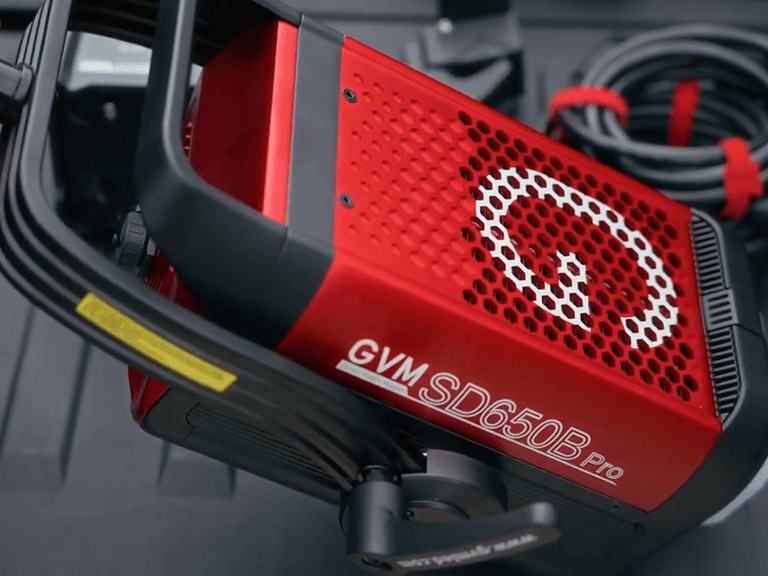
- The Breakdown:
- Built-In 5-Pin DMX & PWM Control: You get
8/16-bitDMX/RDM, four dimming curves (Linear,Log,Exp,S), and adjustable frequency (+0 Hz) to tune out shutter banding. - Separated Ballast Flexibility: Moving the electronics into the ballast takes weight off the
6.7 kghead. Power it fromAC 100V–240Vor the dual V-mount plates. - 3-Mode Cooling:
Smartmode keeps fan noise in check for dialogue.Silentshuts the fans off completely, but caps output as low as60W—so save it for the quietest takes.
- Built-In 5-Pin DMX & PWM Control: You get
| Spec | Detail |
|---|---|
| Power & Lux @ 1m | 650W AC (200–250W V-Mount) | 20,400–21,300 Lux @ 1m (Bare, 5600K–6800K) / 77,300–81,300 Lux @ 1m (With Standard Reflector) |
| CCT & CRI / TLCI | 2700K–6800K Bi-Color + 12 Sources + 12 FX | CRI 97+ / TLCI 97 |
| Control | Separated Controller LCD, 5-pin DMX512 / RDM (8/16-bit), Bluetooth Mesh (≤50 m), RF (≤50 m) |
| Mount | Standard Bowens S-Mount | 5/8" Baby Pin Receiver | Quick-Release Ballast Clamp Included |
| Power & Weight | AC 100V–240V + Dual V-Mount Plates | Head 6.7 kg + Controller 2.6 kg (9.3 kg total) | Noise: Official N/A |
- Pros:
- Up to
81,300 Lux @ 1m (With Standard Reflector @ 6800K)—enough to hold its own against a bright indoor window. - Built-in 5-pin DMX IN/OUT and RDM, so there are no external adapter boxes to carry (or lose).
- A genuinely complete kit: softbox, standard reflector, head cable, ballast clamp, and carrying case.
- Up to
- Cons:
- Battery mode needs two V-mounts and caps draw at
200W–250W. Also, some older web listings call it “waterproof,” but the V3.31 manual is clear: it is not rainproof, so keep it covered outdoors.
- Battery mode needs two V-mounts and caps draw at
Shooting cordless outside? Pair it with the GVM BV-160 & BL-160-II V-Mount Battery Bundle. Working in a compact 2 m room where 650W feels like too much? Drop down to our GVM PRO-SD300B Softbox Kit.
2. GVM 1200B AIO: Best 1200W Flagship for Daylight Window Balance & Wide Sets
This is the light you reach for when the window is winning. Park the GVM 1200B AIO 3 to 5 m back—outside the window or behind an 8×8 silk frame—and let it do the heavy lifting. The 1200W ballast lives inside the head, so there’s only one AC cord to run, not a head cable plus a separate box. Set 2700K–6800K and Studio Mode on the onboard panel, or sync several heads together over Bluetooth Mesh (≤50 m).
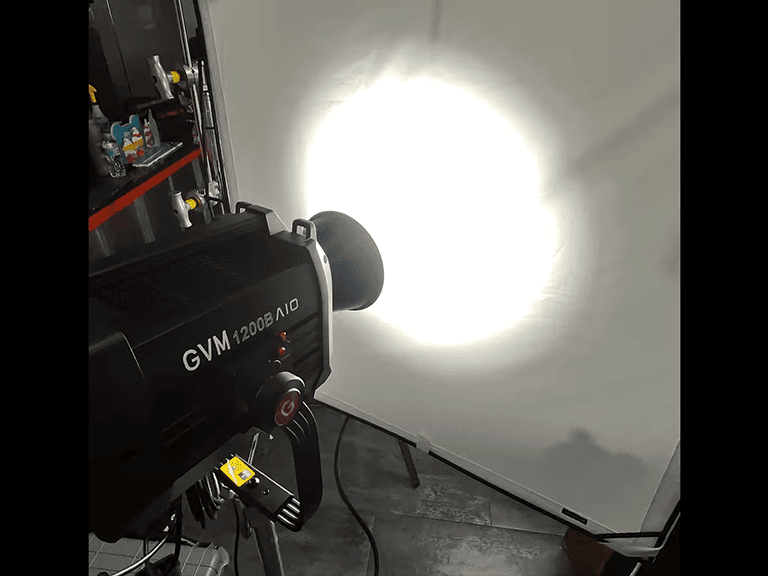
- The Breakdown:
- 28 mm Junior Pin + 5/8″ Yoke: The dual combo receiver seats the
12.5 kghead securely on a proper rolling studio stand like the GVM DL300. This is not a light for a flimsy stand. - Modular DMX / CRMX / Ethernet Port: Add control only when the job calls for it, with optional plug-in dongles (
DCB-XLR5DMX/RDM,CCB-XLR5CRMX,LCB-RJ45Art-Net/sACN). - Long-Throw Intensity:
6,240 Lux @ 3m (Bare)and25,700 Lux @ 3m (With Standard Reflector)—measured at a real working distance, for deep studio throws.
- 28 mm Junior Pin + 5/8″ Yoke: The dual combo receiver seats the
| Spec | Detail |
|---|---|
| Power & Lux @ 1m | 1200W | @ 1m: Official N/A (6,240 Lux @ 3m Bare / 25,700 Lux @ 3m With Standard Reflector) |
| CCT & CRI / TLCI | 2700K–6800K Bi-Color + 12 Sources (App) + 12 FX | CRI ≥97 / TLCI: Official N/A |
| Control | Onboard LCD + Studio Mode, Bluetooth Mesh (≤50 m), Optional DMX / CRMX / Ethernet Data Boxes |
| Mount | Standard Bowens S-Mount | 28 mm Junior Pin + 5/8" Combo Receiver |
| Power & Weight | Integrated AC 100V–240V (No Battery) | 12.5 kg w/ Yoke (10.6 kg Head) | Noise: Official N/A |
- Pros:
- All
1200Wlives in one housing—no external controller box slowing down your room turns. 25,700 Lux @ 3m (With Standard Reflector)still holdsf/4–f/5.6through large scrims.- The junior-pin combo yoke and CRMX/Art-Net dongle support make it an easy fit for commercial crews.
- All
- Cons:
- The base unit doesn’t include a standard reflector—buy one separately, get it via a kit, or add the
3X Optical Intensifier FPXG3BJ(Modifier Only — Light Fixture Not Included).Silentmode caps power at110W, and it runs on AC only.
- The base unit doesn’t include a standard reflector—buy one separately, get it via a kit, or add the
Need something lighter, with V-mount flexibility, for smaller interiors? Head back to the GVM Pro SD650B Softbox Kit.
3. GVM FA500C AIO: Best 500W RGBWW Flathead for Color Grading & Tight Locations
Low ceilings. Narrow apartments. A stand wedged between the couch and the wall. That’s where the GVM FA500C AIO earns its spot in the kit. At just 4.96 inches thick, this flathead tucks in close to walls while still packing a 500W RGBWW engine. Pairing is quick, too: tap your phone on the built-in NFC (after resetting Bluetooth) to join a 50 m Mesh group for HSI, gel, and source-matching control.
- The Breakdown:
- 2000K–10000K +
±G/MTint Trim: Dial in green/magenta correction on set to blend with practical fluorescents or mixed LED ambient light, instead of chasing it later in the grade. - Ultra-Light
3.7 kgHousing:AC 100V–240Vpower is built into the slim chassis, along with a metal Bowens mount and an umbrella slot. - Color-True
CRI/TLCI 97+: Delivers19,000 Lux @ 1m (Bare)across CCT, HSI, RGB, Gel, and16 FXmodes.
- 2000K–10000K +
| Spec | Detail |
|---|---|
| Power & Lux @ 1m | 500W | 19,000 Lux @ 1m (Bare) / With Standard Reflector: Official N/A |
| CCT & CRI / TLCI | 2000K–10000K + ±G/M | CCT, HSI, RGB, Gel, Source Matching, 16 FX | CRI 97+ / TLCI 97+ |
| Control | Onboard Panel, Bluetooth Mesh App (≤50 m), NFC One-Tap Pairing (No Built-in DMX) |
| Mount | Standard Bowens S-Mount | Built-in Umbrella Slot | 5/8" Tilt Mount |
| Power & Weight | Integrated AC 100V–240V (No Battery) | 3.7 kg (8.15 lb), 4.96 in Depth | Noise: Official N/A |
- Pros:
- At
3.7 kg, it slips into tight corners and ceiling grids without a fight. - The wide
2000K–10000Krange plus G/M offset handles tricky mixed practicals. - One AC cord and you’re up—a real time-saver for small-crew turnovers.
- At
- Cons:
- It ships bare: just a carrying bag and an AC cord. Parabolic modifiers like the
GVM ZYG90SPR(Modifier Only — Light Fixture Not Included) are sold separately, and there’s no wired DMX or battery plate.
- It ships bare: just a carrying bag and an AC cord. Parabolic modifiers like the
Need console-grade 5-pin DMX and dual V-mount batteries? Step up to the GVM Pro SD650B Softbox Kit.
4. GVM SD500B AIO: Best Budget Under-$300 500W Movie Light
Tight budget, but not willing to drop below 500W? This is the one to look at. The GVM SD500B AIO puts a 2700K–6800K COB head, internal ballast, standard reflector, and a 15.75"×23.6" softbox under a single SKU—so apart from a stand, you can start lighting the day it arrives. Rig it 1.5 to 2.5 m off-axis, and link more lights over Bluetooth Mesh (≤50 m) as your kit grows.
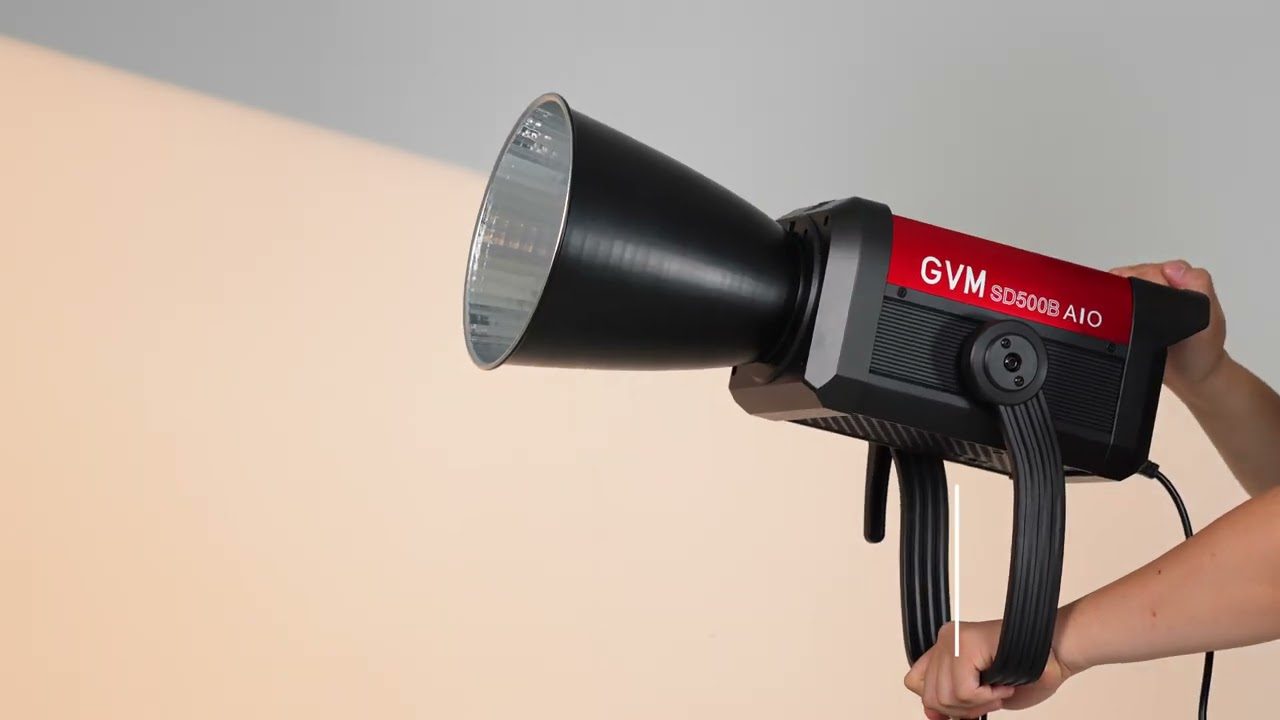
- The Breakdown:
- 500W Output Under $300:
20,490 Lux @ 1m (Bare)and227,040 Lux @ 1m (With Standard Reflector)in V1.2 testing—plenty of punch for bouncing off a card. - All-in-One
6.65 kgHousing: IntegratedAC 100V–240Vpower means no power brick dangling off the stand. - Ready-to-Shape Modifiers: Both a Bowens reflector and a rectangular softbox come in the box.
- 500W Output Under $300:
| Spec | Detail |
|---|---|
| Power & Lux @ 1m | 500W | 20,490 Lux @ 1m (Bare) / 227,040 Lux @ 1m (With Standard Reflector) |
| CCT & CRI / TLCI | 2700K–6800K Bi-Color | CRI ≥97 / TLCI: Official N/A |
| Control | Onboard Panel Controls + Bluetooth Mesh App (≤50 m) (No DMX Port on V1.2) |
| Mount | Standard Bowens S-Mount | 5/8" Stand Receiver |
| Power & Weight | Integrated AC 100V–240V (No Battery) | 6.65 kg | Noise: Official N/A |
- Pros:
- A genuinely accessible price for a
500W,CRI ≥97Bowens fixture. - Comes with both the metal reflector and the
15.75"×23.6"softbox. - One AC cord, no separate ballast to clamp.
- A genuinely accessible price for a
- Cons:
- No wired DMX/RDM, no V-mount battery slot, and no light stand included. Fair trade-offs at this price—just know them going in.
Need full RGBWW color or wired DMX control? Compare the GVM FA500C AIO or the GVM Pro SD650B Softbox Kit.
5. GVM PRO-SD300B Softbox Kit: Best 300W Key, Fill & Rim Light for Indie Studios
Not every light on set needs to be big. For close 1.2–2.0 m dialogue, hair and rim accents, or a head hanging off an overhead boom, the 2.7 kg GVM PRO-SD300B makes more sense than anything heavier. You still get the full PRO feature set, just in a nimble 300W body. Control the 2700K–6800K output onboard, by RF (≤50 m), over Bluetooth Mesh (≤50 m), or through 5-pin XLR DMX.
- The Breakdown:
- 5-Pin DMX & 4 Dimming Curves:
8/16-bitDMX,Linear/Exp/Log/Scurves, and manual PWM frequency tuning (+0 Hzadjustment) keep high-shutter shots clean. - U-Frame Adapter Bracket: The
DC 60V/5Apower supply locks onto the yoke’s V-slot, so your boom cabling stays tidy. - Balanced
65,700 Lux @ 1mKit:13,700 Lux @ 1m (Bare)and65,700 Lux @ 1m (With Standard Reflector), with a softbox and case included.
- 5-Pin DMX & 4 Dimming Curves:
| Spec | Detail |
|---|---|
| Power & Lux @ 1m | 300W | 13,700 Lux @ 1m (Bare) / 65,700 Lux @ 1m (With Standard Reflector) |
| CCT & CRI / TLCI | 2700K–6800K Bi-Color + 12 Sources + 12 FX | CRI ≥97 / TLCI 97+ |
| Control | Onboard Dual Knobs, 5-Pin DMX IN/OUT (8/16-bit), Bluetooth Mesh (≤50 m), RF (≤50 m) |
| Mount | Standard Bowens S-Mount | 5/8" Stand Receiver | Yoke V-Slot for AC Brick |
| Power & Weight | AC 100V–240V via DC 60V/5A Adapter | 2.7 kg | Noise: Official N/A |
- Pros:
- Only
2.7 kg, yet you still get wired 5-pin DMX, PWM tuning, and 12 light presets. - The yoke V-slot keeps the power brick from swinging around on overhead rigs.
- Ships with a softbox, snoot/standard cover, and carrying case.
- Only
- Cons:
- No native V-mount battery plates,
Silentcooling drops output to60W, and the light stand is sold separately.
- No native V-mount battery plates,
Need enough punch to balance a window, or dual V-mount power? Step up to the GVM Pro SD650B Softbox Kit.
FA vs. AIO vs. PRO Film Lights: 300W, 650W, and 1200W Cinema Fixtures Compared
Trying to balance window daylight on an indie set? Our 500W and 600W LED video light wattage breakdown compares bare and reflector photometrics in detail, and our multi-light cinematic lighting kits guide covers how multi-head kits are packaged.
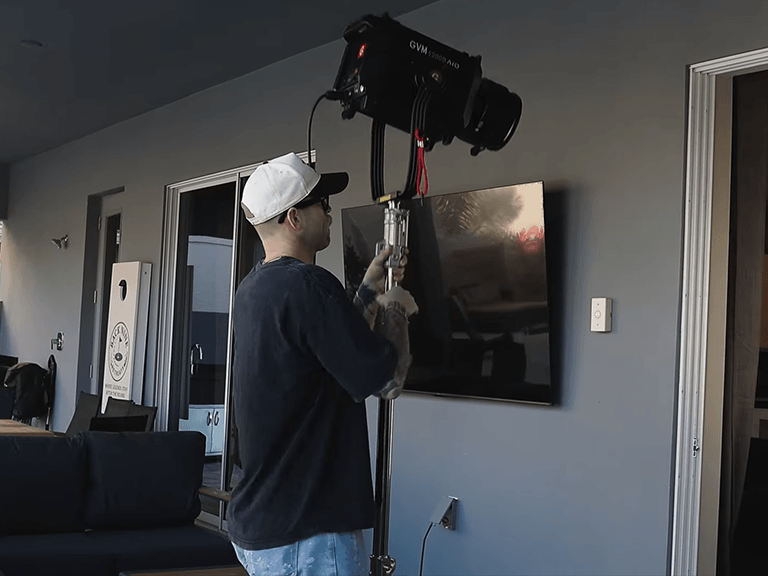
GVM’s cinema lineup comes in three physical designs—FA (Flathead), AIO (All-in-One), and PRO—and each is built for a different kind of set. Picking the right film lights really comes down to three questions: How much rigging space do you have? Are you running DMX cable? Do you need to go cordless? Those questions apply across the 300W, 500W, 650W–700W, and 1200W classes.
- FA (Flathead): The
FA500C AIOand its bi-color siblingFA500B AIO(27,800 Lux @ 1m Bare) are only126 mmthick and weigh3.7 kg—the answer when you’re tight against a wall or packing light for travel. - AIO (All-in-One): The
SD500B AIO,SD700B AIO(29,100 Lux @ 1m Bare), and1200B AIOkeep the ballast onboard for one-cable AC speed. The700B/1200Badd optional DMX/CRMX/Art-Net modules. - PRO: The
PRO-SD300B,PRO-SD500B(61,600 Lux @ 1m With Reflector), andPro SD650Bbuild 5-pin DMX/RDM right into the unit, and the500B/650Badd dual V-mount battery plates.
A simple rule of thumb: tight space points to FA, fast turnovers point to AIO, and console control or batteries point to PRO.
| GVM Cinema Series | Wattages & Verified Output | Power & Ballast Path | DMX / Network Control | Weight & Rigging Profile | Ideal Film Set Role |
|---|---|---|---|---|---|
| FA Flathead Series (FA500B / FA500C AIO) |
500WFA500B: 27,800 Lux @ 1m (Bare)FA500C: 19,000 Lux @ 1m (Bare) |
Integrated AC 100V–240V single cable (No battery) |
Bluetooth Mesh App (≤50 m) + NFC tap pairing (No wired DMX) |
3.7 kg / 126 mm slim depth | 5/8" tilt bracket |
Tight rooms, ceiling grids, mobile solo/2-person kits needing RGBWW (FA500C) or compact packing |
| AIO Integrated Series (SD500B / SD700B / 1200B AIO) |
500W–1200WSD500B: 20,490 Lux @ 1m (Bare)SD700B: 29,100 Lux @ 1m (Bare)1200B: 25,700 Lux @ 3m (w/ Reflector) |
Integrated AC 100V–240V single cable (No battery) |
SD500B: Mesh App; SD700B/1200B: Mesh App + Optional DCB-XLR5 (DMX) / CCB-XLR5 (CRMX) / LCB-RJ45 (Art-Net) |
6.65–12.5 kg | 5/8" (500B/700B) or 28 mm Junior Pin + 5/8" (1200B) |
Fast soundstage turnovers, overhead rags, and daylight competition without external ballasts |
| PRO Series (PRO-SD300B / 500B / 650B) |
300W–650W300B: 65,700 Lux @ 1m (w/ Reflector)500B: 61,600 Lux @ 1m (w/ Reflector)650B: 81,300 Lux @ 1m (w/ Reflector) |
300B: DC 60V/5A adapter on yoke; 500B/650B: Separated ballast w/ AC + Dual V-Mount (200–250W cap) |
Built-in 5-pin XLR DMX IN/OUT + RDM (8/16-bit) + Mesh App + RF (≤50 m) |
2.7 kg head (300B) to 6.7 kg head + 2.6 kg box (650B) | 5/8" yoke |
Gaffer-run grids, console-controlled multi-cam shoots, and cordless V-mount exterior scenes |
How to Choose Film Lights: Photometrics, DMX Control, Power & Rigging
1. Sizing Lux @ 1m vs. 3m After 50% Diffusion Loss
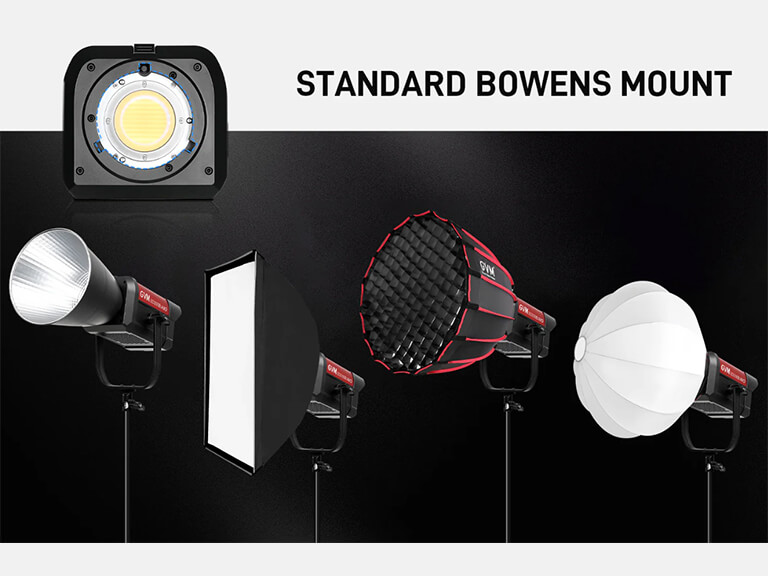
Judging film lights by wattage alone will mislead you, because modifiers change usable throw dramatically. A double-diffused parabolic softbox (ZYG90SPR 36″, Modifier Only — Light Fixture Not Included) or a 6×6 / 8×8 silk frame absorbs 45% to 55% (1 to 1.5 stops) of the raw light, and a grid trims another 20%–30% as it cuts spill. Distance is even less forgiving: pull a fixture back from 1 m to 3 m and illuminance drops to one-ninth (1/9). So check both bare and reflector photometrics at @ 1m and @ 3m. When you need to punch across a deep stage, attach a Bowens optical lens (GVM 3X Optical Intensifier FPXG3BJ or GVM F60 Fresnel, Modifier Only — Light Fixture Not Included).
2. CRI / TLCI Accuracy, G/M Trim & Shutter-Safe PWM Dimming
When color drifts, skin tones give it away first. On multi-camera dialogue shoots, prioritize CRI ≥97 (and TLCI 97+ where published) so faces stay consistent from shot to shot under soft diffusion. Shooting in an office or storefront lit by practical tubes? An RGBWW engine with ±G/M Green/Magenta shift (FA500C AIO, 2000K–10000K) lets you match those green or magenta spikes on set instead of fixing the tint in the grade. For slow motion or narrow shutter angles (1/120s–1/500s), choose a model with manual PWM dimming frequency adjustment (PRO-SD300B, Pro SD650B)—and check your monitor for rolling bars before you call action.
3. DMX512, CRMX & Bluetooth Mesh Synchronization
For small crews, GVM Bluetooth Mesh (≤50 m range, plus NFC pairing on FA500C) is the easiest way to group several film lights and run them from one phone. Console-operated productions rely on wired or wireless DMX instead. GVM’s PRO series builds 5-pin DMX IN/OUT + RDM straight into the controller or housing, while the SD700B AIO and 1200B AIO accept modular Data Port boxes (DCB-XLR5 DMX, CCB-XLR5 CRMX, LCB-RJ45 Art-Net/sACN). Planning complex multi-unit cues? Our LED cinema lighting guide walks through it.
4. AC Circuit Load, V-Mount Discharge Caps & Fan Noise
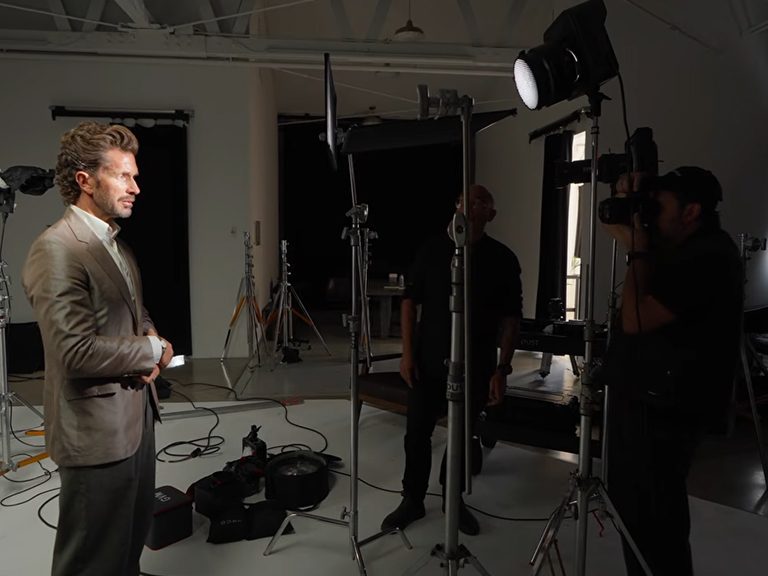
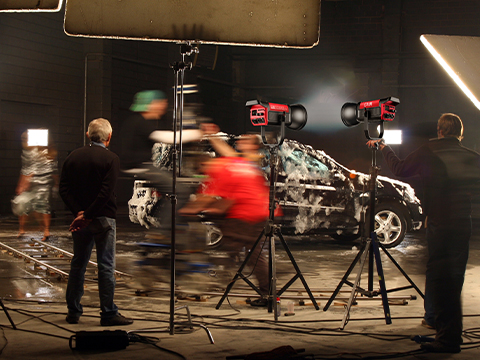
This is the step people skip—until a breaker trips mid-take. Before rigging high-wattage film lights, add up your total draw against a household 15A / 120V circuit (1,800 W peak, ~1,440 W continuous safe limit). One 1200B AIO needs its own branch circuit, and two 500W–650W heads should be split across separate breakers. On location, the dual V-mount plates on the PRO-SD500B and Pro SD650B need both slots filled, and battery power caps at 200W–250W. Fan noise is the other trade-off: Silent fan-off mode caps wattage (50W–110W), so for sound takes it’s usually smarter to stay in Smart mode at moderate dimming. Here’s the 1200B AIO working on set:
Film Lights Sizing: Is 1200W Overkill for Indie Sets or Do You Need 500W–650W?
Yes—in a small bedroom or apartment under 3 × 3 m (10 × 10 ft), a 1200W fixture is usually overkill. A 300W–650W fixture dimmed to 35%–70% gives you smoother gradients without maxing out a single 15A room breaker. At 1.5–2.2 m, a 1200B AIO often forces you into heavy ND scrims even at ISO 400, f/4, and its 12.5 kg chassis needs a heavy-duty 28 mm Junior Pin rolling stand. Save 1200W for competing with unshaded midday windows, pushing soft key light through 6×6 or 8×8 frames from 3–5 m, or lighting wide exterior nights. For most indie interviews and studio interiors, 500W–650W is the sweet spot between output and what your circuits can handle.
Frequently Asked Questions About Movie Lights
Q1: How much illuminance (Lux @ 1m) do movie lights need for an indoor dialogue scene?
For a one- or two-person indoor dialogue scene at 1.5–2.5 m through a double-diffused softbox, a 300W–500W light (13,700–20,490 Lux @ 1m Bare) gets you to f/2.8–f/4 at ISO 400–800. Step up to 650W–1200W for 3–5 m throws or when you’re up against sunlit windows.
Q2: What is the difference between GVM’s FA, AIO, and PRO film lights?
FA fixtures (FA500B/500C AIO) use a slim 126 mm (3.7 kg) flathead body with NFC pairing. AIO models (SD500B/SD700B/1200B AIO) build AC power into the studio barrel. PRO models (PRO-SD300B/500B/650B) add built-in 5-pin DMX/RDM, PWM tuning, and—on the 500B/650B—dual V-mount plates.
Q3: Can I power 500W or 650W movie lights with V-mount batteries on location?
Only the dual-plate PRO models (PRO-SD500B and Pro SD650B) run natively on V-mount packs, and both plates must be filled at the same time. In DC mode, power caps at 200W–250W; the single-cord FA and AIO heads run on 100V–240V AC mains power only.
Q4: Can cinema COB movie lights run fanless (Silent mode) at 100% brightness?
No—fan-off Silent mode throttles maximum output to prevent overheating (60W on PRO-SD300B and Pro SD650B, 110W on 1200B AIO, and 50W on FA500B). If an audio take needs more power, switch to Smart mode and pull the lights slightly farther back.
Q5: Do GVM 1200B AIO and PRO-SD650B ship with reflectors, DMX modules, and stands?
Check the kit contents before you buy. The Pro SD650B ships with a softbox, standard reflector, clamp, ballast, and carrying case (batteries and stands sold separately). The base 1200B AIO includes the light, AC cord, cover, and case—reflectors, DCB-XLR5 DMX boxes, and heavy stands cost extra.
Final Verdict: Choosing Your Movie Lights
- Best Entry Indie Pick (
Under $300 Tier): Start with the GVM SD500B AIO—500Wof AC punch with a reflector and softbox already in the box. If wired 5-pin DMX matters to you, the GVM PRO-SD300B Softbox Kit ($350–$400 Tier) is worth the step up. - Best Workhorse & RGBWW Picks (
$500–$600 Tier): Choose the GVM Pro SD650B Softbox Kit for built-in DMX/RDM and dual V-mount flexibility, or the slim GVM FA500C AIO when2000K–10000K + G/MRGBWW color control comes first. - Best Daylight Flagship (
$1,000+ Pro Tier): Bring in the GVM 1200B AIO (28 mm Junior Pin, modular DMX/CRMX/Art-Net) to overpower windows and fill8×8frames.
Whichever you choose, size your lights for the rooms you actually shoot in, not the biggest set you might land someday. You can always add a bigger head later; an oversized one sitting at 20% is money that could have bought a second light.
Ready to compare live kit configurations, modifier combos, and current stock?