Picking the best LED video light for filmmaking in 2026 comes down to one question: can it hold a scene together across a full shoot day without flicker, color shift, or a lighting rig that eats your setup time?
Filmmakers have more continuous-light options than ever, but not every fixture built for photography translates cleanly to motion work. A light that looks fine in a single still frame can reveal banding, inconsistent color temperature, or harsh falloff the moment a camera starts rolling at a real frame rate. This guide breaks down what separates a filmmaking-grade LED from a general-purpose one, and where a fixture like the GVM SD700B AIO fits into a working cinematographer’s kit.
Continuous Light vs Flash for Filmmaking
Flash units are built for a single instant of exposure — they’re irrelevant once a camera is rolling continuous footage. Filmmaking requires a light source that stays on, stays stable, and stays color-accurate for the length of a take, which is why continuous LED fixtures have become the default for interviews, narrative work, commercials, and live streaming. The trade-off used to be output: early LED panels struggled to match the raw power of tungsten or HMI units. That gap has closed. Modern bi-color COB and AIO fixtures now push tens of thousands of lux at working distance, with wireless dimming precise enough to match flash-era control without sacrificing the “always on” reliability continuous lighting is chosen for.
What Makes a Light “Filmmaking-Grade”?
Not every spec sheet number matters equally on set. For motion work specifically, a handful of characteristics decide whether a fixture earns a permanent spot in the truck:
- Flicker-free dimming across the full output range, not just at high brightness, since interviews and slow push-ins expose flicker fastest at lower percentages.
- Consistent color temperature as brightness is adjusted, so a dimmed light doesn’t drift warm or cool mid-scene.
- High CRI/TLCI (97+ is the current professional benchmark) so skin tones and set colors hold up without a color-correction pass in post.
- Wide bi-color range, typically 2700K–6800K, to match practical lights, daylight exteriors, and tungsten-gelled sources in the same shoot.
- Bowens-mount compatibility, so the fixture can carry softboxes, Fresnels, and grids without a proprietary modifier ecosystem locking the kit in.
- DMX and app/Bluetooth control, for cue-based lighting changes and remote adjustment without walking back to the fixture between takes.
Building a Filmmaking-Ready Setup Around One Fixture
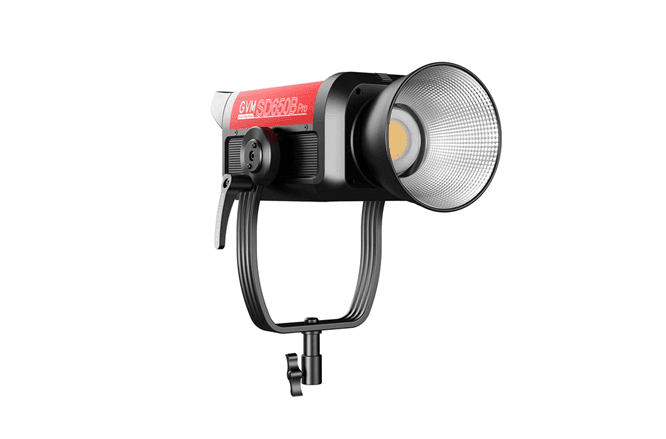
Rather than assembling five single-purpose lights, most working filmmakers now build a kit around one or two versatile AIO (all-in-one) units that cover interviews, B-roll, and product inserts without a gear swap. That’s the gap the GVM SD700B AIO is built to fill — a 700W bi-color fixture designed specifically around the flicker-free, color-stable requirements motion work demands, rather than a stills fixture repurposed for video.
The SD700B AIO uses stepless dimming from 0.1% to 100%, holding color temperature steady at every brightness level — the exact behavior a slow dimming push during an interview needs. It carries a 97+ CRI/TLCI rating, a 2700K–6800K bi-color range, and outputs 26,200 lux at 3 meters with the standard reflector, putting it in range for both controlled interior interviews and larger set coverage. Twelve built-in cinematic effects (lightning, TV flicker, candlelight, explosion, and others) are included natively, which removes the need for separate effect gear on productions where those looks come up regularly.
| Feature | Specification / Benefit |
|---|---|
| Power | 700W bi-color LED |
| CRI/TLCI | 97+ for accurate, true-to-life color |
| Output | 26,200 lux at 3m (standard reflector) |
| Color Temp Range | 2700K–6800K |
| Dimming | Stepless, 0.1%–100%, color-stable at every level |
| Built-in Effects | 12 cinematic presets (flicker, candle, storm, explosion, etc.) |
| Control | Bluetooth app control + 5-pin DMX (wired and wireless CRMX) |
| Mount | Universal Bowens mount |
| Form Factor | Compact, all-in-one, built-in carry handle |
How It Compares to the Competition
Fixtures like the Nanlite FC720B sit in a similar bi-color, Bowens-mount category, with comparable CRI and effect libraries. The meaningful difference for most working filmmakers comes down to configuration and cost per watt: an all-in-one design like the SD700B AIO keeps the head, controller, and power supply in a single compact unit rather than a separated head-and-ballast setup, which simplifies rigging on location and cuts down on cable runs between camera moves. At the 700W bi-color tier, that combination of integrated design and output-per-dollar is where GVM has built its strongest case against separated-ballast competitors — more usable light for the budget, without giving up DMX or app control.
Final Thoughts
The best LED video light for filmmaking in 2026 isn’t necessarily the one with the single highest lux number — it’s the fixture that holds color and brightness steady through a dimmed take, mounts the modifiers your kit already uses, and doesn’t demand a second light to cover the next scene. A 700W bi-color AIO fixture with 97+ CRI, stepless dimming, and Bowens compatibility covers the majority of narrative, interview, and commercial setups without forcing a compromise between output and portability. Ready to build your kit around one? Compare specs against your current setup and see where a fixture like the SD700B AIO closes the gap.

FAQ
What’s the difference between CRI and TLCI for video lighting?
CRI measures how accurately a light renders color for the human eye and photography; TLCI is the video-specific equivalent, calibrated against how cameras and broadcast monitors reproduce color. Filmmaking-grade lights are rated on both, and a 95+ score on either is considered professional-tier.
Do I need DMX control for independent filmmaking?
Not always, but it matters once you’re working with a gaffer or lighting multiple fixtures on a set. App/Bluetooth control alone is usually enough for solo or two-person crews; DMX becomes valuable when a light needs to be cued precisely alongside other fixtures.
Can one bi-color LED light replace a full lighting kit?
For interviews, single-subject narrative scenes, and product videography, a single high-output bi-color AIO fixture with a softbox and reflector can cover key, and sometimes fill, light duties. Larger sets or multi-subject coverage still benefit from a second fixture for backlight or separation.
What lux output do I actually need for filmmaking?
It depends on distance and diffusion, not just the raw number. A fixture producing 25,000+ lux at 3 meters gives enough headroom to punch through a softbox or bounce modifier while still leaving room to dim for close, controlled setups.